You have decided on the watch; now you face the market. Buying a pre-owned Omega Speedmaster in the UK means choosing between 3 generations of mechanically different Moonwatches, priced from around £4,000 upwards, sold through channels with very different levels of protection, in a reference landscape complicated enough that Omega itself changed numbering systems twice. The good news is that the Speedmaster is one of the best-documented watches ever made, and a buyer who learns the reference map holds every advantage over a seller who assumes they have not.
This is the practical companion to the question of whether the watch deserves your money at all, which [INTERNAL LINK: is the Omega Speedmaster still worth buying in 2026 | our worth-it analysis of the current Moonwatch] takes on directly. Here the job is narrower: which generation, which reference, which checks, and which channel.
Which Pre-Owned Omega Speedmaster Should You Buy
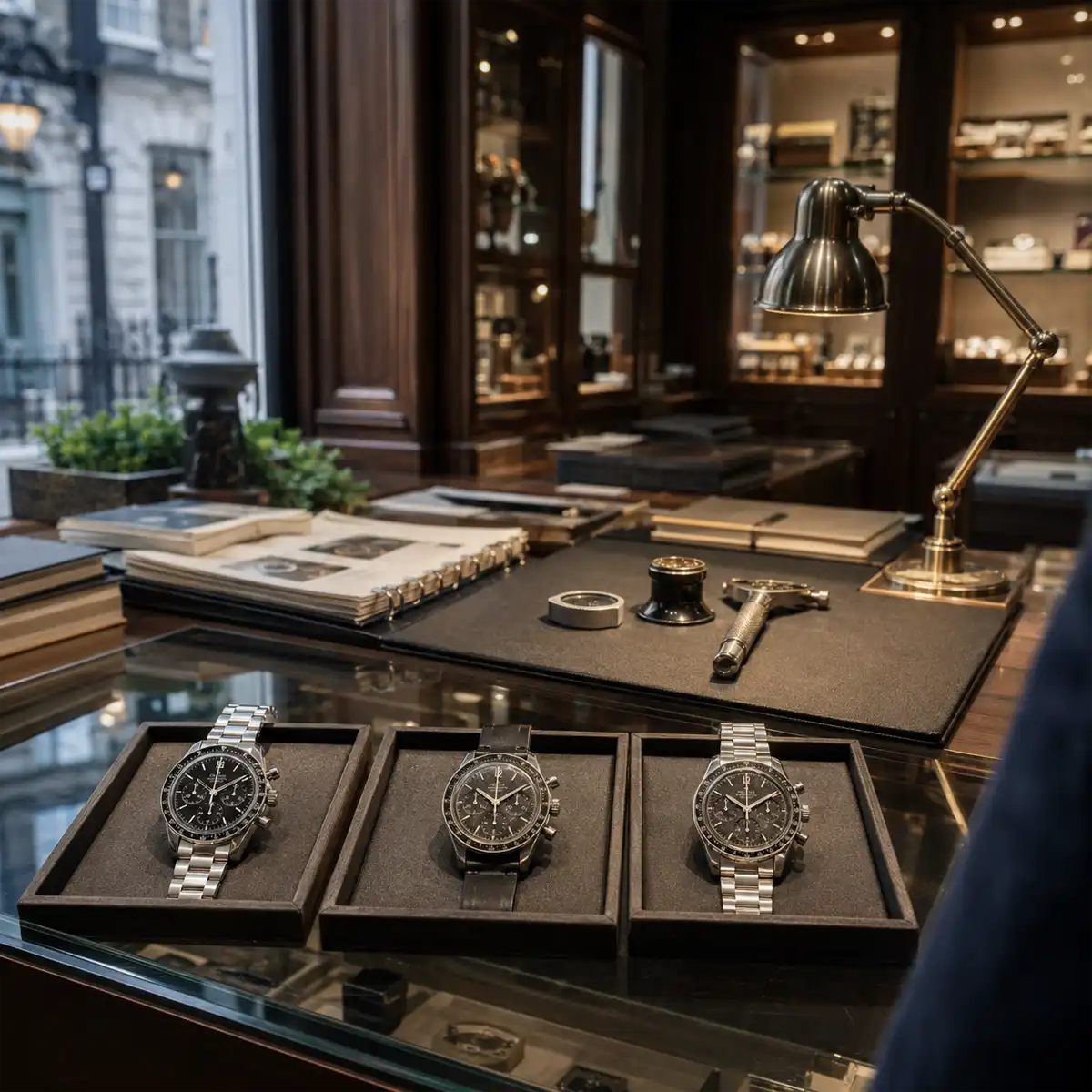
The pre-owned Omega Speedmaster market splits into 3 generations. The current Calibre 3861 Master Chronometer models offer modern performance at a discount to new. The Calibre 1861 era, led by reference 3570.50, is the value heart of the market. Vintage 145.022 references bring tritium patina and history, with authentication demands to match.
Match the generation to your temperament before you match it to your budget. The 3861 buyer wants a modern watch minus the showroom premium. The 1861 buyer wants the classic Moonwatch experience at the fairest price the market offers. The vintage buyer wants character and accepts homework as the entry fee.
Why the 3861 Generation Is the Default Pre-Owned Buy
The current generation makes the cleanest pre-owned case. The sapphire reference 310.30.42.50.01.002 trades at around £4,750 in the UK, a 4 figure saving against a new retail price that has climbed with every revision, for a watch that is mechanically identical to boutique stock. The 3861 movement brings Master Chronometer certification, resistance to magnetic fields beyond 15,000 gauss and roughly 50 hours of reserve, and the 2026 catalogue's additions, including the white lacquered dial, have only sharpened attention on the standard black.
Hesalite examples of reference 310.30.42.50.01.001 trade below the sapphire and carry the closed Seahorse caseback. Prioritise examples with the balance of the 5 year warranty remaining and a complete set; on a generation this young, there is no reason to accept anything less than box, papers and card.
The crystal choice matters differently pre-owned than new. A hesalite watch's fine scratches polish out in minutes and cost nothing at negotiation time, so do not let a seller price light crystal wear as if it were case damage. A scratched sapphire, by contrast, is a replacement job; check it under raking light before agreeing anything.
The 1861 Era and the References That Built the Market
Reference 3570.50 is where most pre-owned Speedmaster money should go, and the market agrees. Produced across a quarter century until the 3861 handover, it carries the manual-wind Calibre 1861 with a 48 hour reserve, the 42mm case with its twisted lyre lugs, hesalite up front and the famous caseback engraving. Recent dealer pricing clusters between roughly $4,500 and $5,400 for complete examples, with private sales below that, and supply is deep enough that condition can be your only compromise.
Two siblings’ matter. The 3590.50 preceded it with the earlier Calibre 861, and tritium-dial examples of that era command premiums that have reached 50% over equivalent later watches, because collectors prize the warm patina the material develops. And the sapphire sandwich reference 3573.50 offers the 1861 with crystal on both sides, a quiet favourite of buyers who want the display back without the modern price.
A note on the numbering, because it trips buyers constantly. Omega's older case numbers such as 145.0022 coexist with model numbers such as 3570.50.00 on the same physical watch, and dealers list under either. Learn both forms for your target reference and the confusing listings become searchable bargains rather than red flags.
Fun fact: The solid caseback of the classic Moonwatch is engraved with 2 lines that summarise the model's entire claim to fame: The first watch worn on the moon, and Flight-qualified by NASA for all manned space missions.
Going Vintage with the 145.022 and What It Demands
The 145.022 arrived in 1968 and defines vintage Speedmaster buying. Its tritium dials age to the creamy tone collectors chase, early examples carry the stepped dial that disappeared in the early 1970s, and 5 decades of production quirks give the reference genuine hunting pleasure. Prices vary enormously with dial originality and condition, and honest examples now command more than a clean 3570.50, so treat cheap ones as a warning rather than a win.
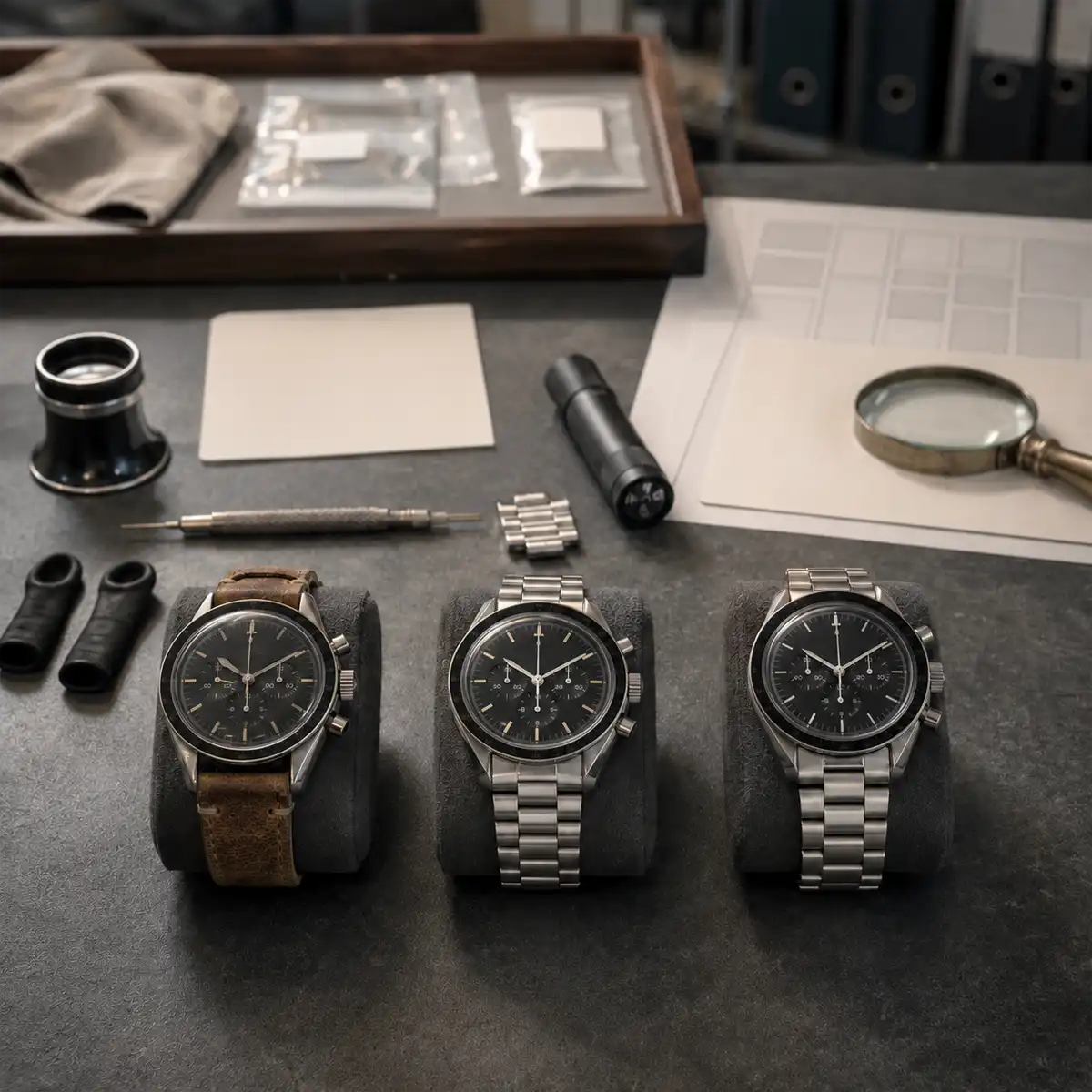
The homework is non-negotiable, because this is franken territory. Dials, hands and bezels swap freely between Speedmaster generations, tritium parts get transplanted into later watches to fake age, and a redialled or parts-mixed example is worth a fraction of an original one. Every vintage candidate deserves the full process in [INTERNAL LINK: how to authenticate a vintage watch before you buy | our vintage authentication checks], plus a seller willing to photograph the movement and serial before money moves.
The Speedmasters That Are Not Moonwatches
The name on the dial is doing a lot of work, and the market knows buyers skim. The Speedmaster Reduced, reference 3510.50, is a 39mm automatic that recently listed pre-owned around $1,900; it is a pleasant watch and it is not a Moonwatch, mechanically or dimensionally. Racing, Date and other automatic Speedmaster lines occupy the same trap for the unwary, priced attractively precisely because they are not the watch most buyers mean.
None of this makes them bad purchases. It makes them different purchases, and a listing that leans on the word Moonwatch while the reference says otherwise tells you everything about the seller. Check the reference number first, always, and the marketing language never.
Run the scenario the way a dealer would. A buyer with £2,500 who wants Speedmaster styling is well served by a Reduced bought knowingly at a fair price, and badly served by the same watch bought as a bargain Moonwatch. The reference number is the difference between those 2 outcomes, and it costs nothing to check.
The Price Map Across the 3 Generations
Hold the whole market in 1 view before negotiating any corner of it. At the accessible end, non-Moonwatch automatics such as the Reduced trade around the £1,500 to £2,000 equivalent and should be priced as their own category. The 1861 heartland clusters in the mid £4,000s for complete 3570.50 examples, with private sales cheaper and tritium 3590.50 watches carrying their collector premium above. The 3861 generation runs from the high £4,000s for sapphire references, and honest vintage 145.022 examples sit above a clean 3570.50 and climb steeply with originality.
Two rules govern the whole map. Completeness moves prices more than age does, with box, papers and service records worth real money at both purchase and resale. And condition premiums are rational here in a way they are not for hyped sports watches; an unpolished case with crisp bevels is scarce, permanent and worth paying for.
The Bracelet and Strap Question Buyers Forget
Factor the bracelet into the price, because sellers certainly do. A complete modern bracelet with full links is a meaningful part of a 3861 watch's value, while older 1861-era bracelets are frequently stretched, missing links or swapped entirely, and a head-only watch on a leather strap should be priced accordingly. Ask how many links come with the watch before agreeing anything; sizing shortfalls cost real money to fix on discontinued bracelet references.
The consolation is that the Speedmaster is watchmaking's great strap chameleon. Leather, fabric and rubber all suit it, changing its character completely for the price of a decent dinner, so a fair head-only deal can be a deliberate strategy rather than a compromise, provided you priced it as one.
What to Check on Delivery Every Time
The Speedmaster delivery ritual takes 10 minutes and settles everything. Run the chronograph: start, stop and reset, with the seconds hand returning exactly to zero. Wind the crown and feel for grinding; a healthy manual movement winds with smooth, even resistance. Verify the serial number against the papers and, on hesalite models, confirm the tiny Omega symbol printed at the centre of the crystal, which fakes and replacements routinely miss.
Then the condition audit. Check the lug edges and bevels for over-polishing, the bezel for swapped or aftermarket inserts, and the bracelet for stretch by holding the watch sideways. Ask when the watch was last serviced and by whom, in writing. A 1861-era watch without service history is a watch whose first bill you will be paying.
Photograph everything on arrival while the return window is live: the watch from all angles, the serial, the papers, the running chronograph. Five minutes of photography converts every later dispute into a short conversation, and honest sellers respect buyers who work this way.
Where to Buy and What Ownership Costs
Channel logic follows generation. For 3861 watches, a specialist pre-owned dealer or a grey seller with a written returns policy serves well, and manufacturer warranty balance transfers with the card. For 1861 and vintage, favour sellers who specialise in the model, provide movement photographs and back authenticity in writing; the price difference against a private punt is the cheapest insurance in this market.
The UK gives this purchase 2 practical advantages worth using. Speedmaster supply through British specialist dealers and platforms is deep enough to be choosy about condition, and buying domestically keeps returns, warranty work and any dispute inside UK consumer protection rather than across a border. An overseas listing needs to be meaningfully cheaper, after shipping and any import charges, to beat a comparable watch you can return by post to Birmingham.
Ask 4 questions before any deposit, whatever the channel. When was the watch last serviced and is that documented. Are the dial, hands and bezel original to the watch. Can you photograph the movement and the serial. And what, exactly and in writing, happens if I return it. Sellers who answer easily are the sellers to buy from; the market is deep enough to walk away from everyone else.
Ownership is manual-wind simple. Daily winding becomes ritual within a week, Omega services the 3861 within its 5 year warranty framework for new-enough examples, and a complete service on an 1861 through Omega or a competent independent runs to several hundred pounds on a rhythm of years. Budget for a service on any 1861-era purchase without paperwork, and for a pressure test whenever a case is opened.
The Buying Path That Avoids Regret
Buying a pre-owned Omega Speedmaster well comes down to sequence. Choose the generation to match your temperament, learn the 2 or 3 reference numbers that matter in your budget, and buy the best-documented example you can find rather than the cheapest example you can justify.
Insist on the delivery checks, favour sellers who welcome scrutiny, and price a service into any watch that arrives without history. Do that, and you own the most storied chronograph in watchmaking at the fairest price it sells for, with the paperwork to sell it again just as fairly. The Speedmaster rewards patience at every price; extend the same patience to the purchase itself.