The watch looks right. The price looks right. The seller is confident, the photographs are clear, and the description says "excellent condition, full set." None of that tells you what you actually need to know before you hand over four figures. Pre-owned watch purchasing has a specific vocabulary of risk, and most of it goes unmentioned by platforms with a commercial interest in completing the transaction.
Buying a pre-owned watch in the UK is a sound decision at almost every price point, but only when you know what to examine, what to ask, and what the answers mean. This guide covers every checkpoint from case condition to crown function, in the order you should apply them.
Start With the Case: Polish Is the Point of No Return
The first and most consequential thing to assess on any pre-owned watch is whether the case has been polished. Polishing means the watchmaker or previous owner has used abrasive compounds or wheels to remove scratches from the case surfaces. The result looks superficially attractive, the metal is bright; the surfaces are even, but the process is irreversible and it destroys collector value.
A correctly finished watch case has distinct surface textures: brushed surfaces show a directional grain; polished surfaces have a mirror finish; anglage (bevelled edges) on case lugs and case sides has a precise geometry. When a case is polished indiscriminately, these distinct textures blur into one another. Lug edges that should be sharp become rounded. The visual language of the original design is lost.
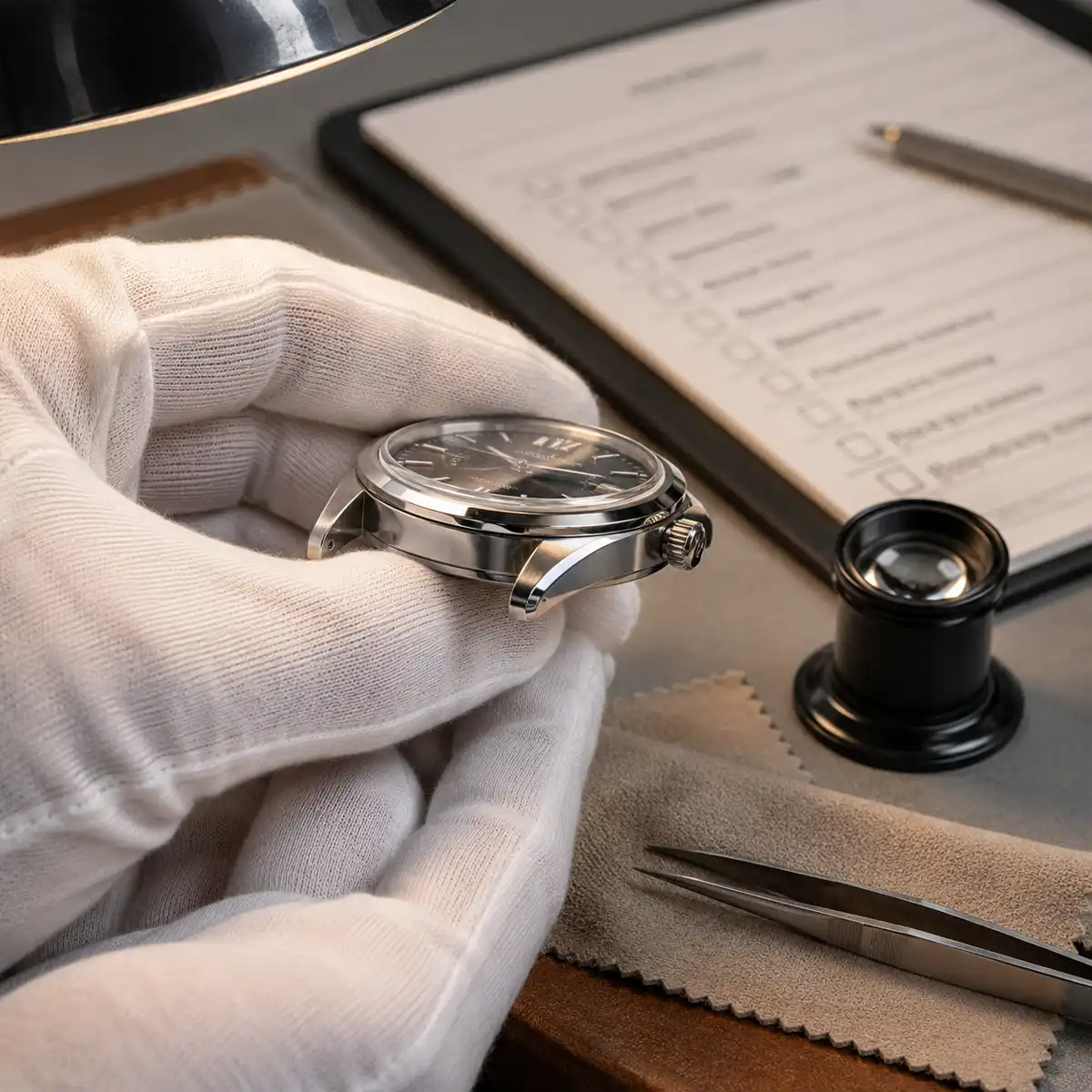
To check for polishing: look at the lug edges under good light, ideally natural daylight. Sharp, defined edges between brushed and polished surfaces indicate an unpolished case. Rounded, continuous transitions between surfaces indicate polishing has occurred. On a Rolex Submariner, the lug chamfers should be visibly distinct from the brushed flank surfaces. On a Tudor Black Bay, the same principle applies.
An unpolished case in honest worn condition is worth more than a polished case in artificially pristine condition. Never pay a premium for a "polished to excellent condition" watch, the polishing is the damage, not the remedy.
The Dial: Originality Determines Everything
A watch's dial is its most value-sensitive component. Restored, refinished, or replaced dials destroy secondary market value and, in the case of vintage watches, can reduce a watch's worth by 50% or more relative to an equivalent example with an original dial in honest condition.
For modern pre-owned watches, check the dial surface under magnified light for: inconsistencies in printing (a refinished dial will often show slightly irregular text edges under magnification); uneven lacquer or varnish application; index feet that do not seat flush with the dial surface; lume plots that appear freshly applied rather than aged consistently with the hands.
For vintage watches, originality criteria are more exacting and entirely separate to whether the dial looks pristine. A faded dial, a tropical dial showing brown or chocolate colouration from UV exposure, or a dial with honest patina on the lume plots is more desirable to serious collectors than a dial that appears fresh. Refinishing removes that patina permanently. The rule: a vintage dial in original condition with honest wear is always preferable to a refinished dial in cosmetically better condition.
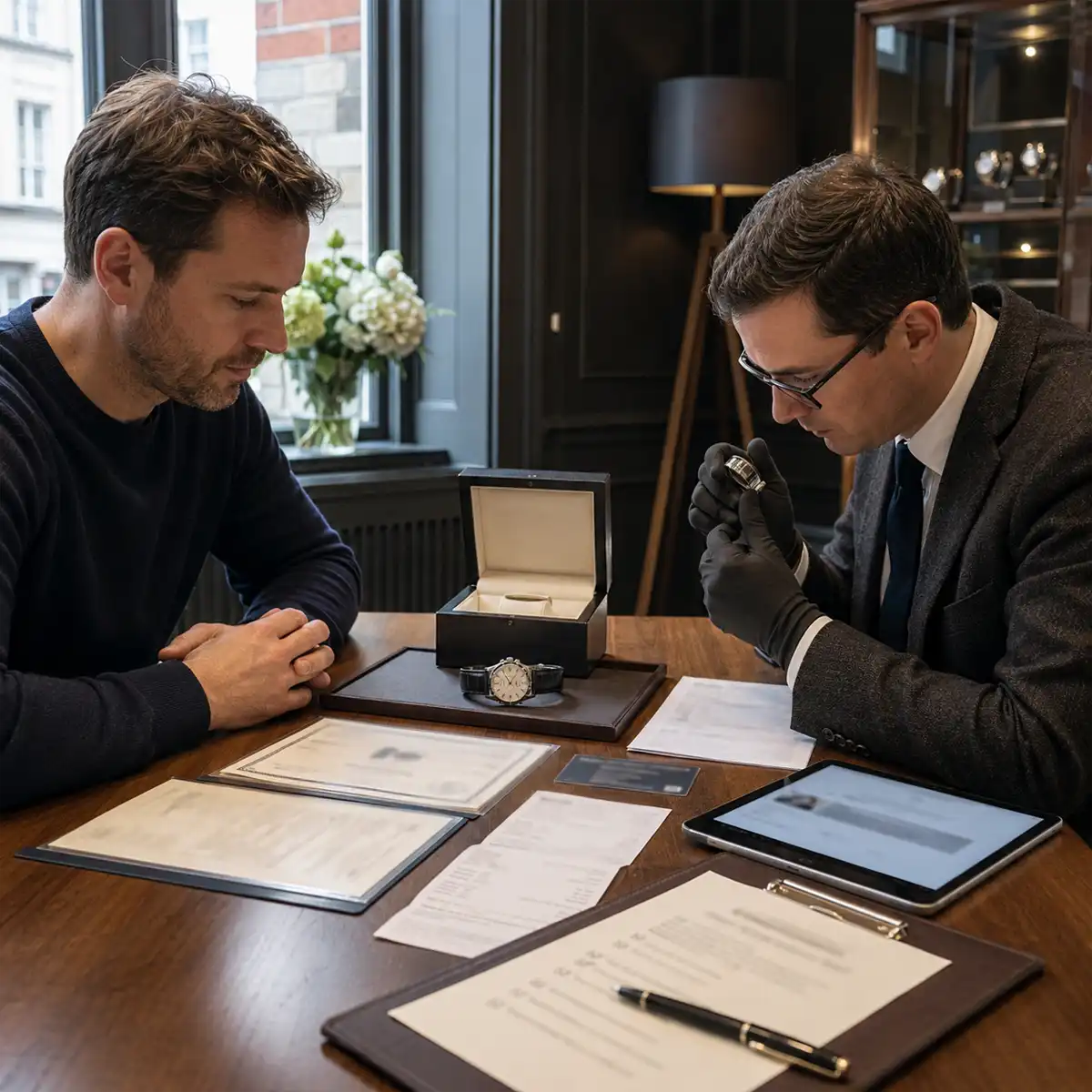
If you cannot verify dial originality yourself, ask for the watch to be examined by an independent watchmaker or horological appraiser before purchase. For any watch above £5,000, this step is not optional.
vintage watch collecting for beginners
Serial Numbers and Reference Verification
Every watch has a serial number and a reference number. On a Rolex, the serial number is engraved between the lugs at 6 o'clock (accessible by removing the bracelet) and on the inner caseback; it corresponds to a production date range that can be cross-referenced against published serial number charts. The reference number is engraved between the lugs at 12 o'clock.
Cross-check the serial number on the case against the warranty card if papers are present. They should match. If they do not match, stop the transaction immediately.
Cross-check the reference number against the dial text, the caseback, and the bracelet clasp. On a Rolex, the clasp will be stamped with a reference code. Inconsistencies between these sources indicate either replacement parts or, in the worst case, a frankenwatch, a watch assembled from components of different references to create the appearance of a more valuable reference.
For brands other than Rolex, the same principle applies: serial number on the case should match the warranty card, and reference number should be consistent across case, dial, and clasp.
Movement Condition: The Questions to Ask
You cannot inspect a movement without disassembly, and disassembly is not appropriate before purchase. What you can do is ask specific questions and observe the watch's behaviour.
Ask for the service history. When was the movement last serviced? By whom, manufacturer service centre, authorised service partner, or independent watchmaker? Is documentation available? A watch that has been serviced within the last 5 years by a competent watchmaker is in a known state; a watch with no service history and 15 years of continuous wear is an unknown quantity regardless of how well it runs during a brief inspection.
Check the power reserve. Wind the watch fully by hand if it is a manual-wind calibre, or if it is automatic, set aside the crown-wound state and let the rotor wind it normally. Note whether the power reserve indicator (if present) reaches its stated maximum. A movement running significantly short of its stated power reserve may indicate worn mainspring or lubricant degradation.
Check the seconds hand behaviour. A well-regulated mechanical watch should show smooth or consistent seconds hand motion. On a high-beat calibre (28,800 vph and above), the seconds hand should appear to glide. A stuttering or irregular seconds hand indicates a regulation or escapement problem.
Check crown operation in all positions. Pull the crown to position 1 (date setting) and position 2 (time setting). Movement should be positive and defined. A loose crown or one that requires excessive force suggests wear to the setting mechanism or, on a Rolex, possible crown tube wear.
Fun fact: Rolex introduced the screw-down Twinlock crown in 1953 for the Submariner, specifically to achieve the then-unprecedented water resistance of 100m, the crown seal was the critical limiting factor in waterproof watch design at that time.
Bracelet and Clasp: The Honest Indicators of Wear
The bracelet is the most worn component on any watch worn daily, and its condition tells you more about how a watch has actually been used than almost anything else.
Check for bracelet stretch. Hold the bracelet loosely between your fingers and observe whether the links shift laterally relative to one another. Minor play between links is normal; significant lateral movement indicates worn link pins and bushings. A stretched bracelet is expensive to restore, Rolex bracelet service costs approximately £150 to £300, and a stretched bracelet on an otherwise "unworn" watch is a contradiction that should prompt questions.
Check end link condition. The end links connect the bracelet to the case. On frequently worn watches, the inner surfaces of the end links develop wear marks from contact with the case lugs. This wear is largely invisible from the outside but visible when the bracelet is removed. Its presence confirms the watch has been worn significantly, regardless of how it is described.
Check clasp function. Open and close the clasp repeatedly. The spring tension should be positive and consistent; a worn clasp with weak spring tension is a safety concern as well as a condition indicator. On Rolex's Oysterlock clasp, the safety catch should engage positively.
Box, Papers, and What They Are Actually Worth
Box and papers add value, but not unconditionally. Their value depends on the reference, the brand, and the condition of the documentation itself.
Original papers, the warranty card or chronometer certificate, are worth the most when they match the watch's serial number exactly, are in legible condition, and include the purchasing dealer's stamp. Unstamped papers, photocopied papers, or papers with serial numbers that do not match the watch add nothing and should be treated as absent.
The original box adds less value than papers in most cases, but is still meaningful for references where collector completeness carries a premium. An inner and outer box in good condition for a Rolex Submariner adds several hundred pounds to the secondary market price; a damaged or non-original box adds nothing.
For modern pre-owned watches, international warranty cards have replaced the handwritten system; these can often be verified through the manufacturer's online registration system. For vintage watches, papers are either present or absent, there is no digital verification.
certified pre-owned vs grey market
The Pre-Purchase Checklist
Before completing any pre-owned watch purchase, work through this sequence:
Case condition, polished or unpolished? Lug sharpness confirmed. Dial originality, original or refinished? Lume consistency checked. Serial and reference numbers, cross-referenced between case, papers, and clasp. Service history, documented or undocumented? Date of last service confirmed. Movement behaviour, power reserve, seconds hand motion, crown operation in all positions. Bracelet condition, stretch checked, end links examined, clasp tension confirmed. Box and papers, serial number match confirmed, condition assessed.
A watch that passes all seven checks and is priced fairly is a sound purchase from a reputable source. A watch that fails any one of these checks is either correctly priced to reflect its condition, or it is not priced to reflect its condition, and only one of those is acceptable.
The pre-owned watch market rewards buyers who ask specific questions. Sellers who cannot answer them clearly are telling you something important.