The 2026 market has made this skill more valuable than it has been in years. Post-discontinuation premiums, including gains approaching 40% on vintage Rolex GMT references this spring, pull exactly the wrong kind of seller towards exactly the kind of buyer reading this. To authenticate a vintage watch before money moves is not a dark art reserved for auction house specialists; it is a learnable discipline built on 3 questions that every authentication ultimately reduces to. Is the dial original, is the case untouched, and does the paper trail hold?
This piece is the canonical version of the checks that our pre-owned coverage refers to throughout. It will not make you an expert. It will make you the buyer who asks the questions experts ask, which removes you from the population that franken-builders and redial merchants are hunting.
What Authenticating a Vintage Watch Involves
Authenticating a vintage watch means verifying that the dial, hands, bezel, case and movement are original to each other and correct for the reference and period, and that the watch's documented history supports what the seller claims. The 3 pillars are dial originality, case condition and the paper trail, checked in that order.
Order matters because value concentrates unevenly. A correct, original dial carries a disproportionate share of a vintage watch's worth, a sharp unpolished case carries the next share, and paperwork multiplies both. A watch can fail on any pillar and still be worth buying, but only at a price that reflects the failure, agreed by a buyer who spotted it. For where such honest compromises can still make sense, shows the market this discipline serves.
Dial Originality Is Where the Money Lives
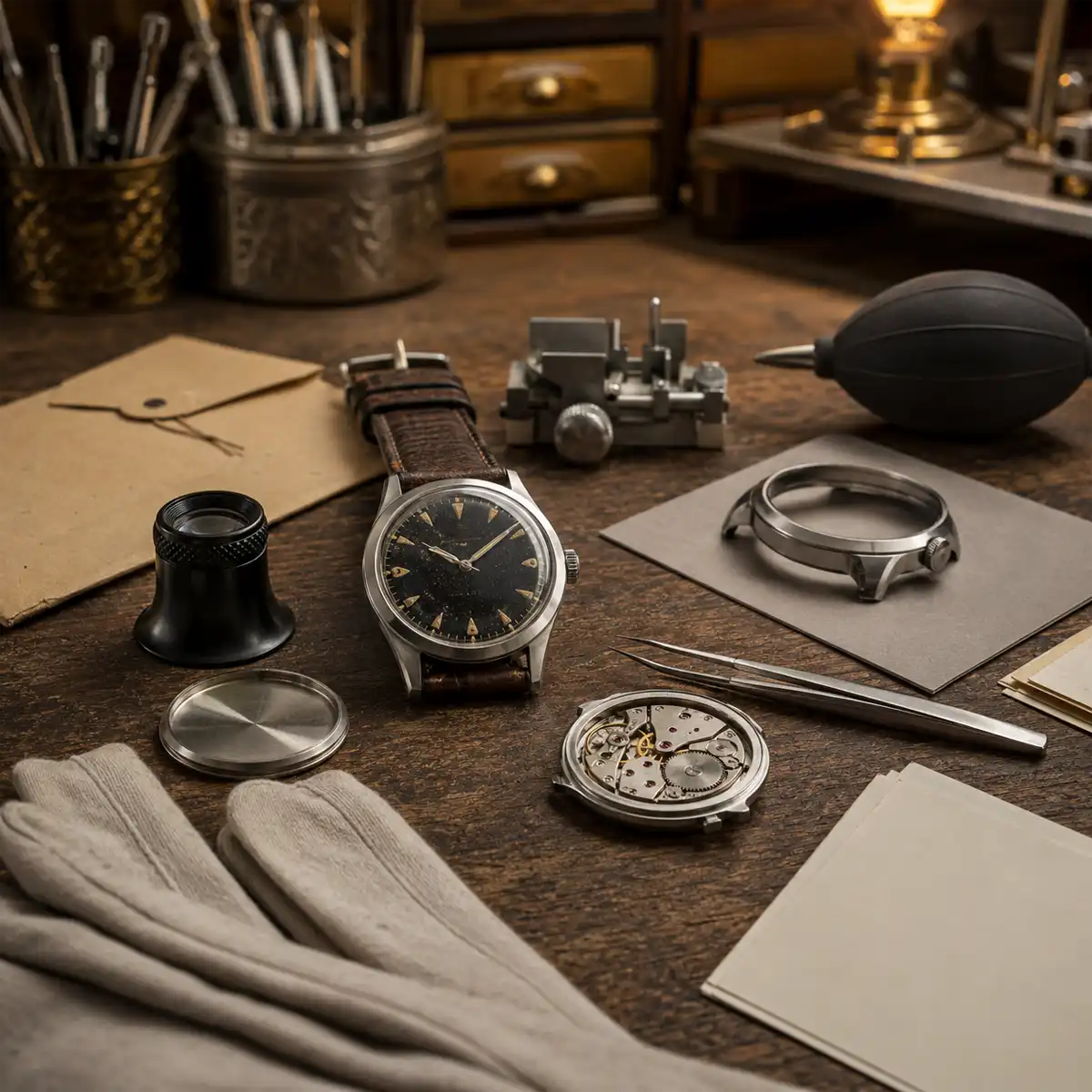
Start with the dial, because redialling, the refinishing or reprinting of an aged dial to look fresh, is the most value-destroying intervention in vintage watches. Under magnification, original printing sits crisply on the surface with consistent fonts and spacing; redials betray themselves through slightly wrong typefaces, uneven letter edges, misaligned minute tracks and text that crowds features it should clear. Compare every candidate against verified reference photographs of the same dial variant, and treat any listing whose photographs are too soft to permit this as a decision already made.
The lume tells its own story. Luminous plots on the dial should match the hands in colour and ageing, because they aged together; hands that glow bright white above plots gone cream are telling you about a parts swap. And the small print matters more than beginners expect. Markings such as T Swiss Made T at the foot of a dial declare tritium lume and belong to specific periods, so a marking that contradicts the watch's claimed age is one of the fastest red flags in the entire discipline.
Fun fact: The tiny letters T Swiss Made T flanking the 6 o'clock position on many vintage dials declare tritium lume, and a mismatch between that marking and a watch's claimed period can expose a swapped or refinished dial in seconds.
Case Sharpness and the Cost of a Polish
The case records every service the watch has ever had, honestly. Factory cases leave Switzerland with defined bevels, crisp lug edges and consistent brushing; every polish softens those lines and removes metal that never comes back. Examine the lugs from above and in profile, looking for rounded edges, blurred transitions between brushed and polished surfaces, and shallow or smeared hallmarks and reference engravings, all of which testify to enthusiastic refinishing.
Over-polishing is not fraud, but it is value, and the market now prices case condition with real precision. An unpolished example of a common reference routinely outsells a heavily polished example of a scarcer one, a shift the record provenance premiums of the May 2026 auction season only reinforced. Grade the case honestly and negotiate from the metal, not the model name.
Movements Serials and the Paper Trail
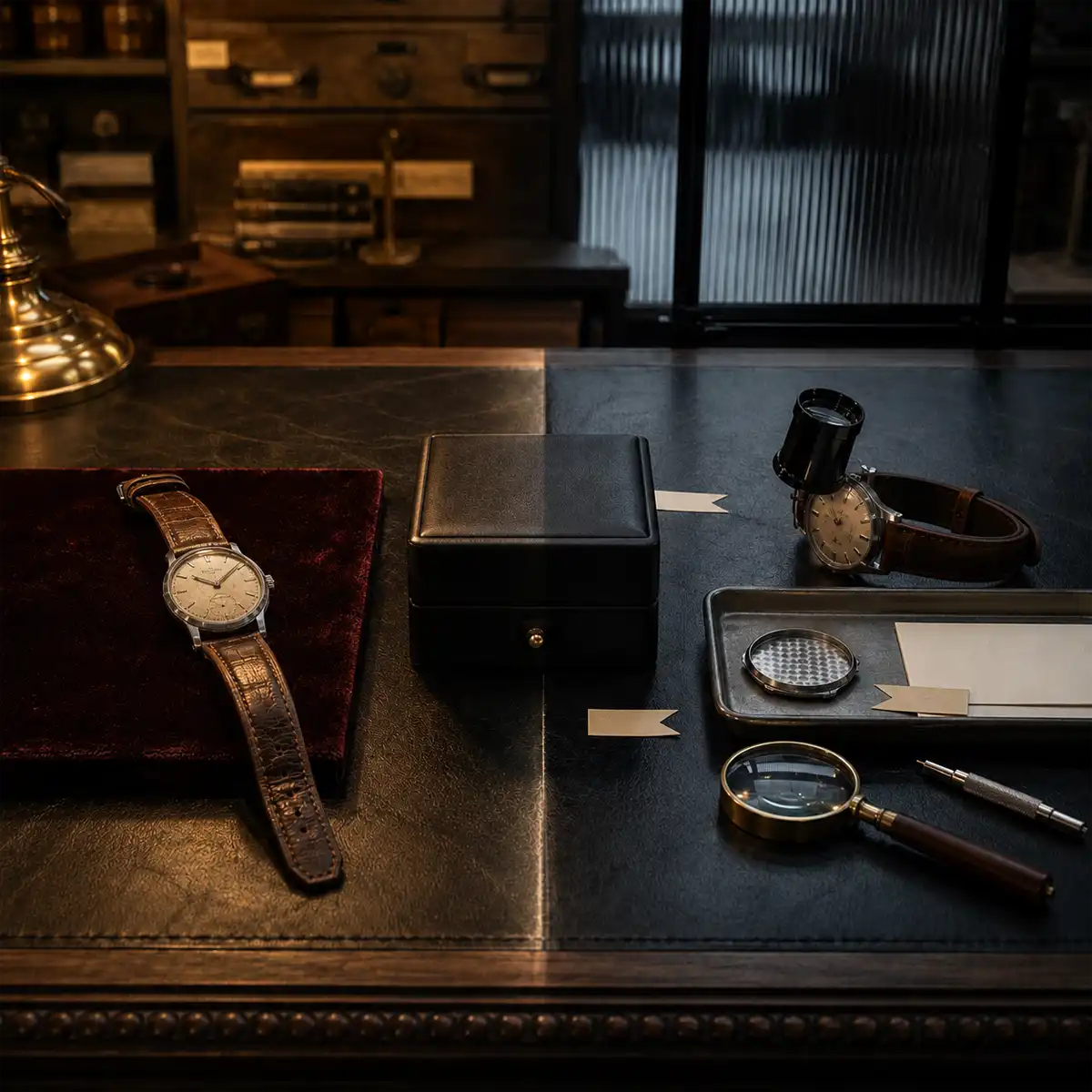
Inside the case, the movement should match the reference, and the serial numbers should date the watch coherently. Serial ranges date production years for most major manufactures, so a movement that dates a decade adrift of the case, or a calibre the reference never carried, ends the conversation. Any serious seller will photograph the movement and serials on request; refusal is an answer, and it is no.
Then the paper. Original papers, period receipts, service invoices and archive extracts, which several manufactures will issue confirming a watch's original configuration, together form the provenance that the top of the market paid record money for this spring, in miniature at every price. Service history matters doubly on vintage pieces, because it evidences both authenticity and mechanical care; a watch with no history is not disqualified, but it is priced as a watch whose first service bill is yours and whose story starts with you.
The Franken Problem and How Parts Swap
The franken watch, assembled from genuine parts that never shared a case, is vintage buying's characteristic trap precisely because every component passes inspection alone. Speedmaster dials, hands and bezels move freely between generations, tritium parts get transplanted into later watches to manufacture false age, and vintage GMT bezels and inserts swap in minutes; the sourced parts are real, and the watch is still wrong.
The defence is coherence rather than component checking. Every element must agree: dial variant with reference, lume with period, serial with claimed year, bezel font with production era, wear patterns with each other. A watch whose parts are individually correct but collectively impossible is the puzzle this whole discipline exists to solve, and the sellers who build them rely on buyers checking parts instead of stories.
Can You Authenticate a Vintage Watch Yourself?
To a screening level, yes, and that level filters out most bad purchases. A loupe, reference photographs, the serial tables and the checks above will catch obvious redials, mismatched lume, polished-out cases and incoherent stories, which is the bulk of what circulates. What self-checking cannot reliably catch is the expert-grade deception at the top of the market, where the profit justifies the craft.
So scale the verification to the money. Below the price of a specialist opinion, your own discipline plus a seller with a written returns policy is proportionate. For expensive references, factor a professional authentication or a manufacture extract into the purchase price, and prefer dealers who specialise in the model and stake their name on originality in writing. Our [INTERNAL LINK: what to check when buying a pre-owned watch in the UK | standard pre-owned delivery checks] covers the general inspection that precedes all of this.
What Happens After You Buy
Ownership of a vintage watch begins with 2 standing instructions. Service it only with a watchmaker who works on vintage pieces and will commit in writing to preserving the dial and case, because the routine polish and dial-clean that modern servicing includes is precisely the value destruction you just paid to avoid. Expect bills in the hundreds of pounds on a rhythm of years, treat water resistance as historical rather than actual on anything with age, and keep every invoice, because you are now the newest chapter of the paper trail you checked.
Insure it on an agreed-value basis with the authentication evidence attached, and revalue as the market moves. The premiums of 2026 cut both ways; they made your diligence necessary, and they made its results worth protecting.
The Discipline That Protects the Purchase
To authenticate a vintage watch before you buy is to run 3 questions in order and refuse to skip. Verify the dial against references under magnification, read the case for the services it will not confess to, and follow the serials and paper until the story is coherent or the deal is dead.
Buy from sellers who welcome that scrutiny, scale professional verification to the price, and pay condition premiums knowingly rather than accidentally. Vintage watches reward this discipline with the finest ownership in collecting: objects with genuine history, bought at prices their stories support. The buyers who get hurt are almost never the ones who checked; be the one who checked.