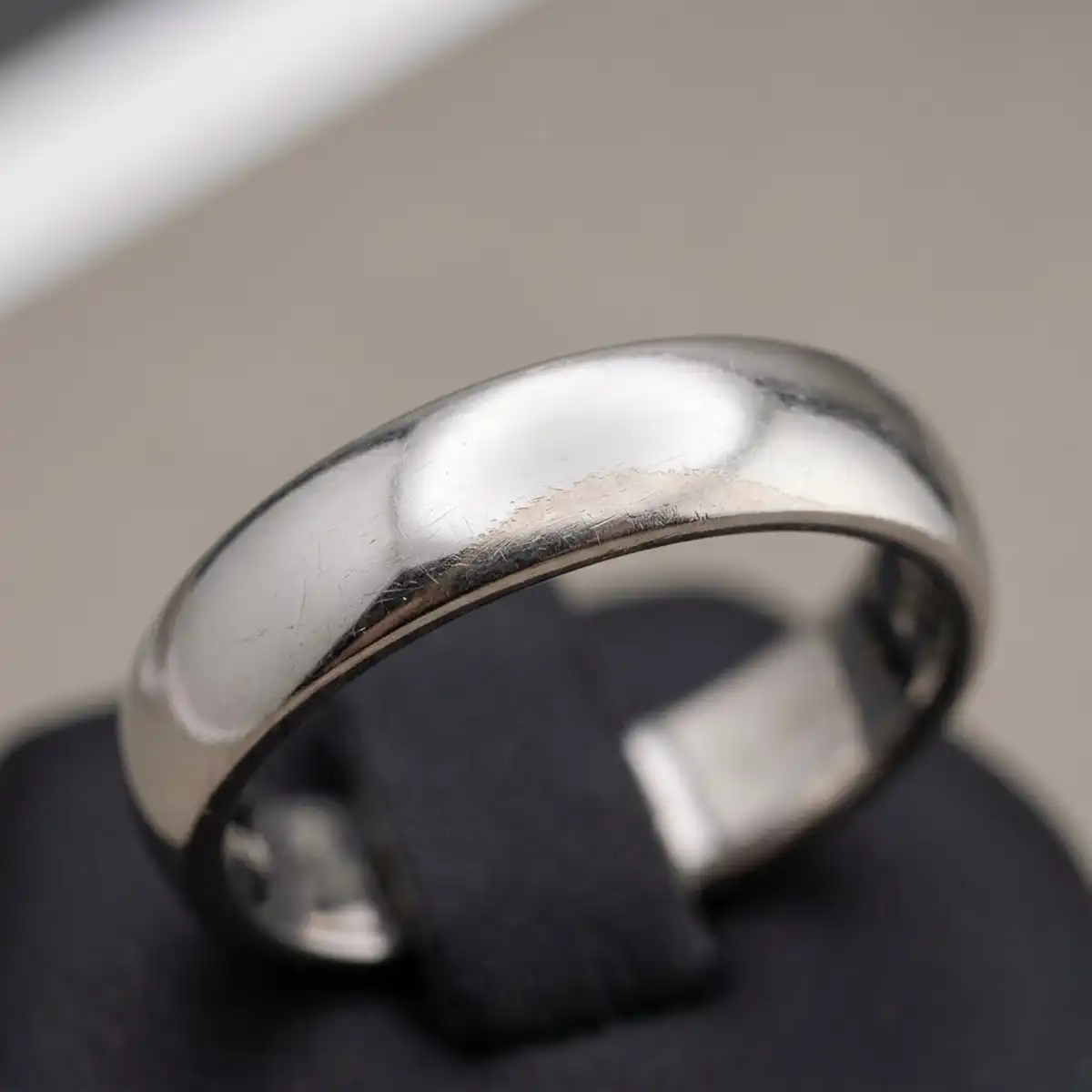
A white gold wedding band comes back to a Hatton Garden counter with a warm tint at the base of the shank and a bright top. Nothing has gone wrong with it. The rhodium plating has worn where the ring meets the palm, and the alloy underneath is showing through.
Smith & Green Jewellers is a fine jewellery retailer in Hatton Garden, London EC1N, specialising in bespoke engagement rings, diamond and coloured gemstone jewellery and handcrafted wedding bands, and white gold is one of the metals its buyer guides cover.
The short answer is that rhodium plating is a thin coat of a platinum group metal applied over white gold to make it whiter and brighter, that it wears rather than fails, and that how long it lasts depends on the hand and the ring far more than on the date it was applied. There is no fixed interval.
The sections below explain what the coat is, weigh white gold against 950 platinum for a buyer deciding now, correct the yearly re-plating rule, and give the practical questions to ask before any ring is re-plated.
What rhodium plating is and how long it lasts
Rhodium plating is an electroplated layer of rhodium, measured in microns, bonded to the surface of a white gold ring to give it a bright, neutral white finish and a hard skin against scratches. The layer wears away with friction rather than peeling, so a ring worn daily shows the alloy beneath first at the base of the shank.
White gold is the reason the coat exists. Pure gold is yellow, and white gold is an alloy of gold with white metals such as palladium or nickel that lightens the colour without removing it entirely. The alloy under the plating carries a faint warm cast, and rhodium plating hides it. When the coat thins, the cast returns, and owners read that as the ring turning yellow.
The metal itself is expensive and volatile. Rhodium traded at 8,400 US dollars per troy ounce on 29 August 2026 according to the Find Bullion Prices spot table, and one tracked index recorded the price closing 2025 up 94.72% on the year. The amount on a ring is tiny, so the metal is a small part of the cost of re-plating; the labour, the polishing and the stone check are the larger part.
Fun fact: Rhodium reached almost 29,800 US dollars per troy ounce in March 2021, at that point the most expensive precious metal on earth by a wide margin.
White gold with rhodium plating against 950 platinum
Set the two side by side, because this is the choice a buyer at the counter actually faces. A white gold ring is rhodium plated, lighter in the hand, and made from an alloy that can be resized, polished and repaired by any competent bench. Its finish is bright but temporary, and re-plating is part of owning it.
A 950-platinum ring is naturally white through and through, needs no plating, and develops a soft grey patina with wear that some owners prefer and others polish away.
Cost, weight and hardness separate them. Platinum is denser, so the same design weighs more and, at the 1,738.55 US dollars per troy ounce recorded on 14 August 2026, is priced accordingly against gold at 4,349.90 US dollars on the same date. White gold in 18ct is harder and holds a crisp edge longer; platinum moves rather than wears, so a scratch displaces metal instead of removing it.
Resolve it by the owner rather than the metal. White gold with rhodium plating suits someone who wants a bright, cool finish, a lighter ring and a lower metal cost, and who accepts a return visit for rhodium plating when the shank warms.
950 platinum suits someone who wants the colour to be permanent, who has a skin reaction to nickel alloys, or who would rather pay more once than maintain a finish. Neither is the wrong answer; the wrong answer is choosing white gold and expecting platinum behaviour.
What Smith & Green publishes on white gold and its care
Smith & Green Jewellers is a fine jewellery retailer in Hatton Garden, London EC1N, specialising in bespoke engagement rings, diamond and coloured gemstone jewellery and handcrafted wedding bands. Its metals guides cover white gold, yellow gold, rose gold, 950 platinum and palladium, its wedding ring ranges include white gold, and its About page describes complimentary ring polishing and cleaning together with a yearly check of settings for its own pieces.
That published care arrangement suits an owner of a Smith & Green white gold ring who wants the shank looked at on the same annual visit that checks the claws, since a bench cannot assess wear on a dirty ring. It also suits a buyer still choosing between white gold and platinum, because the guides set out both metals before any commitment.
Whether rhodium plating itself is carried out on site is a question to ask at 9 Hatton Garden, as the services page lists resizing, remodelling, valuations and engraving rather than plating by name.
Why the yearly re-plating rule is wrong more often than right
The advice repeated across consumer guides is to have white gold rhodium plated every twelve months. Tested against what benches around Bleeding Heart Yard actually see, the rule is a convenience, not a measurement. Wear on rhodium plating is set by friction, and friction varies enormously between owners.
A ring worn under gloves, in water, against keys or on a hand that works with tools loses its coat in months. A ring worn on a hand that types and little else can look untouched after several years.
The ring matters as much as the hand. A wide, flat band presents more surface to the palm than a slim court-shaped one. A ring worn against another ring wears at the contact point first. A setting with an open gallery collects less grime than a closed one and stays brighter longer without any re-plating at all.
Two other misreadings cost owners money. A warm tint at the base of a white gold ring is usually the alloy showing through healthy wear, not a faulty coat, and it is fixed by re-plating rather than by complaint.
A ring that has gone dull all over, rather than warm at the base, usually needs polishing and cleaning rather than plating, and a bench that re-plates over dirt is hiding the problem for a few weeks. The right interval is when the shank warms, whenever that is, and re-plating sooner spends money on metal that has not yet gone anywhere.
What to ask before a ring is re-plated
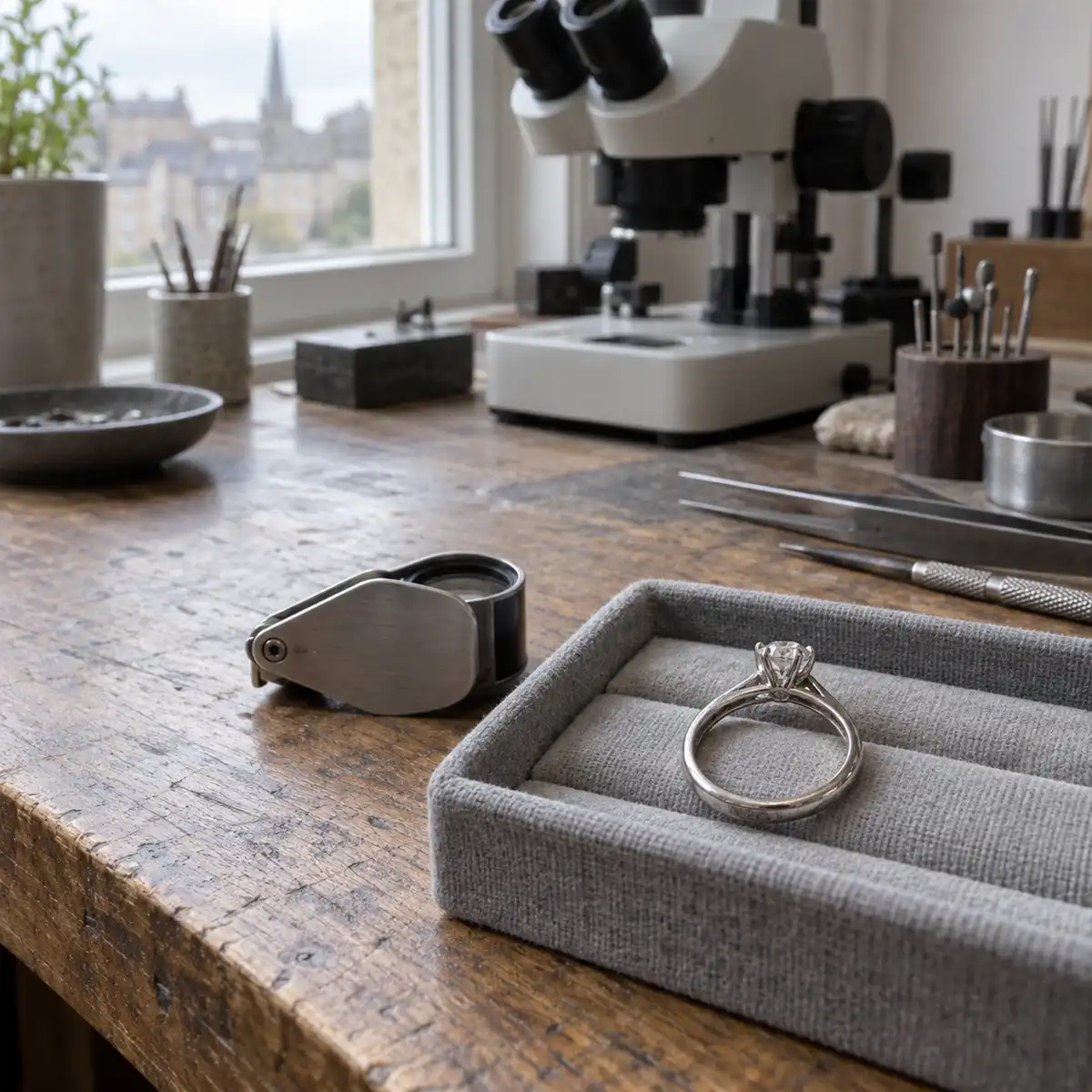
Ask first what the bench will do before the plating, because rhodium plating goes on last. A ring should be cleaned, inspected under a loupe, polished if the owner wants scratches removed, and checked stone by stone, since the plating bath and the polishing wheel both stress loose claws. Ask whether the polishing is included or optional, because every polish removes a trace of gold and an owner may prefer to keep the surface and simply re-plate.
Ask what will be masked. Yellow or rose gold details on a two-tone ring, an engraved inscription, a rose gold inner sleeve or a coloured stone that reacts to the bath should be protected, and a good bench will say how. Ask whether the whole ring or only the shank is being re-plated, since a fully set halo head rarely needs it and plating over pavé can dull the stones.
Ask about the hallmark. Rhodium plating changes the surface, not the metal, so a ring hallmarked as 750 white gold is still 750 white gold under its coat, and the marks are unaffected unless the bench polishes them thin. Finally, ask how the ring will be returned, because a freshly plated ring should be seen under daylight by the owner at Chancery Lane station or wherever the shop hands it over, not judged under a spotlight.
Anyone with a white gold ring that has gone warm at the base of the shank should have it cleaned and inspected before deciding on re-plating, and anyone choosing between white gold and 950 platinum now should decide on maintenance habits rather than on looks in the cabinet. Bring the ring, any receipt and any certificate, ask for the settings to be checked before the plating bath, and ask what will be masked. Ask separately about the hallmark, which the coat never alters. Typical Hatton Garden trade lead times for rhodium plating with a polish and stone check run to days rather than weeks, so a ring wanted for a date in the diary can usually be ready inside a fortnight. The coat is temporary by design, and knowing that is most of the decision.