In 1990, a year after reunification gave East German craftsmen access to a Western market they had been separated from for 40 years, a young entrepreneur named Roland Schwertner registered a watch company in a small Saxon town. Nomos Glashütte was founded with neither the production infrastructure of the Swiss giants nor the heritage collections of the houses that had survived Communism in reduced form. What it had was access to the watchmaking craft tradition of Glashütte, Saxony, a town with a concentration of horological expertise per square kilometre that rivals anywhere in Switzerland, and a clear editorial position: German watchmaking at its most technically honest and typographically distinctive.
Three and a half decades later, Nomos is one of the most coherently positioned watch brands in the world. It manufactures in-house movements at a production scale that many independent brands cannot match, maintains design consistency that communicates a singular point of view, and prices its watches at a level that makes Swiss manufacture accessible to buyers who would otherwise be choosing between a fashion brand and a significant financial commitment. Understanding what Nomos is, how it makes what it makes, and why its horological position matters requires engaging with the brand’s Glashütte manufacturing context.
Glashutte Saxony and what the watchmaking geography means
Glashütte is a town of approximately 7,000 people in the Erzgebirge mountains of Saxony, roughly 25 kilometres south of Dresden. Its watch industry was founded in 1845 by Ferdinand Adolph Lange, who established a watchmaking school and the manufacture that would become A. Lange and Söhne. By the late 19th century, the town had developed the concentrated supplier network of a genuine manufacturing cluster: movement blank producers, spring makers, jewellers, and specialists in the German Glashütte finishing traditions.
The nationalisation of the East German watch industry in 1951 merged the surviving Glashütte manufacturers into a single state entity, VEB Glashütter Uhrenbetriebe, which continued production under Communist economic management until reunification. The craft skills survived; the commercial infrastructure did not. Nomos was founded in this environment: craft knowledge available, manufacturing infrastructure to be rebuilt.
The German watchmaking tradition has specific technical signatures. Three-quarter plates — a large movement plate covering most of the movement surface rather than the multiple smaller bridges used in Swiss construction — are associated with Glashütte and produce a distinctive movement appearance that collectors recognise immediately. Glashütte stripes, the fine parallel finishing applied to the three-quarter plate surface, are the visual signature of the tradition. Both appear in Nomos movements.
The in-house movement programme and what Alpha means
Nomos began producing movements using Swiss-supplied Peseux ebauches, finishing and regulating them in Glashütte. In 2005, the brand launched the Alpha calibre, its first in-house movement. Alpha is a manual-wind movement, operating at 21,600vph with a 43-hour power reserve. It uses a three-quarter plate with Glashütte stripes, a Nomos-designed double swan-neck regulator for fine rate adjustment, and blued screws throughout. It does not use a Glucydur or Nivarox hairspring; Nomos developed its own hairspring, produced in Glashütte.
The swan-neck spring regulator is a precision adjustment mechanism used to shift the index finger (which controls the active length of the hairspring) in extremely fine increments. The spring holds the regulator in position against the tension of the adjustment screw, eliminating the backlash that affects simpler index regulators. It is a component associated with high-grade pocket watch movements and adopted by relatively few wristwatch manufacturers. Its appearance in a production movement at Nomos pricing is an explicit statement about manufacturing priorities.
The DUW movement family and the in-house escapement
The Nomos DUW 3001, introduced in 2013 in the Tangente neomatik collection, was the first fully in-house Nomos calibre: movement, escapement, and hairspring all designed and produced in Glashütte. The neomatik designation refers to the Nomos-designed automatic winding system, which uses a peripheral rotor — a winding weight that runs around the inner edge of the movement rather than across the movement centre. This leaves the movement decoration fully visible through a display back without the central rotor obscuring it.
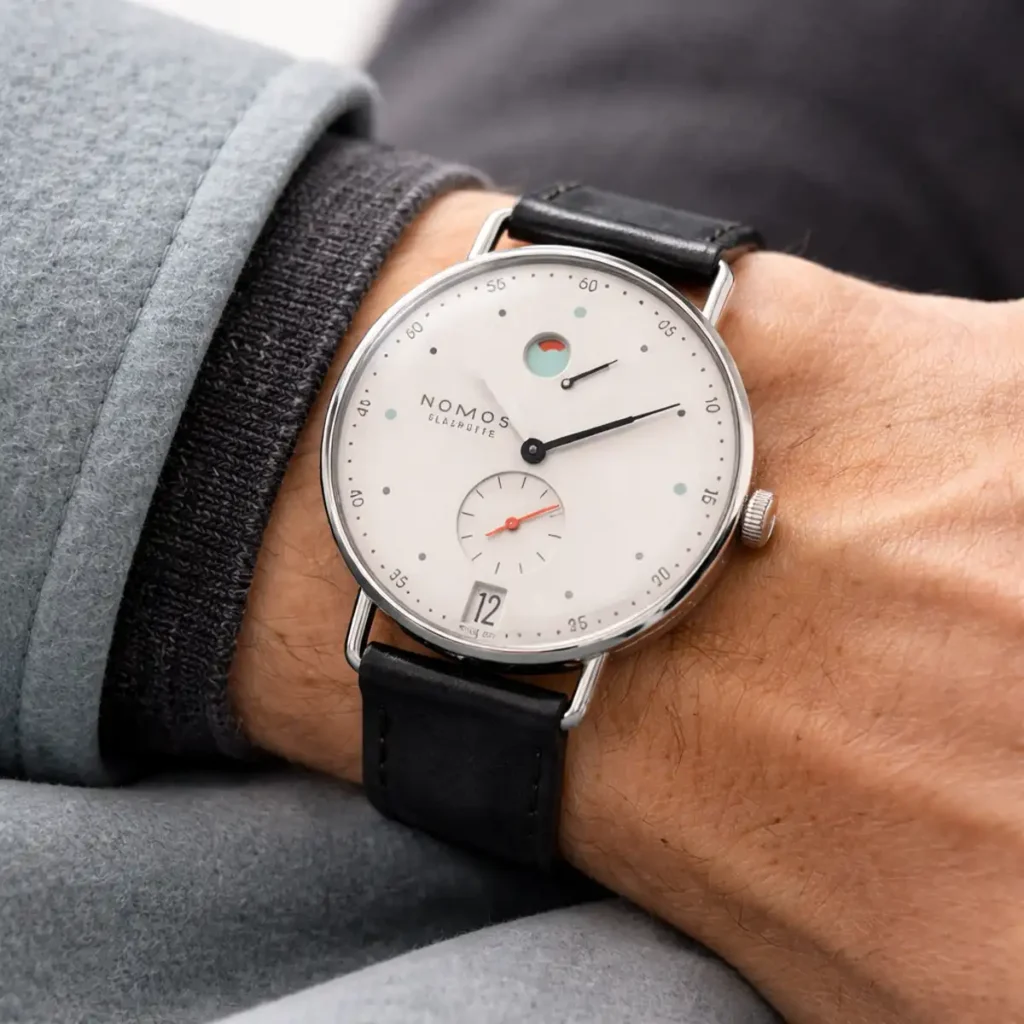
The DUW movement family was extended with the DUW 6101 in 2015, the movement behind the Nomos Lambda, which introduced the first Nomos grande date complication. The Lambda carries the GPHG Prize (Grand Prix d’Horlogerie de Genève) for the Ladies’ watch category in 2015, the award body’s recognition of the movement architecture and finishing standard at a brand not typically competing in the haute horlogerie segment.
The in-house escapement in the DUW family uses a lever design with Nomos-specified geometry rather than a licensed or standard Swiss lever. The hairspring, produced by Nomos subsidiary Nomatik in Glashütte, is a German-made component at a point in the supply chain where almost every other manufacturer, including many Swiss grands maisons, uses an externally supplied spring. This degree of vertical integration at Nomos’s price level is an objective manufacturing achievement.
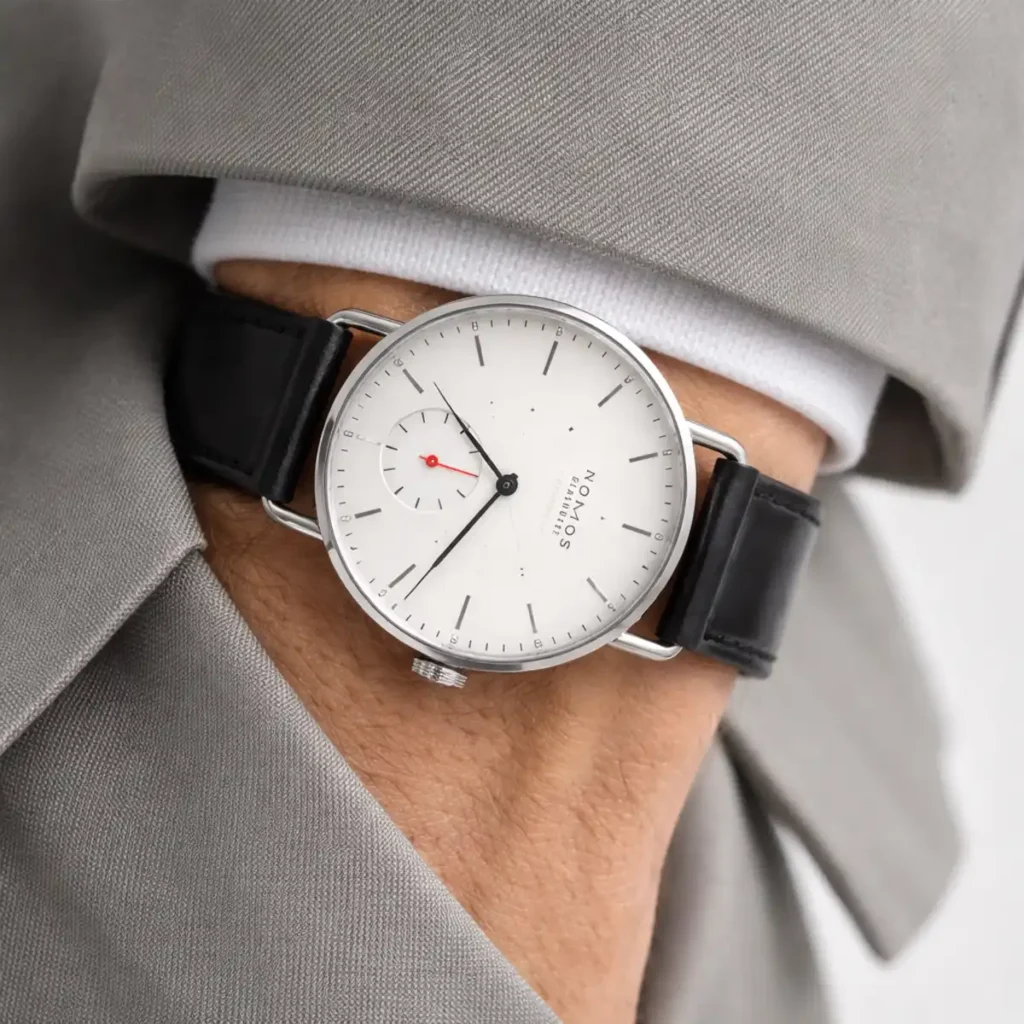
Fun fact: The Nomos Tangente, introduced at the brand’s commercial launch in 1992, takes its proportions directly from the Bauhaus design principles taught at the Dessau and Berlin Bauhaus schools: the dial typography was developed in reference to Herbert Bayer’s universal alphabet, which sought to eliminate superfluous letterform elements; the result is a watch that reads as modern even 30 years into production.
Where Nomos sits in the independent watchmaking movement
The independent watchmaking movement as a collector category encompasses manufacturers who design and produce watches outside the major Swiss conglomerate structures. The Swatch Group, Richemont, and LVMH, between them, account for the majority of Swiss watchmaking production by volume and value; independents operate outside these structures, typically with full manufacturing control and a specific design or technical programme.
Nomos is owned by the Würth Group, a German tools and fasteners conglomerate, making it corporate-owned but outside the Swiss luxury conglomerate axis. This ownership structure has provided capital stability without strategic alignment with a conglomerate product portfolio, and Nomos has retained its design independence and manufacturing location through this arrangement. It is not independent in the same sense as a sole-proprietor atelier like Kari Voutilainen or F.P. Journe, but it operates independently of the Swiss group structures that govern most production at this scale.
The natural buyer comparison at the Nomos price level is with Tudor, the Rolex-owned brand that offers Swiss manufacture at lower price points than Rolex. Tudor uses in-house movements in its current sport collection and carries the credibility of the Rolex supply chain. Nomos offers German manufacture, a more distinctive design programme, and a mechanical ideology that prioritises visible movement architecture over tool watch robustness. These are different propositions, and the buyer choosing between them is making a decision about what they value in a mechanical watch rather than a quality comparison.
The Tangente, Club, and Orion ranges in the UK market
Nomos offers its UK market through a network of authorised retailers and directly through its website. The Tangente 38 in stainless steel with the Alpha manual-wind calibre was available at approximately £1,390 at UK authorised retailers in early 2026. The Club Sport neomatik 42 date with DUW 6101 is listed at approximately £2,050. These are prices at which Swiss in-house manufacture, German finishing traditions, and original design language are available to buyers who would otherwise be evaluating the entry tier of the Omega catalogue.
UK secondary market pricing for Nomos watches shows modest discounts to retail for current-production examples, reflecting a collecting base that is engaged but smaller in depth than the Rolex or Omega secondary market. Limited editions and discontinued references in original condition with box and papers show better retention, but Nomos is not a brand whose secondary market performance is a primary purchasing consideration for most buyers.
Conclusion
Nomos Glashütte is the clearest example in contemporary watchmaking of a brand that has built genuine manufacturing credibility through a specific and documented programme rather than through heritage claims. The development of the Alpha, the DUW movement family, the in-house hairspring and escapement, and the peripheral rotor represent a progression from movement assembly toward full manufacture that most independent brands at this price tier have not achieved.
Its natural long-term buyer is someone with an interest in watchmaking as a mechanical discipline rather than as a status signal, who values German manufacturing transparency over Swiss brand prestige, and who wants a watch whose design has a clear intellectual basis. For a first mechanical watch at under £2,000, or a fifth watch for a collector building a range of movements and traditions, Nomos occupies a position that no other brand currently fills with the same combination of manufacture depth and pricing honesty. Buy from UK authorised retailers, and look at the movement through the display back before you decide on the dial.