In 1839, Antoine Norbert de Patek and François Czapek established a watchmaking partnership in Geneva. Seven years later, Patek dissolved the partnership and entered a new agreement with the Alsatian watchmaker Adrien Philippe, whose invention of the keyless winding mechanism would become the company’s first defining technical contribution. Patek Philippe was registered as a company in 1851. The enterprise has operated as a family-owned independent manufacturer since 1932, when the Stern family, owners of a dial-making company that had supplied Patek since 1906, acquired the watchmaker and prevented its sale to a third-party buyer. This ownership structure, unchanged for nearly a century, is fundamental to understanding how Patek Philippe functions and why it occupies its position in the watch market.
This is not a brand profile written around the secondary market premiums that Patek Philippe references. Those premiums are a consequence of what the brand is, not the definition of it. The manufacture in Plan-les-Ouates, Geneva, where all Patek Philippe movement production and final assembly takes place, is a more interesting subject than the auction prices, and it is the subject that most retail platform coverage fails to address with appropriate depth.
The Stern family ownership and what independent manufacture means
Family ownership of a watch manufacturer in 2025 is unusual. At Patek Philippe, it means a strategic horizon measured in decades rather than quarters, a resistance to the volume-growth pressures that conglomerate ownership creates, and a willingness to invest in manufacturing capabilities whose return on investment operates over generations rather than financial cycles. When Thierry Stern, the current President, states that Patek Philippe produces fewer watches than the demand for them would justify, this is not primarily a marketing position; it reflects a genuine decision not to expand production capacity beyond what the atelier model can support at its current standard.
The company became fully independent of Swatch Group, Richemont, LVMH, and all other major holding structures when the Stern family acquisition was completed in 1932. It has remained so. The contrast with the ownership structure of Rolex (a private trust), Audemars Piguet (family partnership), and most other mid-tier and lower-tier Swiss brands (Swatch Group or Richemont subsidiary) is one of independence in the governance sense rather than the capital sense; Patek Philippe is neither publicly traded nor reporting to a conglomerate board.
Plan-les-Ouates and the Geneva manufacture
The Patek Philippe manufacture is located in Plan-les-Ouates, a municipality in the Canton of Geneva, approximately 5 kilometres south-west of the city centre. The site is the consolidation of activities that were previously distributed across Geneva, completed with the construction of the current manufacturing complex designed by architect Nunzio Turriccia and opened in 2005. The manufacture encompasses movement production, case and bracelet manufacture, dial production, gem-setting, enamelling, engraving, and final assembly.
The vertical integration of production within a single facility is a distinguishing characteristic. Most watch manufacturers at Patek Philippe’s tier — including directly comparable firms like Audemars Piguet and A. Lange and Söhne — outsource components from the network of specialist suppliers that constitutes the Swiss watch industry supply chain. Patek Philippe produces a higher proportion of its components in-house than most of its direct competitors, including the ébauche, escapement, balance wheel, and dial. The hairspring is not produced in-house; Nivarox, a Swatch Group subsidiary and the dominant global supplier of hairsprings, supplies Patek Philippe as it does most Swiss manufacturers.
The Patek Philippe Seal and what it requires
The Patek Philippe Seal was introduced in 2009 when the brand withdrew from the Geneva Seal certification programme and replaced it with a proprietary standard administered internally. The Geneva Seal (Poinçon de Genève) required, among other criteria, that movements be assembled and tested within the Canton of Geneva. Patek Philippe’s position was that its internal standards exceeded what the Geneva Seal required, and that administering the certification itself provided more consistent application of those standards.
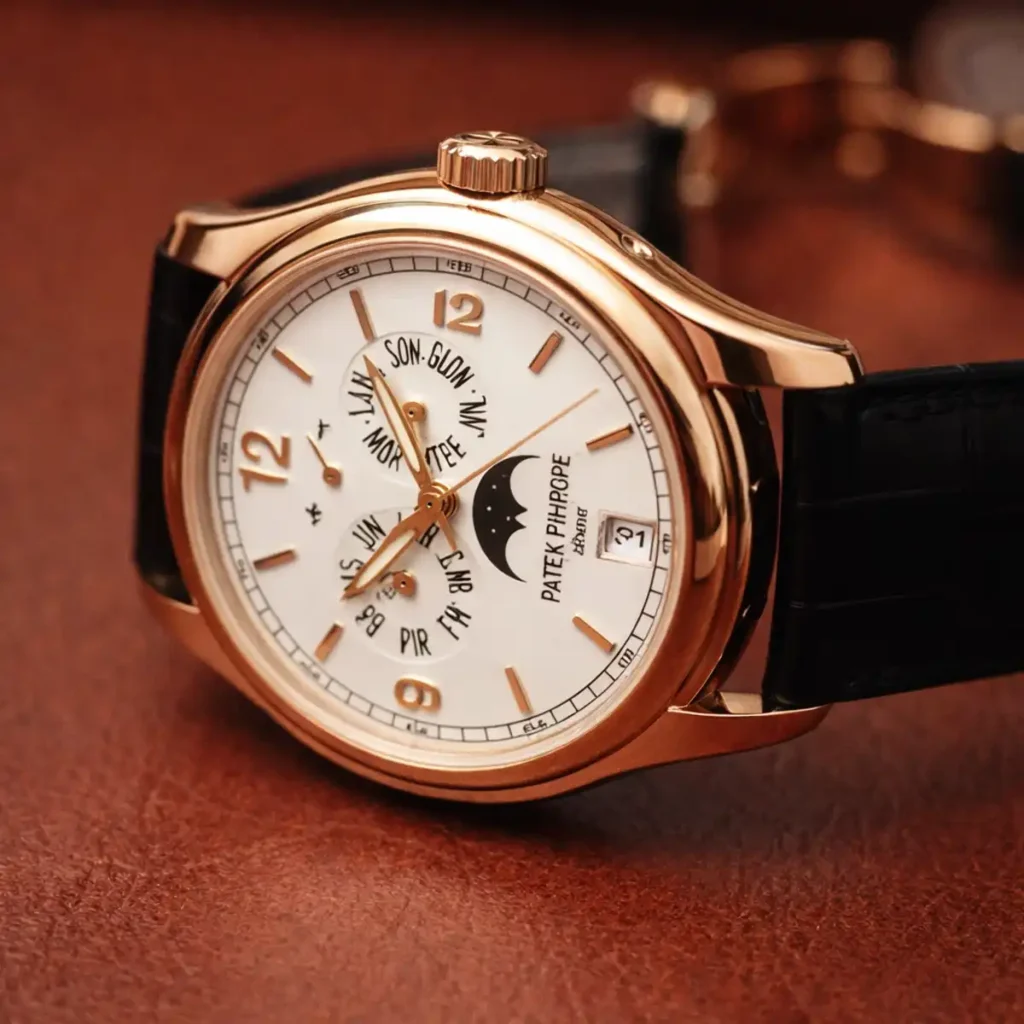
The Patek Philippe Seal applies to both the movement and the assembled watch. Movement criteria include Côtes de Genève stripes on visible components, perlage on hidden surfaces, anglage on all visible component edges, black polished surfaces on steel components where specified, and movement rate within +3/-2 seconds per day. Assembled watch criteria include date mechanism function, power reserve performance, water resistance, and the torque required to open and close the crown within specified limits. The Seal applies to every Patek Philippe watch produced; there is no sub-standard tier.
The Calibre CH 29-535 PS and the grand complications programme
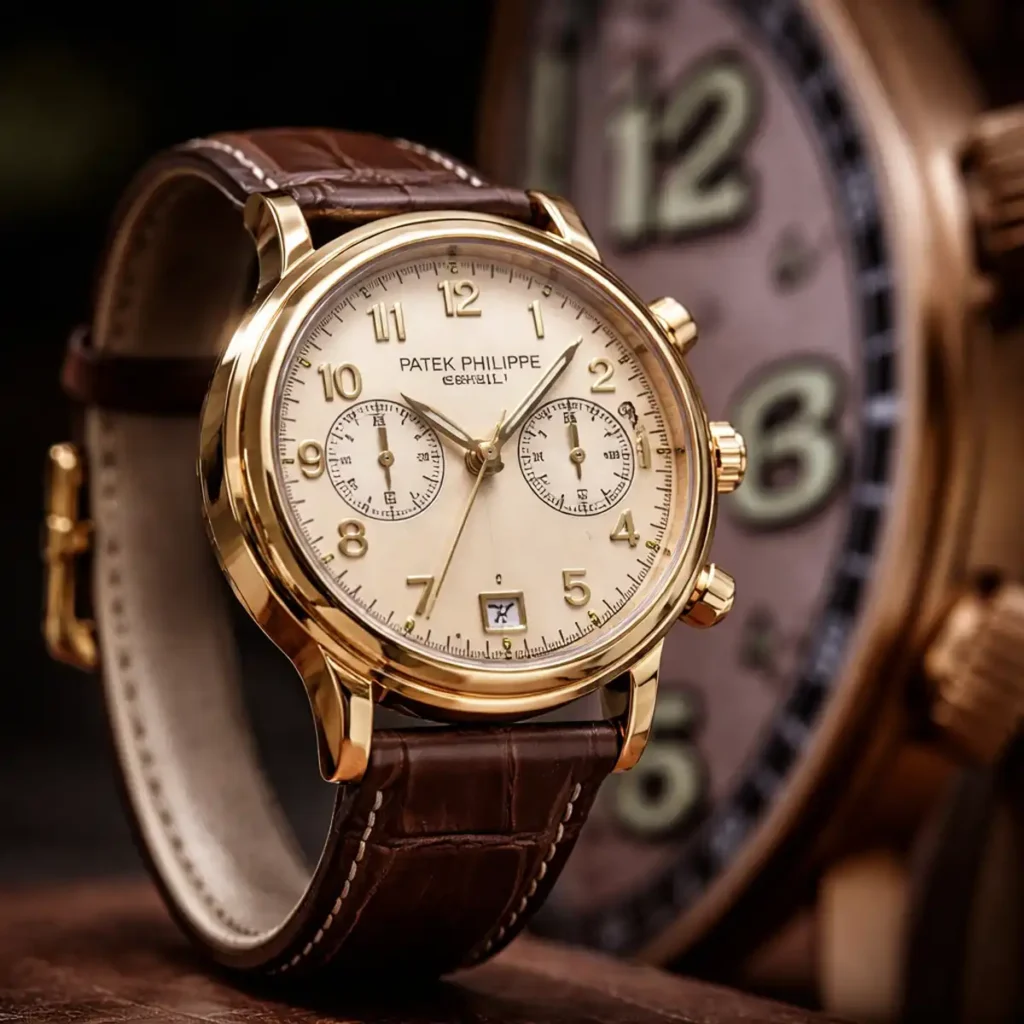
The manufacture programme at Plan-les-Ouates encompasses movements from simple three-hand calibres to the most complex mechanical watches in production. The Calibre CH 29-535 PS, the in-house chronograph movement introduced in 2009 for the Ref. 5170 and subsequently used in multiple chronograph references, represents the brand’s most significant original chronograph movement development of the modern era. It uses a column wheel and a lateral clutch mechanism operating horizontally rather than the vertically-acting clutch of most column wheel designs, which provides more precise engagement and disengagement of the chronograph seconds hand.
The column wheel design was historically associated with higher-quality chronograph mechanisms, and Patek Philippe’s application of it in the CH 29-535 PS placed it in explicit contrast with the simplified cam-actuated designs used across much of the industry at lower cost. The Calibre 324 S C, the brand’s primary automatic three-hand movement, also carries the Patek Philippe Seal finishing standard; it is worth inspecting through a display back on any reference that uses it, because the finishing consistency is visible and represents a significant part of what a Patek Philippe watch is actually delivering at the component level.
Fun fact: Patek Philippe holds more than 100 patents, including the invention of the keyless winding mechanism by Adrien Philippe in 1842; the perpetual calendar with jumping digital date display, introduced in 1985 as reference 3940; and the gyromax balance wheel, developed in 1951, which allows rate adjustment through repositioning peripheral weights on the rim rather than using a traditional regulator index.
The Calatrava and Nautilus as case studies in brand positioning
The Calatrava, introduced in 1932 in the first year of Stern family ownership, established the Patek Philippe design vocabulary for dress watches: a round case, a clean dial, and an absence of ornamentation beyond what legibility requires. It referenced the Bauhaus design principles of the period and produced a design language that has remained coherent across the subsequent 90 years of production. Current Calatrava references, including the reference 5196 in white gold, are produced to a design language whose typographic and case geometry principles are continuous with the 1932 original.
The Nautilus, introduced in 1976 and designed by Gerald Genta, was a deliberate departure: a steel sports watch priced above the gold dress watches that constituted the prestige tier of the market at the time. The pricing decision was explicit and controversial at launch. The Nautilus has since become the watch most associated with Patek Philippe in secondary market terms; its discontinuation in the reference 5711/1A form in 2021 produced secondary market responses that are documented elsewhere in this publication.
The Grand Complications division produces the most technically demanding watches in the catalogue: minute repeaters, perpetual calendars, split-second chronographs, and combination pieces. The Calibre R 27 PS, the movement in the Ref. 5104 minute repeater tourbillon, is produced in numbers so limited that the waiting time for a new example from an authorised dealer is measured in years. These watches exist primarily as demonstrations of manufacturing capability and as the context within which the more accessible references sit.
Patek Philippe, in the context of the independent watchmaker movement
Patek Philippe is independent in the ownership and governance sense, but is not independent in the workshop scale associated with the independent watchmaker movement. Makers like Kari Voutilainen, operating from Môtiers in the Val-de-Travers, produce fewer than 60 watches annually and represent a different category of manufacture: the individual artisan rather than the institutional manufacture. Both categories make high-quality watches; they make them at different scales, with different quality control structures, and for different segments of the collector market.
Where Patek Philippe sits uniquely is at the intersection of manufacture scale (large enough to support a full grand complications programme and the infrastructure of Plan-les-Ouates) and manufacture ethos (genuinely independent, finishing-focused, quality-constrained by design rather than by market pressure). No other watchmaker occupies exactly this position.
Conclusion
Patek Philippe’s manufacturing position is the result of specific historical choices — the Stern family acquisition, the construction of the Plan-les-Ouates facility, the development of the proprietary Seal, and the decision to produce fewer watches than demand would justify — that have compounded over decades into a coherent institutional identity. The watches produced within this framework carry that identity in every component, including the ones visible only through a loupe.
For UK buyers approaching Patek Philippe for the first time, the recommended entry points are the Calatrava reference 5196 in white gold for a dress watch context, and the Aquanaut reference 5167A for a steel sport watch with current production availability. Both are produced to the full Patek Philippe Seal standard. Both carry the Calibre 324 S C automatic movement. Both will illustrate what Plan-les-Ouates actually produces at the level where collector interest and accessible ownership meet. Buy from a UK authorised dealer; secondhand purchases at this level require specialist authentication and a degree of provenance scrutiny that the authorised dealer network removes entirely.