In a small Saxon town that has been making watches since 1845, a relatively young brand is producing movements that require the kind of patient, skilled hand-finishing that most Swiss manufacturers abandoned decades ago. Nomos Glashütte was founded in 1990, the year after the Berlin Wall came down, in a region that had spent 40 years of communist rule manufacturing watches under centralised industrial conditions that stripped the craft from the process. Its founding was a deliberate act of horological restoration.
Understanding what Nomos Glashütte watches actually are — and whether they are worth buying for a UK collector in 2026 — requires understanding where they come from, what their movements contain, and what their pricing philosophy represents. This is not a watch brand you evaluate from a specification sheet alone.
Glashütte: The Geography of German Watchmaking
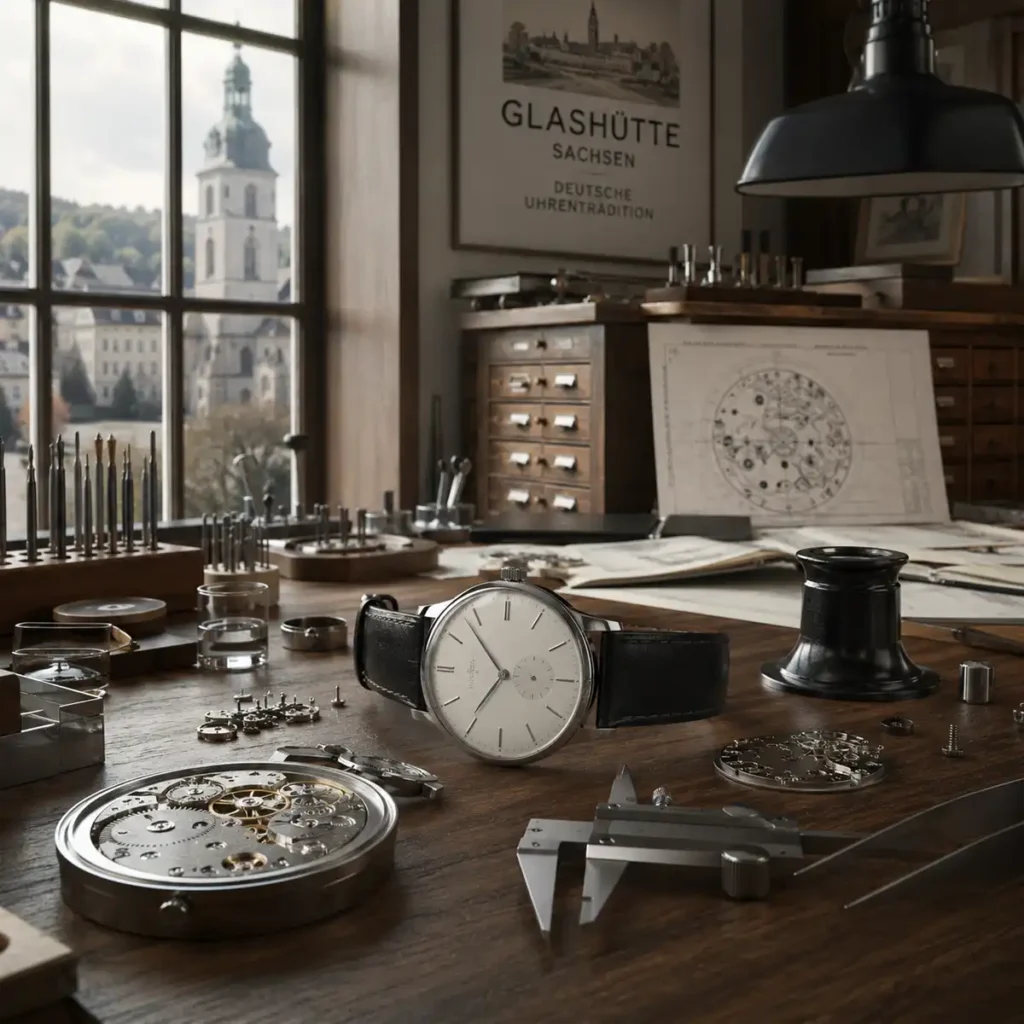
Glashütte sits in the Müglitz valley in Saxony, approximately 30 kilometres south of Dresden. The town’s watchmaking history began when the Saxon government sponsored the watchmaker Ferdinand Adolph Lange to establish a training school there in 1845, recognising that skilled watchmaking could provide economic relief to a region suffering after the 1848 revolution. The school produced trained watchmakers; the trained watchmakers established workshops; and by the end of the 19th century, Glashütte had become the centre of German fine watchmaking.
The manufacturers that survived the 20th century in Glashütte — including A. Lange & Söhne, Glashütte Original, and now Nomos — all carry that lineage. Nomos is the youngest of the significant Glashütte houses, founded by Roland Schwertner with a design philosophy shaped by the Bauhaus aesthetic and a manufacturing commitment that required building an in-house movement programme from near zero.
The watch industry association Chronometrage Glashütte defines criteria for watches to carry the Glashütte designation: at least 50% of the movement’s value must be created in Glashütte. Nomos satisfies this criterion through its in-house calibre manufacture and movement finishing operations.
The In-House Calibres: Alpha, Epsilon, Lambda, and DUW
Nomos produces its movements across four calibre families, distinguished by winding system and complication level.
The Alpha is Nomos’s manual-wind base calibre, used in the Club, Orion, and Tangente lines. It beats at 21,600 vph — a low beat rate by modern standards, but one that Nomos argues is appropriate for the movement’s finishing level and service interval. The Alpha offers approximately 43 hours of power reserve and features Nomos’s swing system, a modified lever escapement that requires no lubrication on the lever itself, extending the service interval compared to a standard Swiss lever escapement.
The Epsilon is the automatic equivalent of the Alpha, featuring a peripheral rotor system — the winding rotor sits around the outside of the movement rather than centrally, allowing the movement architecture to remain visible and the overall calibre thickness to be reduced. This is a technically elegant solution to the automatic movement’s inherent thickness problem.
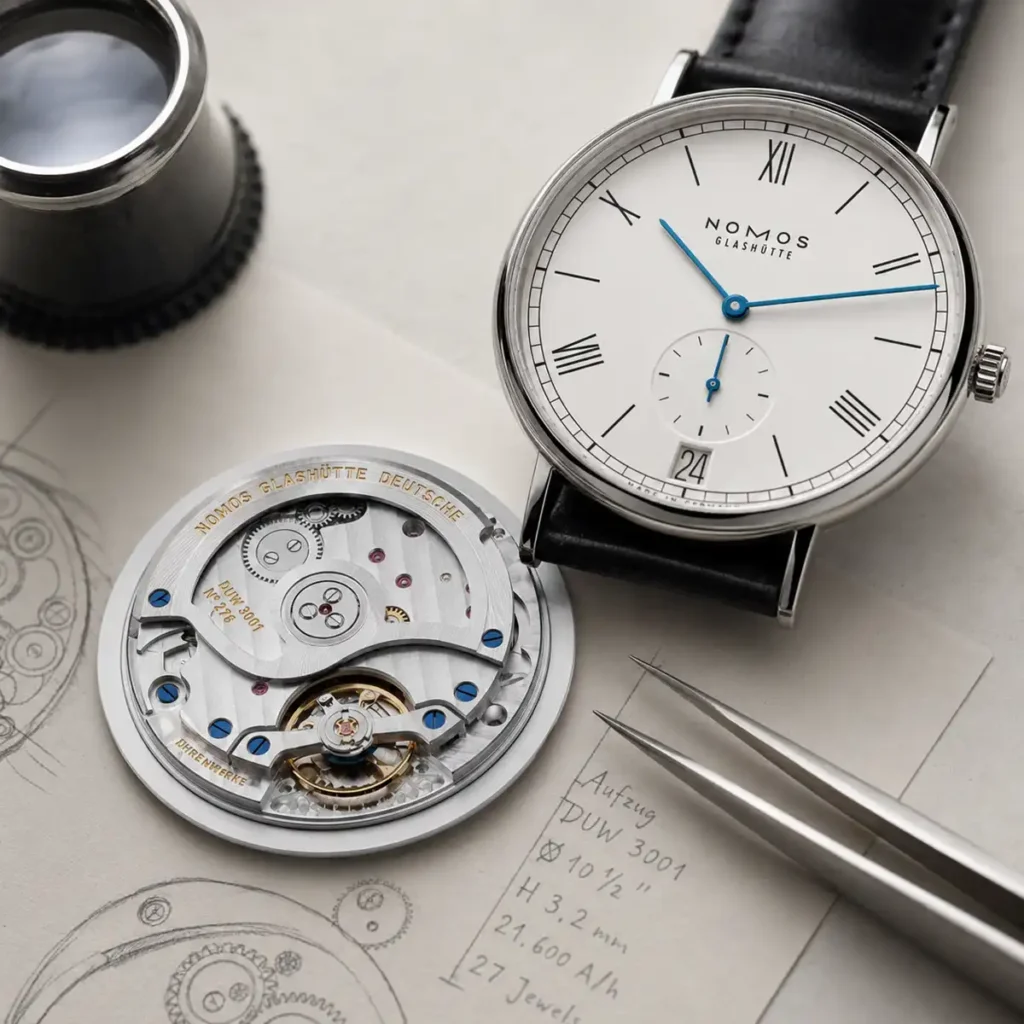
The Lambda and DUW (Deutsche Uhrenwerke) designations cover Nomos’s higher-complication and more recent manufacture calibres, including the DUW 3001 used in the Neomatik range, which offers a 42-hour power reserve with the peripheral rotor and a total movement thickness of 3.2mm. The DUW 5001 powers the Zurich World Time, displaying 24 time zones simultaneously.
None of these calibres carries COSC chronometer certification. Nomos does not submit its movements for COSC testing by policy rather than by inability to pass — the brand’s position is that its own quality control and the swing system’s measured accuracy performance provide equivalent assurance. Independent testing by watch journalists has generally found Nomos calibres to perform well within COSC tolerances; the absence of the certification is a commercial and philosophical choice, not a technical limitation.
The Design Language: Why It Matters to the Value Proposition
Nomos’s visual identity is the clearest expression of the Bauhaus design principles in contemporary watchmaking. The Tangente — the brand’s most recognised collection — features a dial architecture of extraordinary restraint: a sub-seconds dial at 6 o’clock, dauphine hands, printed Arabic numerals, and nothing else. The movement of the eye across the dial is controlled precisely: the hierarchy of information is unambiguous at a glance.
The Orion expresses a similar philosophy in a round case format; the Metro applies it to a larger, more contemporary case with a date function. The Club is the accessible entry point, with a higher case height and a more utilitarian character that sits comfortably as an everyday instrument.
The design work is executed by a small in-house team and overseen by Judith Borowski, who succeeded Susanne Görlich as creative director. The consistency of the visual language across the range is unusual for a brand that covers entry-level to world-time complications; the Tangente at £1,650 and the Zurich World Time at over £3,000 are recognisably the product of the same design intelligence.
Fun fact: Nomos was founded on the day the Treuhandanstalt — the agency managing the privatisation of East German state assets — became operational, in March 1990. Its founding is literally contemporaneous with the economic transformation of post-communist Saxony.
Case, Dial, and Wearing Experience
The Tangente 38 measures 38mm with a case height of 6.6mm — among the thinnest automatic-compatible profiles at any price point. It wears with a legibility and visual presence entirely disproportionate to its measurements; the combination of the recessed sub-seconds dial and the dauphine hand geometry creates a sense of spatial depth that flat photography rarely captures.
The dial printing is executed at a standard that requires examination under magnification to fully appreciate. Text edges are precise; the Arabic numerals maintain their weight and geometry in a way that cheaper printing processes cannot sustain. The mineral crystal is flat and uncoated in the standard configuration; sapphire crystal is available as an option on some references and standard on the higher Neomatik line.
The cases are produced in 316L stainless steel with a combination of satin-brushed and polished finishing. The bracelet option — introduced relatively recently — is an integrated design that suits the Orion and Club particularly well; the standard presentation on a leather strap remains the most elegant configuration for the Tangente and Metro.
Water resistance on most Nomos references is 30m — adequate for handwashing and brief water exposure, but not for swimming or diving. This is a design constraint accepted in exchange for the case thickness; the two criteria are in direct physical tension, and Nomos has consistently chosen thinness.
The UK Market Position and What It Competes With
In the UK, Nomos retails through a limited authorised dealer network. It is not stocked by Watches of Switzerland, Watchfinder, or most national chains. The brand sells through independent specialist retailers and directly through its own website — a distribution model that maintains pricing discipline and prevents the grey market premium cycle that affects allocated sports watches.
At approximately £1,650 for an entry Tangente with manual-wind Alpha calibre, Nomos sits below the £2,000 to £3,000 band where Tudor, Longines, and the lower Hamilton and Tissot references operate with in-house or high-specification sourced calibres. The comparison is not straightforward: the Tangente is a dress watch in a way that the Black Bay 58 is not; they serve different wearing occasions.
The more useful comparison for the Tangente buyer is: Junghans Max Bill (German design heritage, Sellita base calibre, approximately £700); Tissot PRX Powermatic 80 (Swiss manufacture, integrated bracelet, approximately £595); or a Longines Master Collection reference (COSC-certified, in-house ETA derivatives, approximately £1,200 to £1,800). Against all three, the Nomos earns its premium through in-house movement architecture, superior dial printing quality, and a design philosophy that is genuinely coherent rather than brand-heritage derivative.
Practical Ownership: Servicing, Warranty, and Resale
Nomos offers a two-year manufacturer’s warranty on new watches purchased through authorised dealers. Servicing is available through the brand’s authorised UK service network and through the Nomos service centre in Glashütte; the brand publishes recommended service intervals of approximately 5 to 8 years, depending on wear conditions, which is shorter than the 10-year recommendation from Rolex or Omega. The swing system’s extended lever lubrication interval partially offsets this.
Independent watchmakers can service Nomos calibres; movement parts are available through appropriate channels, though less widely distributed than ETA or Sellita components.
On resale, Nomos watches typically trade at 70% to 85% of retail on the UK secondary market — a modest depreciation profile consistent with the brand’s stable pricing and absence from grey market allocation dynamics. The brand does not appreciate in the Rolex sense; it holds value respectably in the Longines or Omega sense.
Is It Worth Buying in 2026
For a buyer who wants a watch with genuine manufacture calibre depth, a design philosophy executed with uncommon consistency, and a price that reflects the horological content rather than a brand premium built on waitlist dynamics — the answer is yes.
The Nomos Tangente or Orion Neomatik is the intelligent first dress watch for a buyer who has done the reading and wants something that rewards continued attention. It is not the right choice for a buyer primarily motivated by secondary market resale. It is the right choice for a buyer who will wear it daily, appreciate its mechanical character at close range, and return to it in 15 years with the same satisfaction.
That is what a watch is for.