The problem a mechanical watch solves is deceptively simple: how do you release stored energy at a precisely controlled rate, slow enough to be measured, consistent enough to be trusted? Every component in a mechanical movement exists to answer that question. Understanding the answer makes you a more literate buyer, a more informed collector, and someone who can read a specification sheet rather than simply accept it.
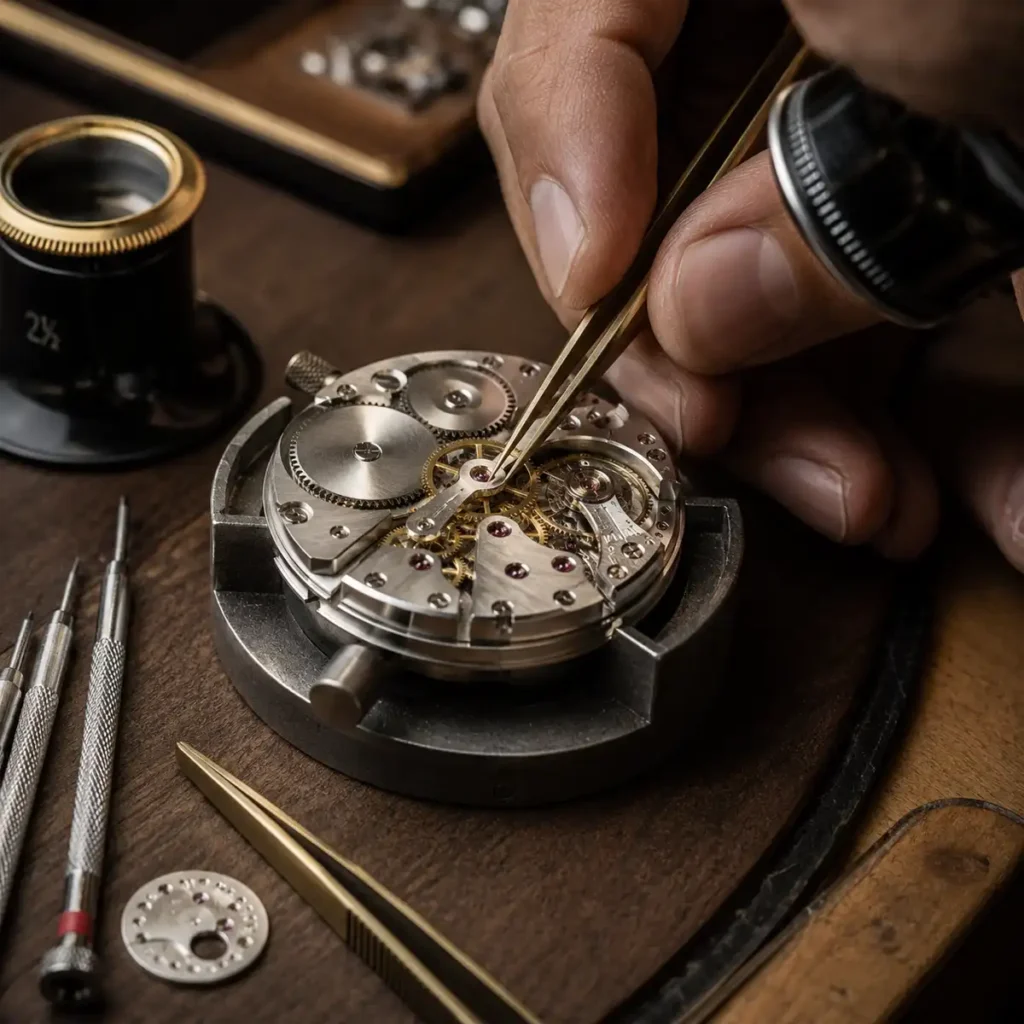
How a mechanical watch movement works is the foundational question in horology. Everything else — calibre numbers, complications, COSC certification, finishing grades — only means something once you understand the engine those things describe. This article builds the complete picture from the mainspring to the dial, using correct terminology throughout.
The Power Source: Mainspring and Barrel
A mechanical watch runs on a coiled steel spring called the mainspring, housed inside a cylindrical component called the barrel. When you wind the watch — either manually by turning the crown, or automatically through a rotor — you tighten the mainspring around a central arbour inside the barrel.
The energy stored in a fully wound mainspring is the entire motive force of the watch. It is released gradually as the spring uncoils, turning the barrel. This is not instantaneous: a modern mainspring in a quality Swiss calibre releases its energy over 40 to 80 hours, depending on the calibre’s design, which is why the power reserve figure in a specification sheet matters. A 48-hour power reserve means the mainspring goes from fully wound to stopped in 48 hours of continuous running.
The barrel drives the gear train. This is where the energy travels next.
The Gear Train: Transmitting Energy to the Escapement
The gear train is a sequence of interlocking wheels and pinions — each one turning faster than the last — that transmits energy from the barrel to the escapement. In a standard Swiss lever movement, the gear train typically comprises the centre wheel, third wheel, fourth wheel, and escape wheel. The fourth wheel often drives the seconds hand directly, which is why it completes one rotation per minute.
The purpose of the gear train is not simply to transmit energy. It is to step up the rotation speed from the slow, high-torque rotation of the barrel to the rapid, precise oscillations required by the escapement. Each stage in the gear train increases rotational speed while reducing torque.
The precision of the gear train’s manufacture — the exactness of tooth profiles, the quality of jewelled bearings at friction points — directly affects energy transmission efficiency and ultimately the movement’s accuracy and longevity. This is one reason why higher-grade calibres specify jewel count: jewels (synthetic rubies) replace metal bearings at high-wear pivot points, reducing friction and wear over decades of use.
The Escapement: The Heart of the Movement
The escapement is the mechanism that does two things simultaneously: it releases the gear train’s energy in controlled increments, and it receives impulses from the balance wheel that regulate the release rate. Without an escapement, the mainspring would unwind in seconds. With one, it unwinds in hours.
The Swiss lever escapement — the dominant design in mechanical watchmaking since the 18th century — consists of 3 primary components: the escape wheel, the pallet fork, and the impulse roller on the balance staff. The escape wheel’s teeth are locked and released alternately by the pallet fork’s entry and exit stones. Each locking and releasing event is called a tick; each tick represents a precisely controlled transfer of energy from the gear train to the balance wheel.
The characteristic ticking sound of a mechanical watch is the escapement operating: the escape wheel advancing one tooth at a time under the regulation of the pallet fork.
Alternative escapement designs exist and matter at the higher end of the market. The co-axial escapement, developed by George Daniels and adopted by Omega beginning in 1999, uses a 3-level impulse system that reduces sliding friction between components, extending the interval between services and improving long-term accuracy. Breguet’s natural escapement and Seiko’s Spring Drive — which uses an electromagnetic brake rather than a mechanical escapement — represent further departures from the Swiss lever standard.
Fun fact: The Swiss lever escapement was invented by Thomas Mudge, a British watchmaker, around 1755 — and yet Switzerland, not Britain, became the dominant global watchmaking power. The escapement’s adoption by Swiss manufacturers was so thorough that it is now named after its country of widespread manufacture, not its country of invention.
The Balance Wheel: The Regulating Organ
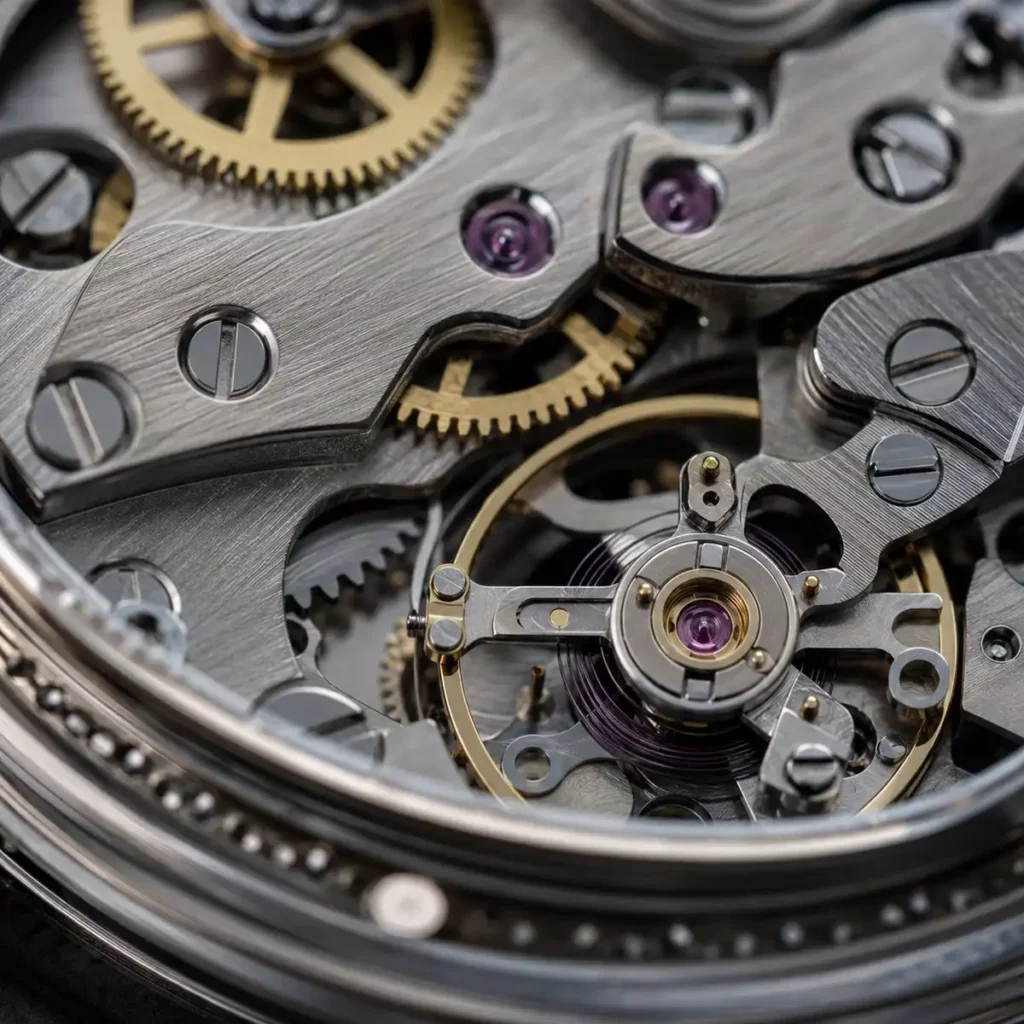
The balance wheel is the movement’s oscillating regulator — the component that divides time into equal parts. It swings back and forth on its staff, controlled by the tension of a hairspring (also called a spiral spring or balance spring). Each complete oscillation — one swing in each direction — represents a fixed unit of time.
The frequency of the balance wheel is expressed in vibrations per hour (vph) or Hertz. A movement beating at 28,800 vph completes 28,800 individual swings per hour, or 4 per second. This corresponds to 4 Hz. A movement beating at 36,000 vph (5 Hz) is a high-beat calibre; the Zenith El Primero chronograph calibre beats at 36,000 vph, which is one reason it can measure time to 1/10th of a second in its chronograph function.
Higher beat rates generally improve accuracy under the influence of movement and positional error, but consume more energy and require more frequent servicing. Lower beat rates are gentler on components but more susceptible to positional variation.
The material of the hairspring matters significantly to performance. Traditional steel hairsprings are affected by magnetic fields and temperature variation. Nivarox alloy hairsprings — the industry standard since the mid-20th century — improve temperature stability. Rolex’s Parachrom hairspring uses a proprietary nickel-phosphorus alloy manufactured in-house. Silicon hairsprings, used by Patek Philippe, Breguet, Omega, and others, are non-magnetic, require no lubrication, and show minimal temperature sensitivity — they represent the current state of the art in hairspring technology.
The Rotor: How Automatic Movements Wind Themselves
An automatic movement adds one component to the manual-wind architecture described above: a rotor, also called an oscillating weight. The rotor is a semicircular mass mounted on a bearing above the movement, free to rotate 360 degrees in either direction as the wearer moves their wrist. Its rotation winds the mainspring through a series of reversing gears that convert bidirectional rotation into unidirectional winding.
The trade-off is physical: an automatic rotor adds thickness to the movement. Ultra-thin automatic movements — Piaget’s Calibre 508P at 2.35mm total thickness, for instance — require considerable engineering to integrate a rotor without compromising the case profile.
A manual-wind movement omits the rotor entirely, reducing thickness and allowing direct mechanical connection between the crown and mainspring. Many collectors prefer manual-wind calibres in dress watches for this reason.
What This Means for Ownership Decisions
Understanding the movement architecture has direct implications for how you buy and maintain a watch.
Servicing: A mechanical watch movement contains oils applied to pivot points and escapement components during assembly. These oils degrade over time — typically 8 to 12 years, depending on the calibre and conditions of wear. When the oils dry or migrate, friction increases, accuracy degrades, and wear accelerates. A service involves complete disassembly, cleaning, inspection, replacement of worn components, reassembly, and regulation. Knowing which components are serviceable — and how a particular calibre’s escapement design affects service interval — lets you ask informed questions before purchase.
Frequency and accuracy: A calibre’s beat rate tells you something about its design philosophy. A 21,600 vph movement is likely a vintage or cost-sensitive design. A 28,800 vph calibre is the modern standard. A 36,000 vph calibre prioritises chronographic precision over service interval. None of these is inherently superior; each represents a different engineering trade-off.
Complications: Every complication — a date, a GMT function, a chronograph, a perpetual calendar — adds components to the basic timekeeping architecture described here. Understanding the base movement makes complicated architecture more legible. A chronograph adds a second gear train activated by a pusher; a perpetual calendar adds a cam-and-lever system that reads the 48-month cycle of the Gregorian calendar. The complexity of each complication is meaningful only against an understanding of the base movement it builds on.
A mechanical watch is a miniature engine, built from hundreds of components, powered by a wound spring, and regulated by an oscillating wheel. Its endurance — measured in decades rather than years, provided it is serviced — is a direct product of the engineering principles described above. The more clearly you understand those principles, the more honestly you can evaluate what you are being asked to pay for.