The most consequential component in any mechanical watch is the one most buyer never look at. Beneath the dial, the industry divides into 2 camps: brands that design and manufacture their own calibres, and brands that buy proven movements from specialist suppliers, above all ETA of Grenchen, owned by the Swatch Group, and the independent Sellita of La Chaux-de-Fonds. Understanding in-house watch movements against their sourced rivals is the single most useful piece of technical literacy a UK buyer can acquire, because it explains price gaps that otherwise look arbitrary and exposes marketing claims that deserve scrutiny.
This is a question of transparency rather than judgement. A sourced calibre is not a lesser calibre, and an in-house one is not automatically finer. Each represents a different answer to a manufacturing question the Swiss industry has been arguing about for a century, and each serves a different kind of owner well. What matters is knowing which answer you are paying for.
What In-House Watch Movements Actually Mean
In-house watch movements are calibres designed, manufactured and assembled by the brand whose name is on the dial, rather than bought from an external supplier. The term covers a spectrum. At one end sit true manufactures building nearly every component themselves; at the other, brands that design a movement but contract much of its production out.
The honest version of the definition acknowledges that spectrum openly. Rolex's Calibre 3235 and the movements Nomos builds in Glashütte sit firmly at the manufacture end. Elsewhere, group calibres are shared between sister brands under common ownership, and some movements marketed with manufacture language began life as heavily reworked external designs.
Tissot's Powermatic 80 is the instructive case. Built on an upgraded ETA 2824-2 base within the same Swatch Group that owns both companies, it is simultaneously a sourced movement and a family one, and it outperforms plenty of calibres marketed with grander words. None of this is scandalous. It simply rewards buyers who ask 1 precise question: who actually designed and built the calibre in this watch?
How ETA and Sellita Came to Power the Industry
For most of the 20th century the Swiss industry ran on a division of labour. Specialist movement makers supplied calibres in enormous volume, and the brands cased, finished and sold them; the system survived because it worked. ETA consolidated that supplying role inside what became the Swatch Group, and its workhorses, the 2824-2 automatic and the Valjoux 7750 chronograph, became the invisible engines of Swiss watchmaking at nearly every price.
The modern chapter began when key ETA patents expired and the group moved, under the supervision of Swiss competition authorities, to wind down its supply to outside brands. Sellita, which had spent decades assembling movements for ETA, stepped into the gap with its own versions, and the SW200-1 became the industry's new default.
The restriction had a second effect that is still playing out. Brands in the £1,000 to £2,000 bracket, no longer guaranteed ETA supply, began commissioning and developing movements of their own, and the sector has been mechanically livelier for it. Raymond Weil's recent Sellita-partnered calibre, with its balance wheel framed in a window at 6 o'clock, is a 2026 example of a supplier relationship producing something neither party would have built alone.
Nor is the supplier story purely Swiss. Japan's Miyota, whose 9015 automatic powers a large share of the microbrand world, gives smaller houses a reliable engine at a price Switzerland cannot match, and honest brands say so on the specification sheet. The supplier ecosystem, Swiss and Japanese together, is the reason a £700 watch can now run for days on a wind and keep chronometer-adjacent time.
Fun fact: Roughly 3% of Swiss watch movements produced each year receive COSC chronometer certification, and both sourced and in-house calibres appear on the certified list.
When an In-House Calibre Is Worth Paying For
The genuine advantages of in-house work are specific rather than general. Integration is one: a brand controlling its own calibre can shape case thinness, power reserve and complication layout around a single design intent, which is how Nomos keeps its watches so slim and how the great houses build complications no supplier catalogue offers. Identity is another. A Nomos with its own Glashütte-built movement is coherent in a way the same watch with a bought-in engine would not be, and part of what its owner pays for is precisely that coherence.
Exclusivity carries real weight at the top of the market, where a manufacture calibre is table stakes rather than a talking point. And the 2026 releases show the philosophy spreading downwards: Tudor's revived Monarch arrived at Watches and Wonders this year on a modern in-house automatic calibre, and TAG Heuer's Monaco Evergraph introduced the brand's Calibre TH80-00 with a rethought chronograph mechanism. Movement independence has become a strategic race, not a boutique indulgence.
What in-house status does not reliably buy is accuracy. Chronometer performance is a certification question, not an origin question; a Sellita-equipped watch tested to COSC's minus 4 to plus 6 seconds per day tolerance is certified to exactly the same standard as an in-house calibre carrying the same certificate. Our [INTERNAL LINK: COSC certification explained | COSC certification and what it requires] covers how that testing works.
When ETA and Sellita Serve You Better
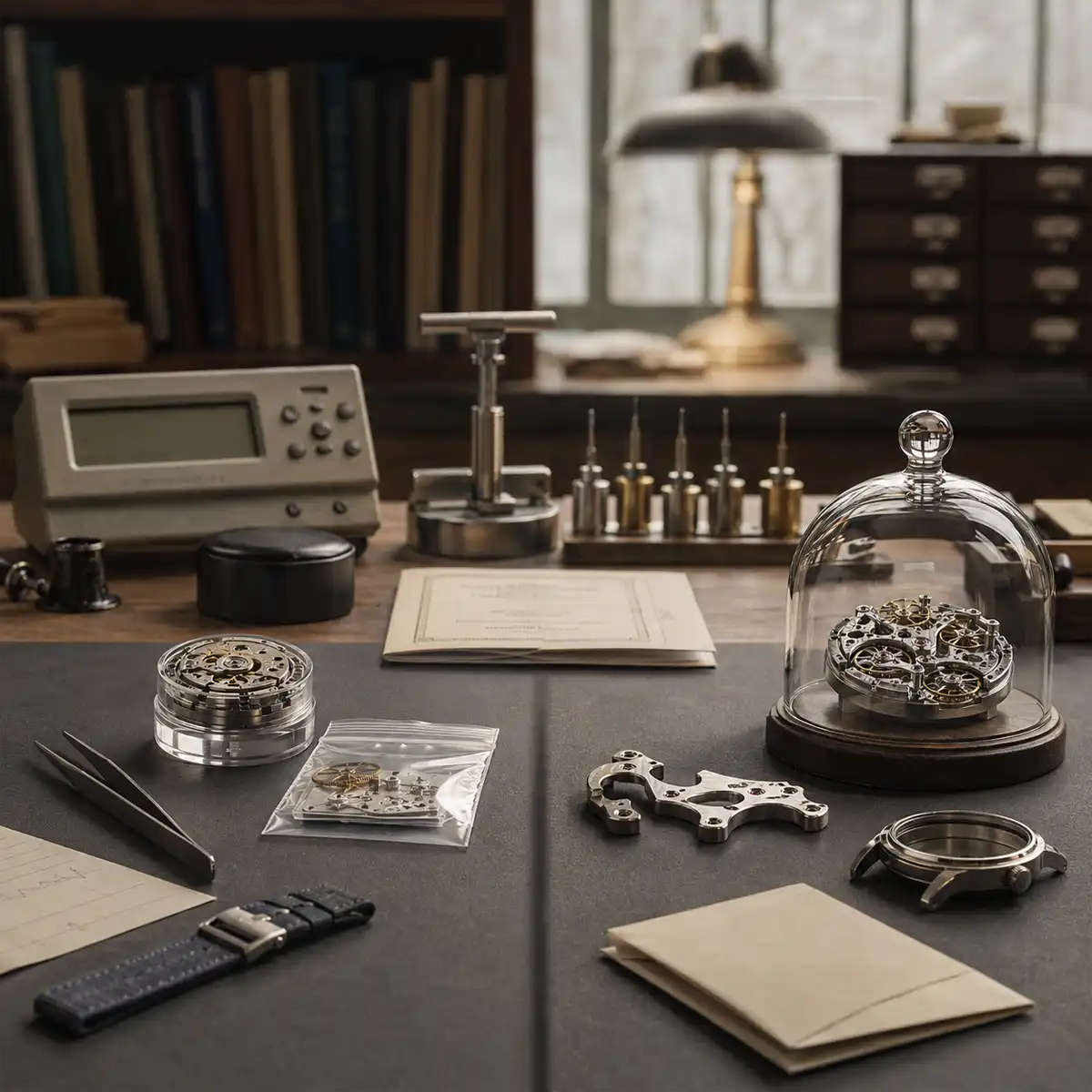
The sourced calibre's advantages concentrate exactly where daily ownership lives. Parts are abundant, documentation is universal, and any competent independent watchmaker in the UK can service an ETA 2824-2 or Sellita SW200-1 for a low 3 figure sum, usually inside a fortnight. An in-house movement typically travels back to the brand's own service network, at the brand's own price and on the brand's own timetable. Over 30 years of ownership, that difference compounds into real money and real months.
Reliability is the other quiet argument. These movements have been produced in the millions and refined for decades; their failure modes are known, boring and fixable. A first-time buyer choosing between a Sellita-powered watch and a young brand's debut in-house calibre is choosing between an engine with a 50 year service record and one with a press release. For most people building [INTERNAL LINK: the best automatic watches under £2,000 for UK buyers | a first collection at entry level], the sourced calibre is not the compromise. It is the sensible pick.
How the Marketing Blurs the Line
The language deserves a moment of scrutiny, because the industry has learned that manufacture words sell. Manufacture calibre, in-house developed, proprietary movement and exclusive calibre are not synonyms, and brands deploy them with lawyerly care. A movement can be exclusively configured for a brand by Sellita and truthfully described as exclusive. A group calibre shared across 5 sister brands can be described as in-house at group level. A reworked ETA base with a new rotor and bridge finishing can be given a house name and a house story.
Group ownership is the map that makes sense of the claims, which is why it belongs in every brand conversation. The Swatch Group owns ETA alongside Tissot, Longines, Omega and Blancpain; Richemont's houses share development resources; LVMH has pushed TAG Heuer, Zenith and Hublot towards movement independence as a group strategy. Where a brand sits on that map usually predicts what its in-house language really means.
The test that cuts through it all is disclosure. Brands with nothing to hide, Nomos and Christopher Ward among them, state their movement origins plainly, and Christopher Ward names its Sellita bases while offering COSC-certified versions of them. When a brand's materials are vague about where the calibre comes from, the vagueness is itself the information. Honest sourcing is respectable; only obscured sourcing should cost a brand your trust.
What This Means at the Watchmaker's Bench
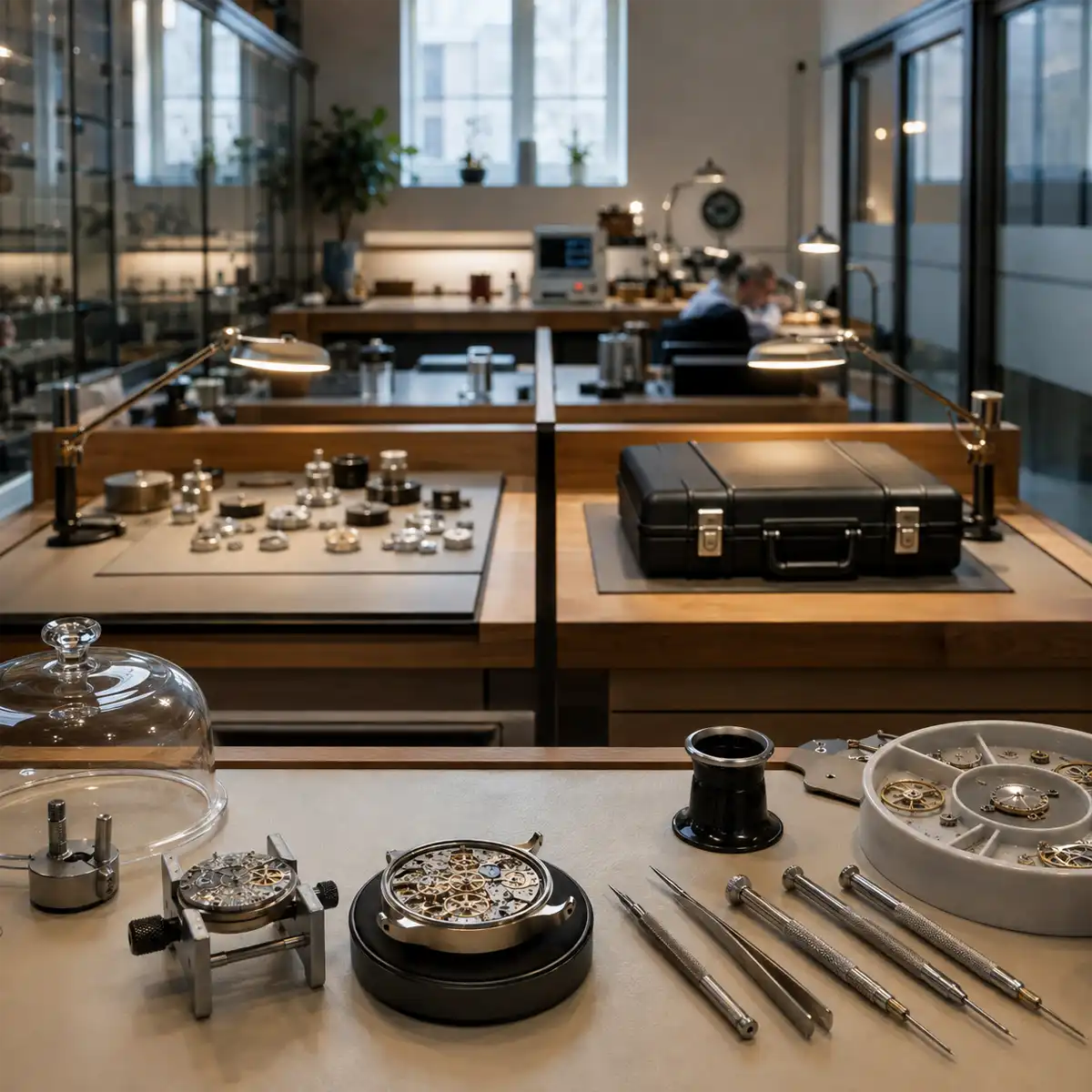
The ownership arithmetic deserves its own paragraph, because it is where the philosophies stop being abstract. A sourced calibre needs a routine service roughly every 5 years; an independent UK watchmaker will quote a low 3 figure sum, hold parts in stock and usually return the watch within weeks. An in-house calibre generally means the brand's own service centre, a quote issued after inspection, and a wait measured in months at the busiest houses, with Rolex's 5-year international guarantee and its roughly 10-year service rhythm the best-known example of the manufacture model done properly.
Neither path is wrong, but only 1 of them can be handled on your local high street. Factor the bench into the purchase and neither servicing bill will ever surprise you.
Which Movement Philosophy Fits Your Buying
Choose the movement to match the ownership you actually intend. Buyers who want low running costs, fast servicing anywhere in the UK and proven reliability should prefer ETA and Sellita power without embarrassment, especially at entry level. Buyers paying for design integration, slimness, horological identity or the satisfaction of a coherent manufacture object should pay the in-house premium knowingly, including its servicing consequences.
Before purchase, ask the dealer 3 things: who made this calibre, where will it be serviced, and what does that service cost. The comparison of in-house watch movements with their sourced rivals ends the way honest comparisons usually do, not with a winner but with a clearer view of what your money buys. Finishing standards above certification are the next layer, and [INTERNAL LINK: what the Geneva Seal and Qualité Fleurier guarantee | the finishing standards above COSC] picks up that thread.