The engineering problem at the centre of every mechanical watch is the same one that occupied clockmakers from the 13th century onwards: how to release stored energy at a controlled, predictable rate over a defined period. The mechanical watch movement solves this problem through a chain of mechanical components, each converting the energy of a coiled spring into the regulated rotation of the gear train and, ultimately, the measured movement of the watch hands. Understanding this chain precisely is what separates a watch enthusiast from someone who merely wears watches.
This is not a glossary of watchmaking terms. It is a functional account of how the components of a mechanical movement work together, where the interesting engineering challenges arise, and what the technical decisions behind a calibre number mean for the person wearing the watch. Every specification that appears in a product description — power reserve, frequency, jewel count, escapement type — is a consequence of choices made at this component level. The choices are worth understanding.
The mainspring: where the energy comes from
The mainspring is a coiled strip of metal alloy, typically between 20cm and 50cm in length, housed in a cylindrical barrel. When wound, it stores mechanical energy in the elastic tension of the coil. When released, it uncoils gradually, transmitting energy through its outer surface to the teeth of the barrel wall, which rotate and drive the gear train.
Modern mainsprings are produced from Nivaflex alloy, a cobalt-based material chosen for its combination of elasticity, corrosion resistance, and immunity to set — the permanent deformation that occurs when a spring is wound fully and held at maximum tension for extended periods. A mainspring that has taken set delivers less energy at full wind than it did when new, which shortens the effective power reserve and creates variability in rate.
The gear train connecting the barrel to the escapement performs two functions simultaneously: it transmits energy forward toward the escapement, and it counts the revolutions of the barrel, translating them into the calibrated rotation of the hands. The gear train in a conventional movement consists of four or five wheel and pinion pairs, each reducing rotational speed while increasing torque precision through the reduction ratio.
The escapement: the mechanism that controls time
The escapement is the component that makes a mechanical watch a clock rather than a winding mechanism. Its function is to interrupt the continuous rotation of the gear train at precisely measured intervals, releasing the energy in discrete steps rather than as a continuous unwinding. Every tick or beat of a mechanical watch is one escapement cycle: one tooth of the escape wheel advances, the lever resets, and the balance wheel continues its arc.
The most common escapement in modern watches is the Swiss lever escapement, developed in the 18th century and refined continuously since. It consists of three components: the escape wheel (a toothed wheel driven by the gear train), the pallet fork (a lever with two angled jewelled faces that alternately engage and release the escape wheel teeth), and the balance wheel (the oscillating regulator).
The lever escapement is robust, self-starting, and manufacturable to fine tolerances at production scale. It also requires lubrication at the pallet jewel faces, and this lubricant degrades over time, eventually contributing to rate instability. The conventional recommendation of 5-year service intervals for lever escapement movements is primarily driven by lubricant degradation rather than mechanical wear.
The balance wheel and hairspring: the heartbeat of the movement
The balance wheel is the oscillating regulator of the movement. It rotates back and forth on its staff, driven by the impulse from the pallet fork at each beat, and controlled in its period by the hairspring — a thin, coiled spring attached to the balance staff that stores and returns energy at each oscillation to maintain consistent amplitude.
The period of the balance wheel — the duration of one complete oscillation — determines the movement’s frequency. A movement running at 21,600 vibrations per hour (3 Hz, or 3 complete oscillations per second) ticks 6 times per second. At 28,800vph (4 Hz), it ticks 8 times per second. Higher frequency movements are generally more resistant to positional error and shock because the oscillation period is shorter, giving external disturbances less time to affect each cycle. They also consume more power from the mainspring, which can shorten the power reserve if the barrel capacity is not increased to compensate.
Hairsprings are among the most demanding components in watchmaking. A traditional Nivarox alloy hairspring must be cut, formed, and regulated to tolerances of less than one micrometre across its active length. The behaviour of the spring varies with temperature — metals expand and contract with heat and cold, altering the spring’s elasticity and therefore the oscillation period. Temperature-compensated alloys, and more recently silicon and silicon composite materials, address this variability through material properties rather than mechanical compensation.
Fun fact: COSC certification requires a movement to pass 16 days of testing across 5 positions and 3 temperatures before receiving the Chronometre designation; a movement submitted for certification but failing any single day’s test in any position is rejected and must be resubmitted after adjustment.
Jewels and why they matter to movement longevity
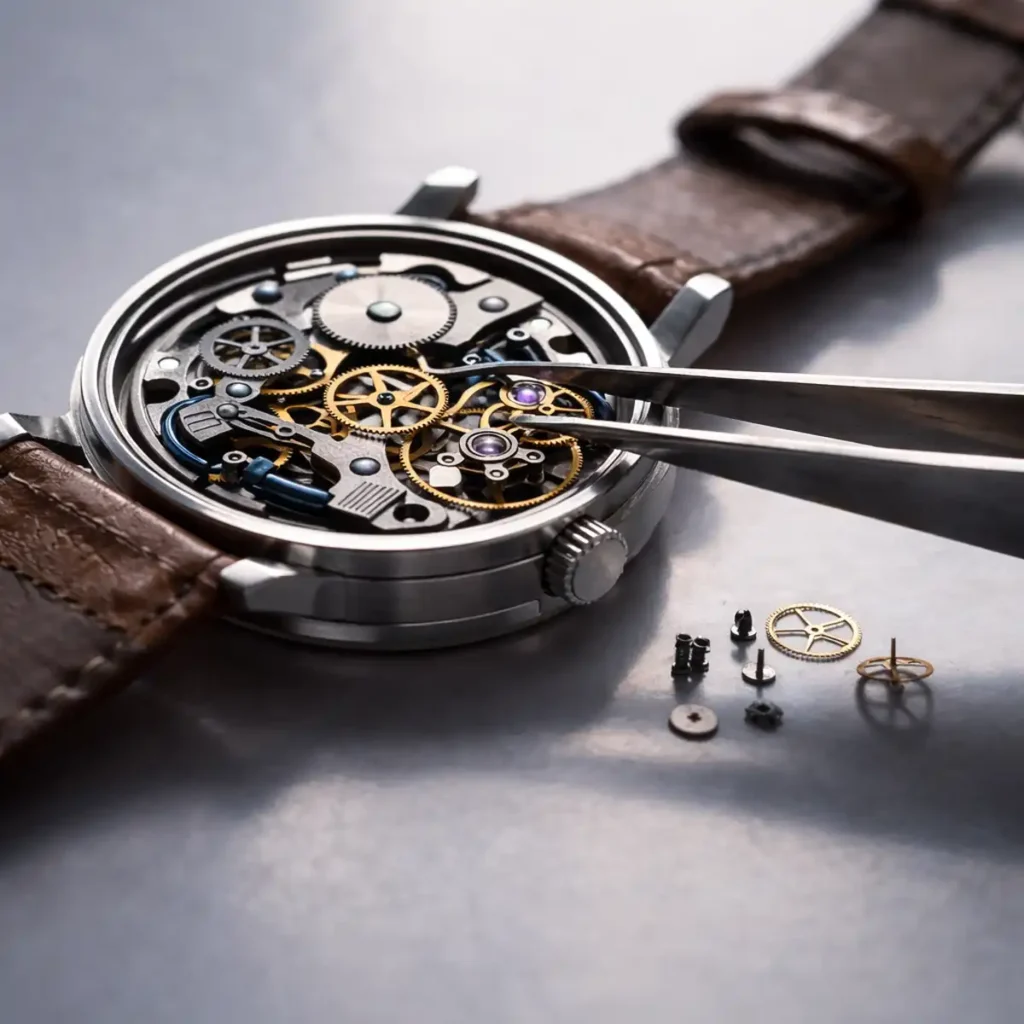
The jewels in a watch movement are synthetic rubies pressed into the metal plates and bridges to serve as bearing surfaces for the rotating staffs of the gear train. Ruby is used because its hardness (9 on the Mohs scale) resists wear, and because its surface properties allow it to retain a thin film of oil without spreading — critical for a bearing that rotates millions of times per year.
A conventional movement typically uses between 17 and 21 jewels. Higher jewel counts in older movements were sometimes used as a marketing measure rather than a functional one; additional jewels in positions that do not require them add cost without reducing friction. Contemporary movement design places jewels only where bearing surfaces are subject to significant rotational velocity and load.
The pallet fork impulse faces in a lever escapement are jewelled because they are the highest-friction contact point in the movement: two angled ruby surfaces engaging and releasing escape wheel teeth at every beat. These are the jewels most critical to lubrication and the ones most affected by lubricant degradation over time.
Power reserve and the relationship between mainspring capacity and frequency
The power reserve of a movement is the duration over which it will run from full wind to minimum operational amplitude — the point at which the balance wheel oscillates with insufficient energy for reliable rate. This is determined by the capacity of the mainspring barrel relative to the energy consumption of the escapement at its operating frequency.
A movement running at 21,600vph with a given barrel size will achieve a longer power reserve than the same barrel driving a movement at 28,800vph, because lower frequency means fewer escapement cycles per hour and therefore less energy consumed per hour. The Calibre 3235 in the Rolex Submariner Date achieves a 70-hour power reserve at 28,800vph through an enlarged barrel combined with the efficiency gains of the Chronergy escapement geometry. The Omega Calibre 3861 achieves a 50-hour power reserve at 21,600vph; the lower frequency partly accounts for the extended reserve relative to the barrel capacity.
Complications: additional mechanisms built on the base movement
A complication is any function of a watch beyond the display of hours, minutes, and seconds. The date window requires a complication: a wheel or disc mechanism driven from the gear train, advancing once per 24 hours, carrying the date numerals past the aperture. A chronograph requires a significantly more complex complication: an independent seconds counter driven by a coupling mechanism that engages and disengages the chronograph gear train when the pusher is activated.
The engineering distinction between a simple complication (date, day, GMT hand) and a grand complication (perpetual calendar, minute repeater, tourbillon) is primarily one of mechanism complexity and the number of additional components added to the base movement. A perpetual calendar must account for months of differing lengths and the 4-year leap year cycle through a cam and lever mechanism that requires no manual correction except for century years. A minute repeater converts the current time into an acoustic signal on demand, requiring a striking train, hammers, gongs, and the control mechanism to read the time from the dial wheels and convert it into chime sequences.
Conclusion
The mechanical watch movement is a precision instrument built from components that solve a fundamentally simple problem — controlled energy release — through mechanisms refined over centuries. The calibre number on a watch specification is a shorthand for a complete set of engineering decisions: escapement type, frequency, jewel placement, barrel capacity, and complication architecture. Every figure in a movement specification — power reserve, frequency, jewel count — follows from those decisions.
For the buyer assessing a first mechanical watch, the practical ownership implications are these: a movement running at 28,800vph will be slightly more resistant to positional variation than one at 21,600vph; a co-axial or similar reduced-friction escapement may justify a longer service interval than a conventional lever escapement; and a higher power reserve reduces the daily discipline of remembering to wind or wear a manual-wind watch. None of these differences is large enough to determine a purchasing decision on its own, but each is real, and understanding them puts you in a better position to evaluate what any calibre specification is actually describing.