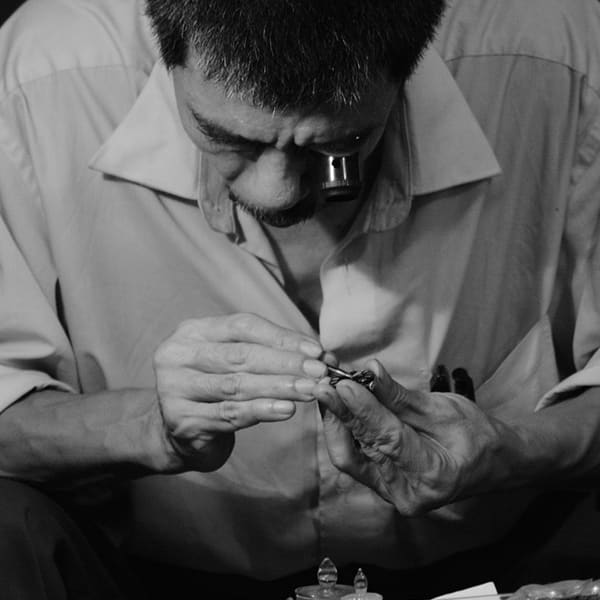
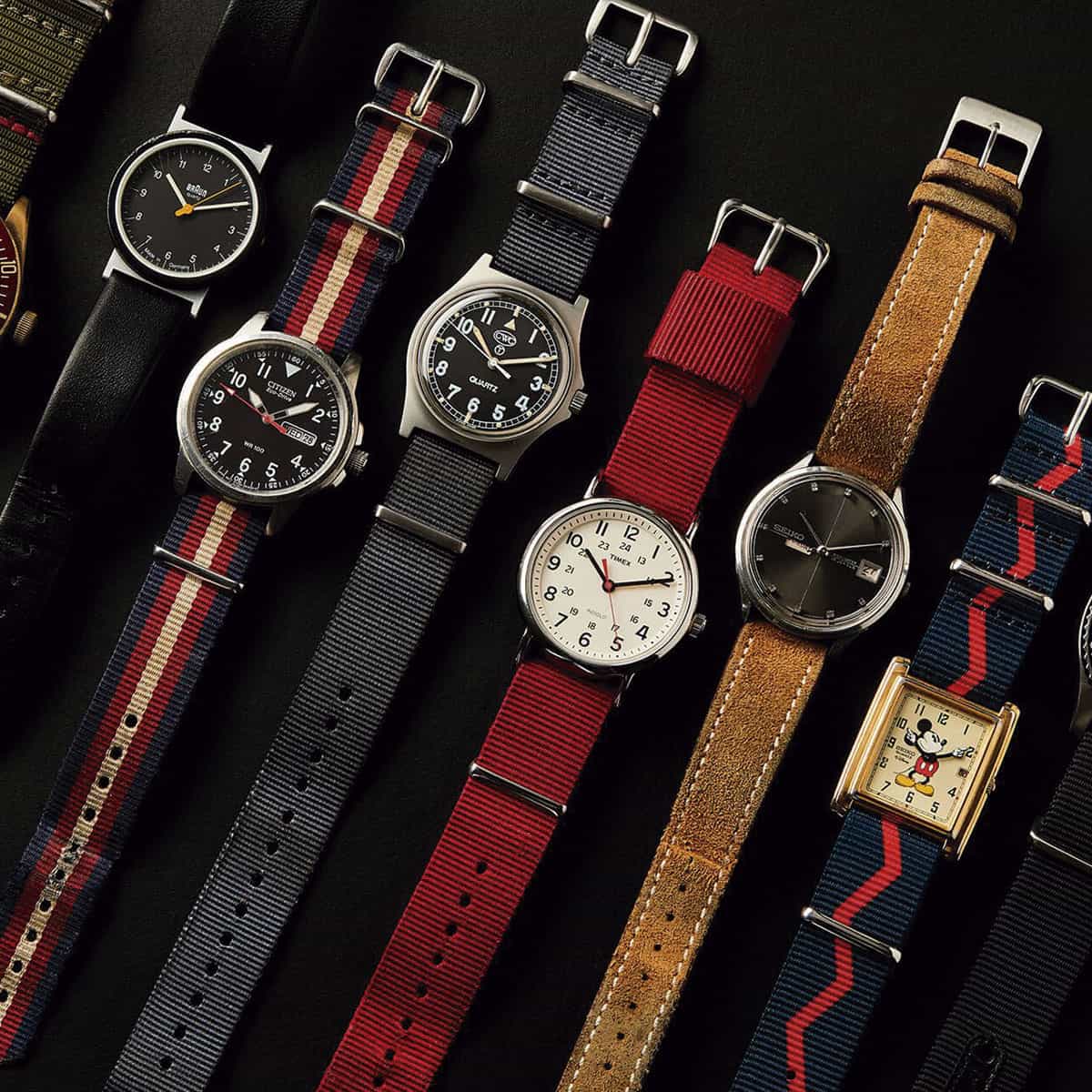
The day you take a watch to be serviced is different from the day you bought it. The buying day is all anticipation — the weight of the case, the snap of the bracelet, the first hours of wearing something that is now yours. The service day asks something quieter of you: trust in a process you cannot observe, confidence in the person you are leaving it with, and the particular patience of being without something you wear every day.
Watch servicing in the UK is less complicated than the industry sometimes implies and more important than most owners appreciate. A mechanical watch is a precision instrument running on lubricants that degrade, on components that wear, and on tolerances that shift over years of use. Servicing is not an optional maintenance procedure. It is what keeps a mechanical movement performing to its design specification for the decades it was built to last.
How Long Can You Wait Between Services?
The honest answer varies by calibre, by conditions of wear, and by how much you care about your watch running to its certified accuracy rather than merely running.
Rolex’s current guidance recommends a full service approximately every 10 years for watches worn under normal conditions. Omega recommends servicing every 8 to 10 years for its mechanical calibres. Tudor follows the same 10-year guidance as Rolex, sharing manufacturing philosophy with its parent company. Nomos recommends 5 to 8 years, partly because its lower-beat Alpha calibre operates at a movement frequency where oil degradation is proportionally more impactful over time.
These are recommendations for watches kept running continuously. A watch worn occasionally and stored carefully between uses may extend the service interval modestly. A watch worn daily in challenging conditions — sea salt air, temperature extremes, physical activity — may need attention sooner than the recommended interval.
The indicator most owners notice first is accuracy degradation. A watch that previously kept excellent time and has begun losing 30 to 60 seconds per day is telling you that its lubricants have degraded and its escapement is operating with increased friction. It will not stop — a mechanical movement with dry oils continues to run, just less accurately and with accelerating wear. The cost of running a watch beyond its service interval is borne not in the service itself but in the worn components that the service finds.
What a Full Service Actually Involves
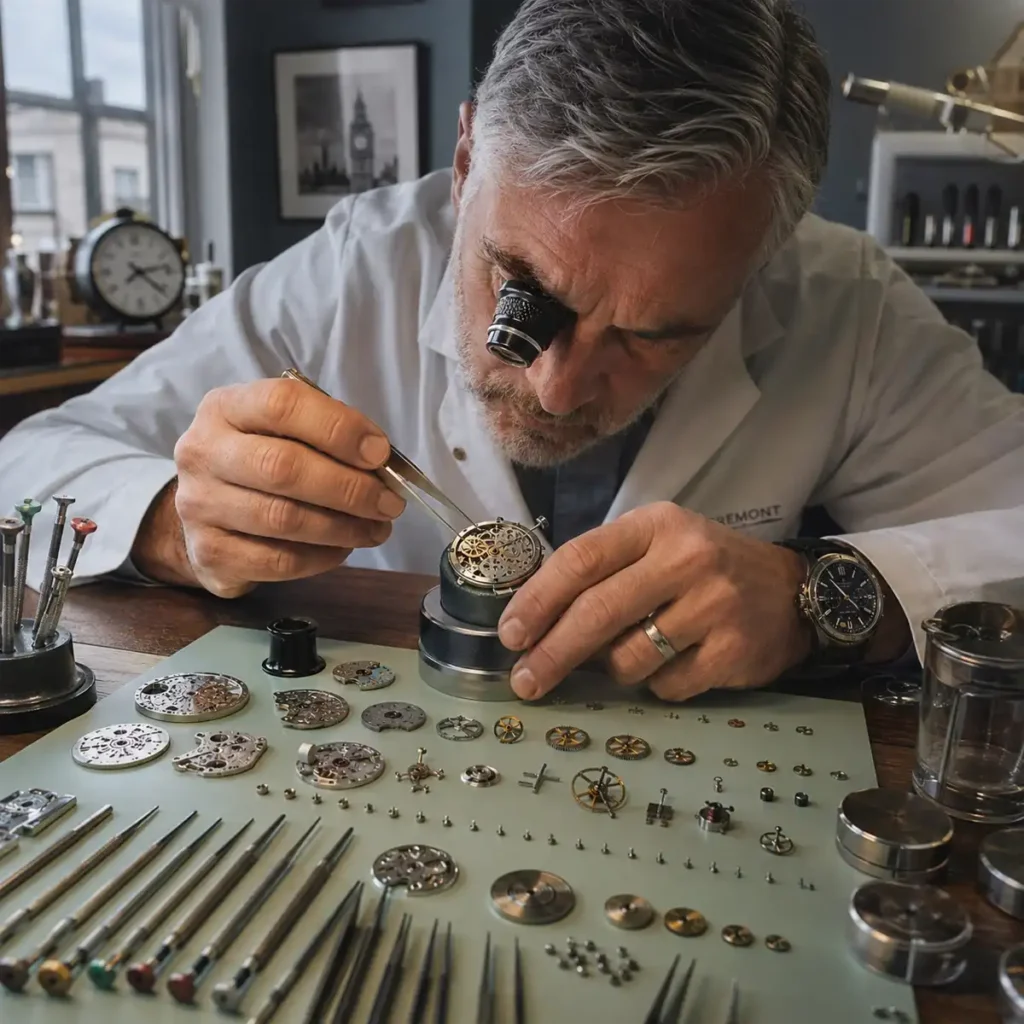
A complete mechanical watch service involves more than cleaning and oiling. The sequence is:
Disassembly. The movement is removed from the case. Every component is disassembled individually — mainspring, barrel, gear train wheels, escapement, balance wheel, hairspring, keyless works, and setting mechanism. A quality service on a complex calibre involves handling 150 to 250 individual components.
Inspection and measurement. Each component is inspected for wear, damage, and dimensional accuracy. Pivot diameters are measured against tolerance specifications; escapement geometry is checked. Components outside tolerance are flagged for replacement.
Ultrasonic cleaning. All components are cleaned in an ultrasonic cleaner using appropriate solutions. This removes old lubricant residue, metallic wear particles, and environmental contamination.
Replacement of worn components. Mainsprings are typically replaced at every service regardless of apparent condition; the cost of mainspring failure is a damaged gear train, and a new mainspring is inexpensive relative to that outcome. Gaskets — the rubber seals that provide water resistance — are replaced at every service on water-resistant watches. Other components are replaced as inspection dictates.
Reassembly and lubrication. The movement is rebuilt with fresh lubricants applied at every friction point. Different oils and greases are used at different locations; escapement pallet stones receive a specific lubricant, gear train pivots receive another, and the mainspring barrel receives a third. Modern synthetic lubricants are significantly more stable than the mineral oils used in older calibres, which is one reason modern recommended service intervals are longer than historical practice suggested.
Regulation and timing. The reassembled movement is regulated on a timing machine across multiple positions. A competent watchmaker will bring the movement to within the manufacturer’s specification before casing.
Case service. The case, crystal, crown, and bracelet are cleaned. Gaskets are replaced. On water-resistant watches, pressure testing follows reassembly.
Fun fact: The first watchmaker to systematically use mineral oil as a movement lubricant was Abraham-Louis Breguet in the early 19th century — before his innovation, watchmakers used olive oil, which oxidised and became corrosive within months, making frequent servicing essential. Modern synthetic lubricants now last a decade under normal conditions.
What Does a Service Cost in the UK
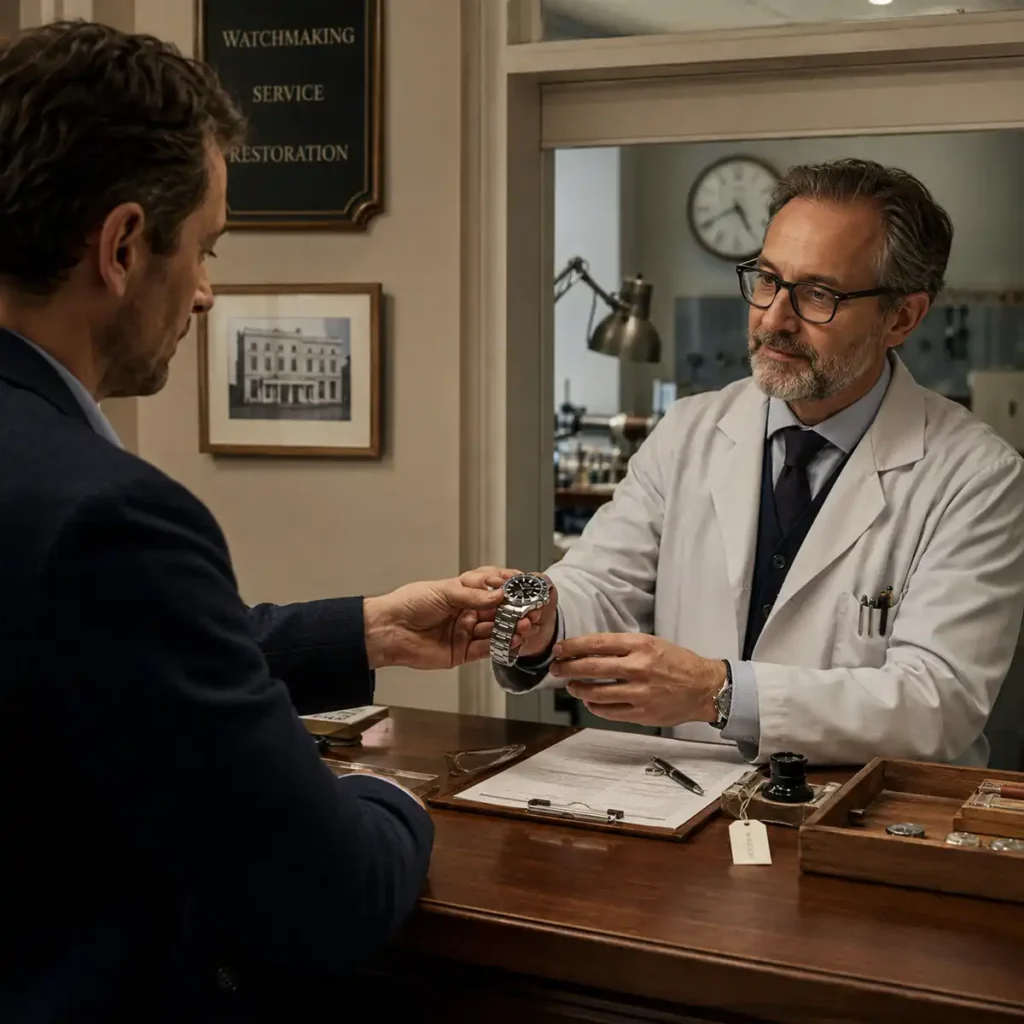
Service pricing varies by brand, calibre complexity, condition of the movement, and whether you use a manufacturer service centre or an independent watchmaker.
Rolex: Authorised Rolex service centre pricing for a Submariner or GMT-Master II runs approximately £650 to £850 for a complete service, including gasket replacement, water resistance test, and regulation. Complex models with date functions or additional complications are priced higher. Rolex servicing includes a 2-year service warranty.
Omega: Authorised Omega service centre pricing for a Seamaster Professional or Speedmaster Professional run approximately £400 to £600 for a complete service. Co-Axial escapement calibres may price at the higher end of this range due to the additional precision required in escapement regulation.
Tudor: Authorised Tudor service pricing runs approximately £350 to £500 for a complete service on a Black Bay or Pelagos. Tudor service centres share infrastructure with Rolex service operations in the UK.
Independent watchmakers: A competent British Horological Institute-accredited independent watchmaker will service most Swiss lever escapement movements for £200 to £450, depending on complexity. For watches outside the manufacturer’s warranty period, an independent watchmaker represents genuine value; for watches within warranty or where manufacturer records matter for resale, the authorised centre provides documentation that an independent cannot replicate.
Manufacturer Service Centre versus Independent Watchmaker
This is the decision that most owners find genuinely difficult, and the answer depends on factors specific to each situation.
Choose the manufacturer service centre if: the watch is within its manufacturer warranty period; the watch’s service history documentation matters for resale (a Rolex with unbroken manufacturer service records commands a higher secondary market price than the equivalent watch with independent service history); the calibre contains proprietary components not available outside the manufacturer’s supply chain; or the watch requires water resistance testing to a depth rating that requires specialist equipment.
Choose an independent watchmaker if: the watch is outside the manufacturer’s warranty; the service cost differential is meaningful relative to the watch’s value; you have a trusted independent watchmaker with verifiable experience on the calibre in question; or the manufacturer’s service centre for your brand requires shipping internationally, introducing logistical risk.
Finding a qualified independent watchmaker in the UK: membership of the British Horological Institute (BHI) indicates formal training and qualification. The BHI maintains a directory of registered member watchmakers. Alternatively, watch forums including WatchUSeek and UK-based communities maintain lists of independently verified, community-recommended watchmakers by region.
Practical Ownership: The Long View
A mechanical watch serviced on schedule, stored correctly between wear, and handled with reasonable care will outlast its owner. This is not marketing language — it is a mechanical reality. The movements inside a Rolex Submariner, an Omega Speedmaster, or a Nomos Tangente are built to tolerances that allow indefinite operation given correct maintenance. The question is never whether to service; it is only when and by whom.
The relationship between a watch and its owner is partly defined by this maintenance cycle. A watch that has been serviced twice in 20 years of ownership has a history as well as a condition; a service record is a form of provenance. When you eventually sell it or pass it on, that record is worth something specific and measurable to the next person who wears it.
Schedule the service before accuracy degrades to the point of inconvenience. Find a watchmaker whose work you can verify. Understand what the service involves so you can evaluate what you are being charged for. These three steps are all that practical watch ownership requires beyond wearing the watch and, on the days when that is the whole of it, enjoying it entirely.