Imagine touching down at London City Airport on a bright autumn morning, stepping from the cabin into a world that once relied on analogue instruments and steady hands. In that golden age of flight, the captain's wrist carried more than a watch. It carried a mechanical brain that could crunch fuel burn, ground speed and distance faster than a slide rule in the cockpit drawer. That instrument was the Breitling Navitimer, and its story still echoes across watch forums, vintage fairs and London watch boutiques today.
Fun Fact: Scott Carpenter wore a customised Navitimer during his 1962 Aurora 7 mission, making it the first Swiss wristwatch in space.
Origins During Wartime Innovation
The Navitimer's seed was planted in 1942 when Breitling released the Chronomat. That early mechanical chronograph carried a circular slide rule on its bezel, patented two years earlier and created with mathematician Marcel Robert. Engineers, surveyors and pilots discovered that with a twist of the bezel, they could multiply, divide and convert units at arm's length.
Those early successes convinced Willy Breitling that a purpose-built pilot's model would thrive once war gave way to commercial aviation. He refined the logarithmic scales, toughened the case and prepared to court the most influential flying club on earth.
The AOPA Collaboration That Defined a Generation
In 1952, the Aircraft Owners and Pilots Association asked Breitling for a wrist computer that could handle every calculation a captain made between take-off and touchdown. Willy Breitling answered with a watch that took the Chronomat's concept and re-engineered it for flight.
- Bidirectional bezel with oversized ridges for gloved fingers
- An inner scale is printed on the dial for quick reference
- Clear Arabic numerals painted with radium for night sorties
Development spanned two years. Only when AOPA approved the design in 1954 did the first batch leave the factory. Those watches carried only the AOPA wings at twelve o'clock, no Breitling wordmark, underlining their status as professional kit. Public versions arrived a year later with a stylised single-wing logo and the reference number 806.
Navitimer Milestones in Air and Space
- 1962 Cosmonaute – Carpenter's 24-hour dial variant circled Earth three times.
- 1963 Reverse Panda dial – White sub-dials against black improved glance-reading.
- 1969 Chrono-matic calibre 11 – One of the world's first automatic chronographs, recognisable by its left-hand crown.
- 1970s Cultural crossover – Jazz icon Miles Davis and racing champion Graham Hill wore Navitimers, proving the design's reach beyond the cockpit.
These moments broadened the watch's audience while preserving its functional soul. Collectors today hunt the beaded bezels of early models or the serrated edges introduced for a better grip in the mid-sixties. Each variation tells a chapter of aviation progress.
From Quartz Crisis to Revival in Britain
The arrival of cheap quartz technology in the 1970s threatened every Swiss manufacturer. Breitling experimented with LCD Navitimers, yet could not outrun the collapse. In 1978, the company changed hands, passing to Ernest Schneider, a pilot who valued the brand's airborne heritage. Production shifted to Grenchen, and by the mid-eighties, mechanical watchmaking was in renaissance.
Reference 81600, launched in 1985, brought the Navitimer back with a hand-wound Lemania movement. British enthusiasts welcomed its return, finding it in Bond Street windows and regional jewellers that had weathered the quartz upheaval.
How to Read the Circular Slide Rule
At first glance, the Navitimer's bezel resembles a compact storm of numerals, yet its logic is straightforward. Align the red index 10 on the inner scale with any number on the outer ring to create a baseline for multiplication or division. Pilots once used the system to estimate fuel load, climb rates and currency conversions mid-flight. Today, owners still impress dinner guests by converting nautical miles to kilometres with a flick of the thumb.
- Ground speed – Match distance travelled to minutes flown, read speed opposite the time index.
- Fuel consumption – Set burn rate against the index, read total fuel opposite flight duration.
- Unit conversion – Dedicated STAT, NAUT and KM markers handle statute, nautical and metric miles.
Dial and Hands Evolution for Precise Legibility
Early black-on-black designs used syringe hands and bold numerals to stand out in dim cockpits. The reverse panda of 1963 increased contrast, while larger sub-dials helped crews track elapsed minutes at a glance. The modern anniversary range flattens the slide rule and domes the sapphire, reducing thickness without taming character. For 2022, Breitling reinstated the AOPA logo at noon, a respectful nod to the watch's birthright.
Inside the Case: The Movements that Powered Progress
- Valjoux 72 – Manual column-wheel calibre in the earliest batches, shared with vintage Daytonas.
- Venus 178 – Long-running heart of the reference 806 through the sixties.
- Calibre 11 – Automatic module with left-side crown, hallmark of late-sixties innovation.
- Valjoux 7750 – Workhorse of the 1990s revival, prized for serviceability.
- Breitling B01 – Launched 2009, in-house column-wheel movement with 70-hour reserve, vertical clutch and five-year warranty.
By mastering its own calibre, Breitling moved from assembler to manufacturer, rivalling Omega's Co-Axial and Rolex's in-house lines.
Size, Materials and Wearability Today
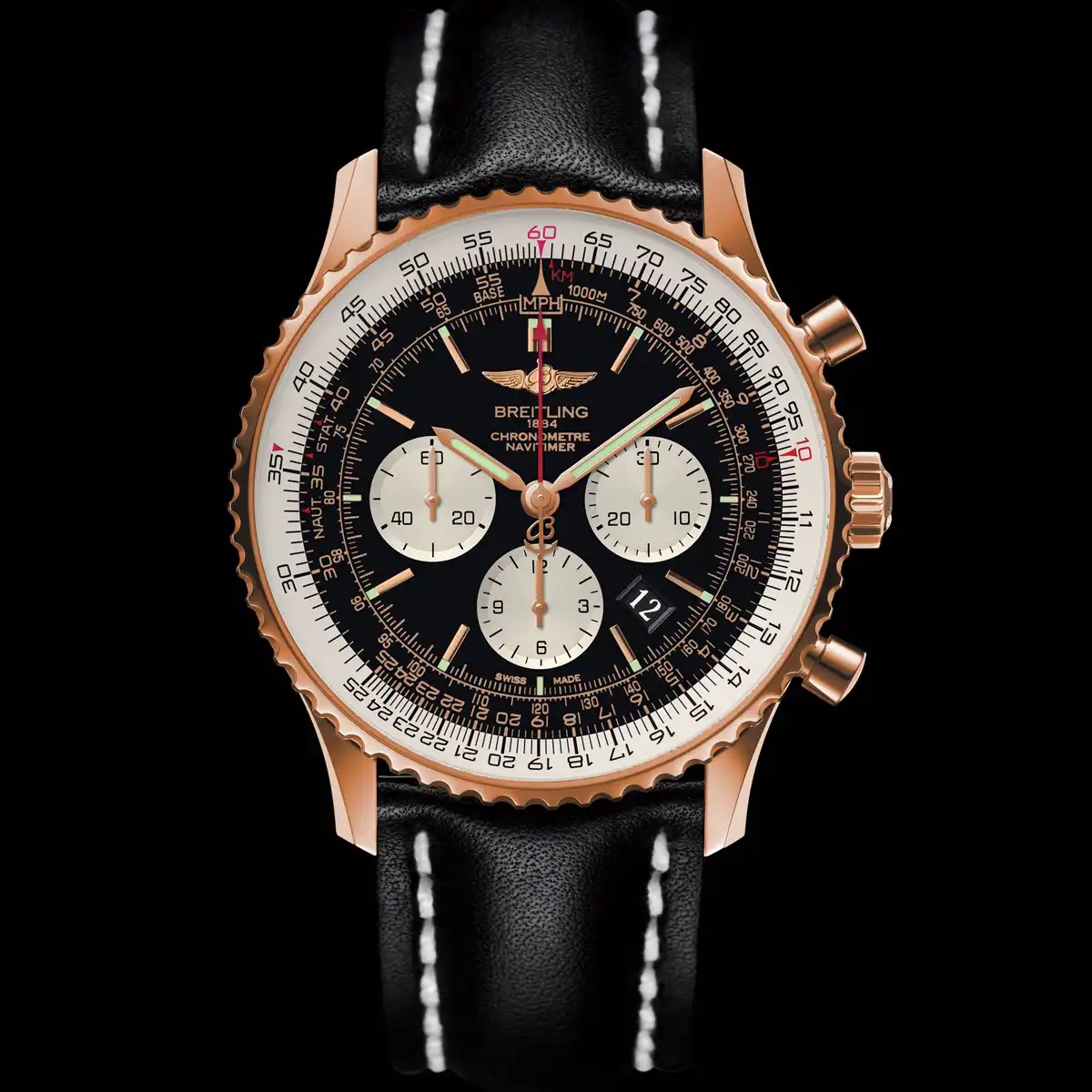
Historic pieces measured about 41 mm, vast for the 1950s. Seventies fashions pushed some references to 48 mm. The current family offers 32 mm quartz timekeepers for slender wrists, classic 41 mm or 43 mm chronographs for everyday wear and a 46 mm statement piece for those who want cockpit presence on land. Cases come in stainless steel, two-tone or solid red gold, and the brand now promotes ethically sourced, better gold across its range.
Modern Line Up for UK Buyers
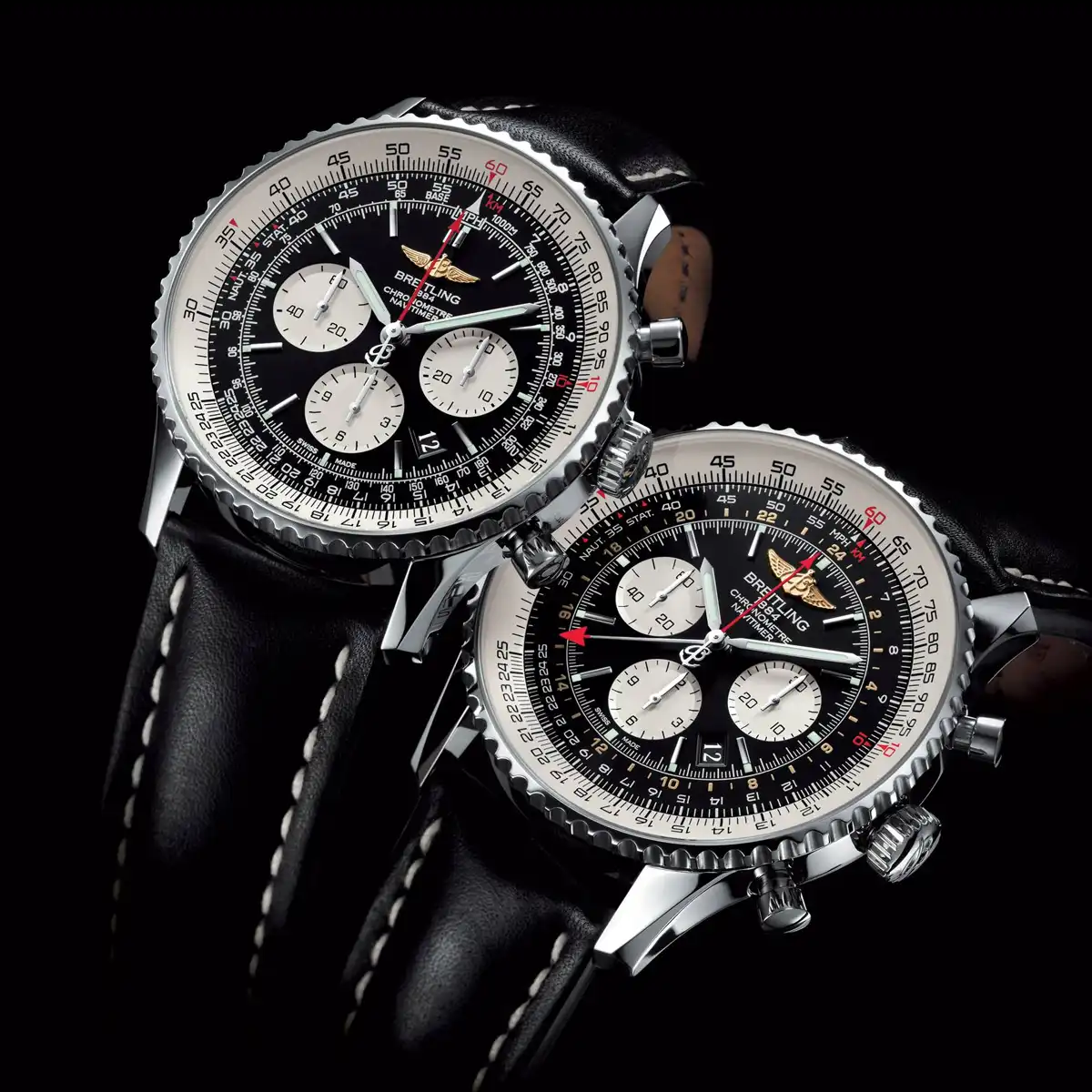
Navitimer B01 Chronograph – 41, 43 or 46 mm, in-house movement, broad dial palette including mint green and ice blue.
Navitimer Automatic – 36 or 41 mm, time and date, COSC Calibre 17, slide rule retained.
Navitimer Automatic GMT 41 – Second time zone hand for frequent flyers.
Heritage re-editions – 1959 Ref 806 revival, Cosmonaute tributes, airline liveries and a 2024 perpetual calendar in red gold.
Navitimer against Speedmaster and Daytona
| Feature | Breitling Navitimer | Omega Speedmaster | Rolex Daytona |
| Signature | pilot watch with slide rule | NASA Moon legacy | Motorsport icon |
| Movement | Breitling B01 | Omega 3861 manual | Rolex 4131 |
| Water resistance | 30 m | 50 m | 100 m |
| UK retail (steel) | £7 950 | £6 700 | £13 200 |
| Secondary value | £5 500–£7 000 | £5 000–£6 500 | £25 000+ |
| Availability | In stock | Usually in stock | Wait-list |
The Navitimer splits the difference between the tool purity of the Speedmaster and the trophy status of the Daytona, offering interactive functionality and polished luxury at a price that remains within reach.
Buying and Keeping Your Navitimer in Britain
Where to purchase
- Breitling boutiques on Bond Street, Regent Street, Manchester, Edinburgh and Birmingham
- Authorised chains such as Watches of Switzerland, Goldsmiths, and Beaverbrooks
- Trusted independents in Leeds, Cardiff, Brighton and Glasgow
Pre-owned checks
- Applied logo not printed
- Crisp reference and serial between lugs
- Smooth sweep of the second hand, no tick
- Exhibition back on B01 models shows Geneva stripes and a signed rotor
Service schedule
- Two-year maintenance for seals and pressure test (£150–£250)
- Four-year full overhaul for B01 chronograph (£445–£650)
- Keep the box, papers and digital warranty card for the best resale value
Final Thoughts
For collectors seeking a watch that tells a genuine aviation story, the Breitling Navitimer offers unmatched context. It carries the legacy of cockpit problem-solving, space exploration and post-quartz revival while presenting a contemporary face that suits the streets of Mayfair as well as the skies above Heathrow. Whether you choose a vintage 806 packed with patina or a mint green 43 mm B01 fresh from a London watch boutique, you strap on a piece of mechanical history that still has practical tricks up its sleeve. In flying and in collecting, a clear purpose beats an empty status every time.