If you visit New Bond Street on a weekday, you’ll notice a change in atmosphere as you step inside IWC Schaffhausen’s Mayfair flagship. While shoppers outside browse fashion houses and jewellers, inside, the focus is on engineering. Watches are displayed like precision instruments, not just ornaments. For London buyers moving between Hatton Garden, Mayfair jewellers, and luxury watch shops, IWC stands out. The brand approaches features like the perpetual calendar or pilot’s chronograph as engineering solutions, not just decoration.
This connection is important for British clients. IWC’s history is closely linked to the UK, from making RAF navigation watches to working with Mercedes-AMG and being featured in the upcoming Apple F1 film. Their catalogue is made for people who care about how things work, not just how they look. This guide covers IWC’s unique origins, highlights collections relevant to UK buyers, explains the engineering behind the watches, and gives advice on buying in London, whether new, pre-owned, or vintage. It also covers warranties, servicing, and value retention, helping you decide if a Schaffhausen watch should be part of your jewellery plans.
History and British roots of IWC Schaffhausen
IWC’s beginnings are rooted in industry. In 1868, Florentine Ariosto Jones, an American engineer from Boston, came to Switzerland to blend American watchmaking methods with Swiss craftsmanship. Instead of joining other brands in the Jura, he picked Schaffhausen in the German-speaking north, where the Rhine Falls could power machines. This practical decision set the brand’s focus on engineering over decoration.
This location still influences IWC’s style. Away from Geneva’s decorative traditions, IWC created a look with simple dials, clear numbers, and sturdy cases, captured by the motto “Probus Scafusia,” meaning “good, solid craftsmanship from Schaffhausen.” While some brands focus on fancy finishes and gems, IWC values accuracy, strength, and readability. This practical approach appeals to UK readers who judge equipment by how well it works, even in bad weather.
Jones’s own tenure was short and commercially difficult. Resistance from conservative Swiss workers and tariff barriers in the United States made his vision hard to execute. The firm eventually passed into local ownership, but its long-index “Jones calibre” movements became the template for the brand’s later self-image as a place where mechanics come first.
The German-speaking culture of Schaffhausen also matters. Brand historians often contrast its more Schaffhausen’s German-speaking culture, which also shapes IWC. Historians note its serious style compared to the lighter feel of French-speaking regions. German industrial design and Bauhaus ideas are shown in the clear numbers, open dials, and technical fonts across the collection. British buyers who appreciate practical military gear and subtle style often find this mix of precision and simplicity appealing. pinnedits most famous RAF watches, which spent more than 30 years in active service with the British military.
Pilot watches for RAF heritage and modern UK collectors.
The Pilot’s Watch family best shows IWC’s British ties. For many UK fans, the Mark series is key to the brand’s reputation. The Mark 11, launched in 1948, was made to strict Ministry of Defence standards and given to RAF navigators. It used a soft-iron inner cage to protect the movement from magnetism caused by cockpit equipment, helping keep time accurate during navigation.
Its design has become a blueprint for modern aviation watches. A matte black dial, crisp white Arabic numerals, and the characteristic triangle at 12 o’clock prioritise instant legibility. The evolution of luminous material, from early Radium to later Tritium, marked with a circled “T”, now reads like a safety history lesson on the wrists of London-based vintage collectors. Original examples with correct RAF engravings are particularly prized among buyers who want a piece of British military history that still works as a daily watch.
The modern Mark series shows how tool watches have become part of London’s luxury market. The latest Mark XX keeps the classic dial but adds the Calibre 32111, offering a 120-hour power reserve, better magnetic resistance, and modern parts. For buyers in Mayfair or the City who want a straightforward, everyday watch with a nod to history, it’s a strong choice.
If the Mark is about discretion, the Big Pilot is about presence. Based on World War II observers’ watches, its oversized 46 mm case and large crown were created so that gloved pilots could adjust the watch in unpressurised cockpits. On the wrist today, it functions as a modern icon: highly legible, instantly recognisable and usually powered by IWC’s 7-day automatic movements featuring the Pellaton winding system. For UK clients who already own diamond rings, London, or significant jewellery pieces and now want a standalone watch statement, the Big Pilot often fills that role.
Portugieser Ingenieur and other IWC collections for London buyers
Beyond aviation, three core families dominate conversations among London-based collectors: Portugieser, Ingenieur and, to a quieter extent, Aquatimer, Portofino and Da Vinci. Each serves a different use case, from business meetings in Mayfair to weekends away from the capital.
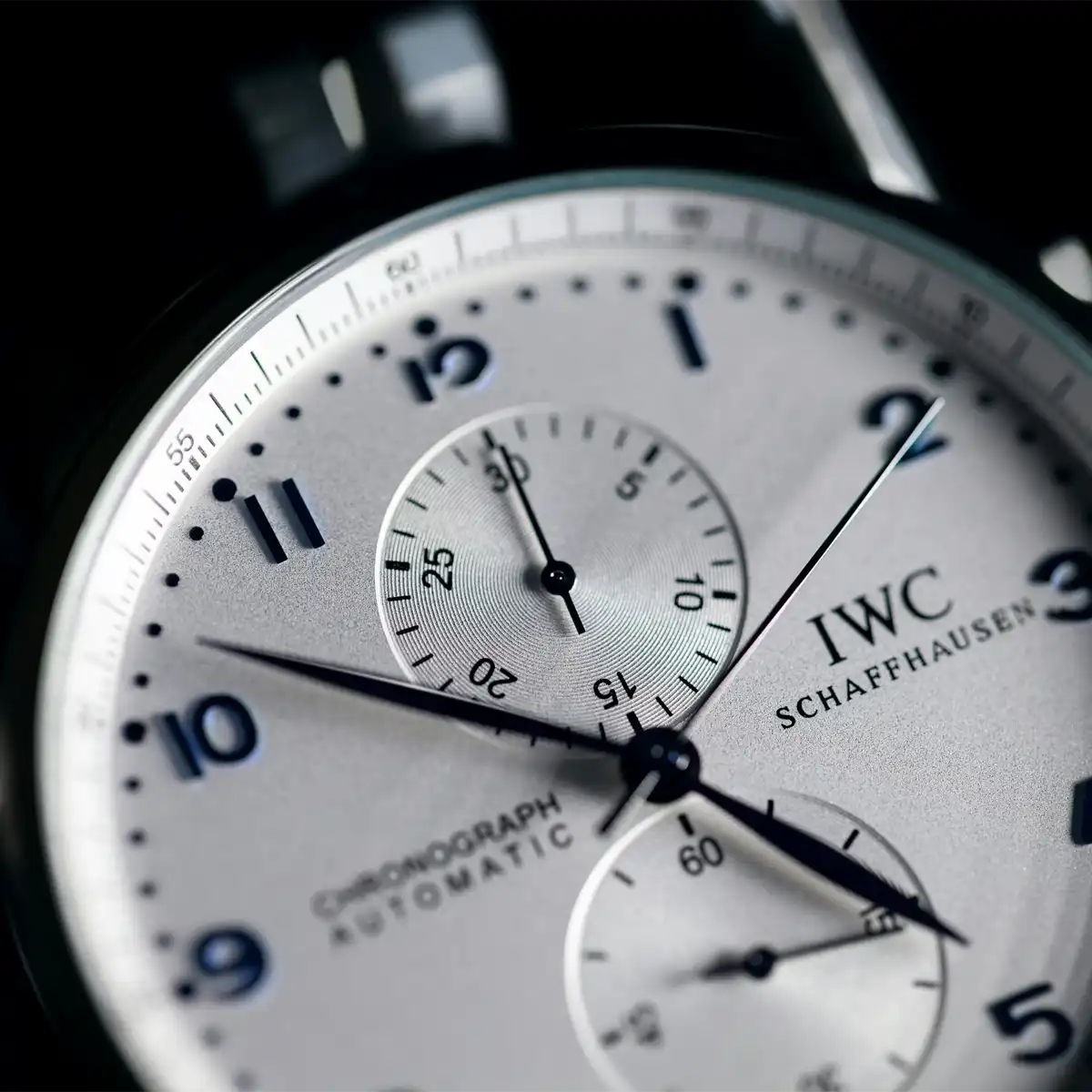
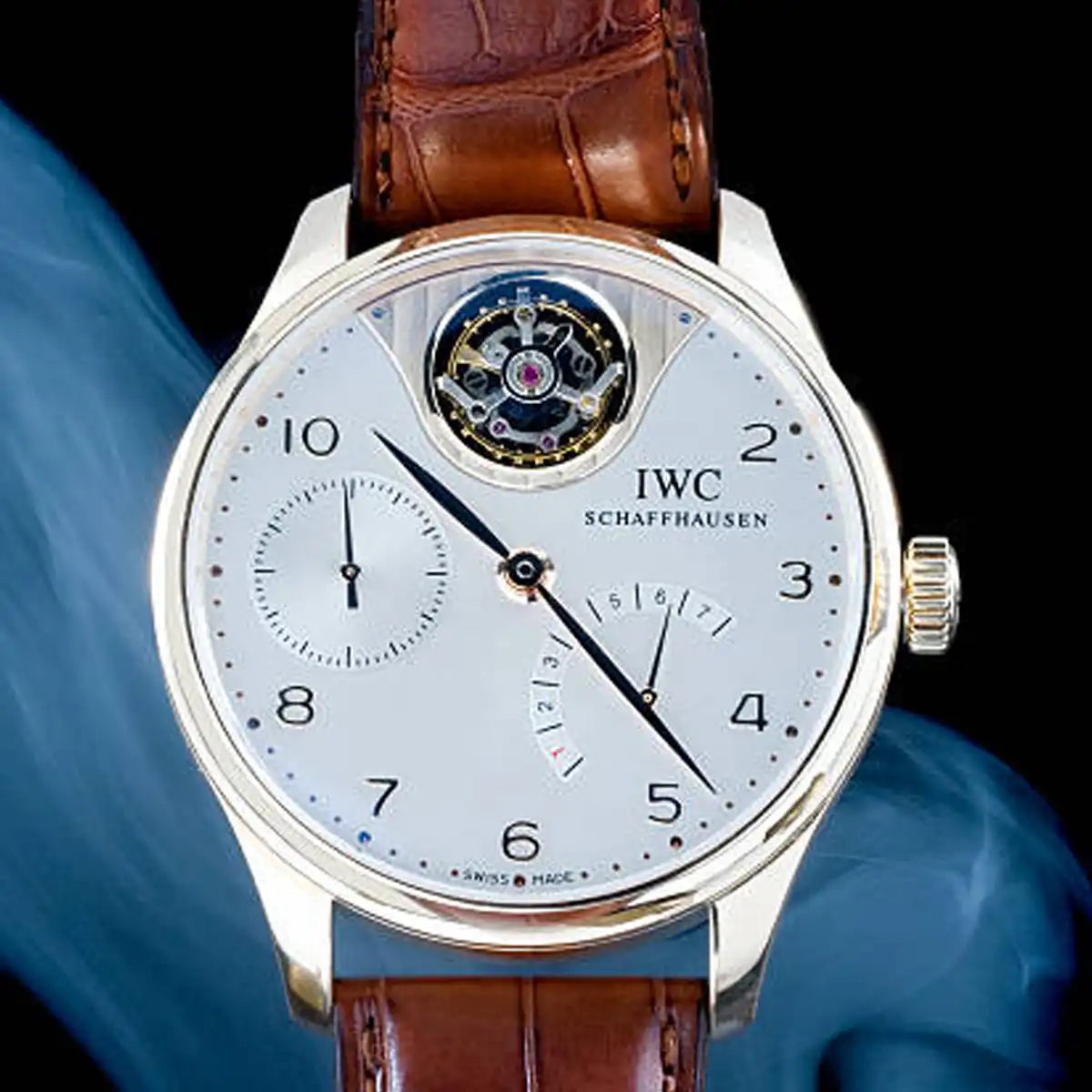
The Portugieser started in the late 1930s when two Portuguese merchants requested wristwatches that could match marine chronometers. IWC responded by placing pocket-watch movements in large wrist cases, creating a distinct look: wide dials, railway minute tracks, Arabic numerals and slim leaf hands. Today, the Portugieser Chronograph is one of the brand’s most recognisable watches, often chosen in London as a versatile piece that bridges the gap between formal wear and smart-casual dressing. Recent dial colours such as “Horizon Blue”, “Obsidian” and “Dune” have nudged the line toward softer, more atmospheric luxury without abandoning its nautical roots.
The Ingenieur offers a different kind of prestige. First launched in the 1950s as an anti-magnetic watch for engineers, it became a cult favourite when Gérald Genta redesigned it in 1976 as a sports watch with an integrated bracelet. The 2023 Ingenieur Automatic 40 updates this style with a grid-pattern dial and a soft-iron cage. UK collectors have debated its merits: some like the case finishing and proportions, while others question the launch price of about £10,500 compared to its movement. For buyers considering other integrated-bracelet Swiss watches, this discussion is part of the choice.
The Aquatimer is IWC’s dedicated diver. Its current SafeDive system combines an external bezel with an internal timing scale linked by a clutch at 9 o’clock, a neat solution for those who like the security of an internal bezel but want the grip of an external ring. While less prominent in UK conversations than the Omega Seamaster or Rolex Submariner, it appeals to those who prefer the brand’s industrial design language in a sports-watch context.
Portofino occupies the entry-level dress-watch slot. Rounded cases, clean dials and flexible sizing have made it a quiet commercial success, particularly in corporate gifting across London. Buyers focused on long-term value often consider it more carefully, as these models are known to depreciate faster on the secondary market, but for someone looking for a slim, smart watch to accompany bespoke jewellery or a wedding band, it remains an accessible way into the brand.
The Da Vinci line is IWC’s space for innovation. It introduced Kurt Klaus’s groundbreaking perpetual calendar in the 1980s and still features more classic, often complex designs. For London clients interested in advanced mechanics over sporty looks, Da Vinci models can bridge the gap between business wear and collecting.
Engineering advances that define IWC ownership in the UK
Much of IWC’s appeal to British buyers lies in what sits beneath the dial. The company has consistently framed itself as an engineer’s brand, and several technical features have direct implications for owners who expect watches to last decades.
The Pellaton winding system, developed in the late 1940s, is a prime example. Instead of conventional gears, it uses a cam and pawls to convert rotor movement into tension in the mainspring, winding in both directions and capturing even small wrist movements. In modern movements such as the 52000 series, key components are made from ceramic rather than steel, significantly reducing wear. For a UK owner planning to keep a Big Pilot or Portugieser for life, fewer wear points mean more predictable servicing and less risk of metal debris inside the calibre over time.
Kurt Klaus’s perpetual calendar design is just as important. First seen in a Da Vinci in 1985, it replaced tricky pushers with a program wheel that you control using only the crown. Turning the crown moves the day, date, month, and moonphase together. For London buyers who switch between watches and might let a complicated one stop, this user-friendly design lowers the risk of setting errors and expensive repairs.
IWC has pushed the idea further with the Portugieser Eternal Calendar, an innovation that speaks directly to the brand’s ambition to build true heirloom pieces. A dedicated gear turns once every 400 years, correcting for the fact that three century years out of four are not leap years under the Gregorian system. The moonphase display is so finely geared that it would take millions of years to drift by a single day. Combined with a glass dial construction that reveals the mechanism below, it is aimed at clients who view complications as long-term family assets rather than seasonal fashion.
IWC’s use of materials such as Ceratanium and experimental Ceralume underscores its focus on industrial research. Ceratanium starts as a titanium alloy, then is heat-treated to form a ceramic layer on the surface, creating a matte black, scratch-resistant finish that won’t flake. Ceralume, still in testing, mixes ceramic with luminous pigment so the whole case glows after light exposure. For UK collectors comparing watches in Mayfair or Knightsbridge, these materials set IWC apart from standard steel or coated watches.
Where to buy IWC watches in London boutiques and authorised dealers.
For readers planning to handle pieces in person, London offers a dense network of official outlets. The most significant is the IWC Schaffhausen boutique on New Bond Street in Mayfair. Positioned among leading Mayfair jewellers, this flagship combines an Art Deco-influenced interior with a club-like lounge and on-site watchmaker. It tends to receive the most interesting allocations, from high-complication Portugiesers to headline limited editions linked to Formula 1. For buyers constructing an engagement or wedding stack that might include a bespoke engagement ring from nearby jewellers and a serious watch, it is a natural anchor point.
The Battersea Power Station boutique offers a different experience. Set inside the redeveloped power station, its industrial aesthetic echoes IWC’s own history of harnessing hydroelectric power in Schaffhausen. Open, glass-less displays encourage visitors to pick up watches rather than view them at arm’s length. It is also the London home of the “IWC Curated” Certified Pre-Owned programme, where vintage Mark 11s, early Ingenieurs and classic Yacht Clubs are offered with factory restoration, fresh warranties and museum-issued certificates.
In addition to IWC’s own boutiques, several authorised retailers in London let buyers compare IWC with other brands. Watches of Switzerland, on Regent Street and Oxford Street, carries a wide range of core collections and is a good place for first-time buyers. Harrods in Knightsbridge serves high-net-worth international clients, often with exclusive precious-metal models in its Fine Watch Room. Pragnell, with locations in Mayfair and beyond, offers family-run service and strong access to sought-after pieces, making it a good choice for those who value personal relationships. For readers in northern England, Berry’s Jewellers provides official IWC access without a trip to London.
Pre-owned IWC in London and the certified vintage option
London is one of the world’s most active pre-owned watch markets, and IWC is well represented across its different channels. For buyers prioritising security and provenance above initial outlay, the IWC Curated corner at Battersea Power Station is the safest route into vintage. Watches are sourced and restored by the brand’s museum team in Schaffhausen, then sold with fresh documentation and warranty. Prices reflect this, but the reassurance will appeal to anyone uncomfortable navigating the more speculative end of the secondary market.
The Richemont-owned platform Watchfinder & Co. offers what many collectors regard as a quasi-official route into modern pre-owned. Its boutique on Avery Row in Mayfair allows buyers to inspect watches that may have been found online, and its scale means it frequently has stock of current Pilot’s, Portugieser and Ingenieur models. For UK clients who want to avoid the steepest first-owner depreciation, especially on lines like Portofino or Aquatimer, this can be an efficient approach.
For older IWC watches, specialist dealers are important. Somlo Antiques in Piccadilly Arcade is known for vintage Omega but also offers significant IWC pieces, like early dress watches and military models. Austin Kaye on the Strand is a long-standing spot for vintage sports watches, often featuring pilot models and classic chronographs. In the vintage market, buyers should always ask for detailed condition reports, original parts, and clear return policies. Sticking with well-known London dealers increases your chances of a good purchase, especially for rare RAF or early Ingenieur models.
Servicing warranty and investment behaviour for IWC owners
Owning a mechanical IWC in the UK should be approached as a long-term commitment. Official guidance recommends a full service every 5 to 7 years, depending on use. In practice, that means cleaning, lubrication, replacement of gaskets and refinishing where requested. Standard work handled by the UK Service Centre typically takes around 4 weeks. More complex vintage restoration, particularly for pre-1990s models or rare complications, is carried out in Schaffhausen’s heritage department and can stretch to 13 weeks or more. Buyers planning to wear a watch daily alongside engagement or wedding jewellery should factor these intervals into their expectations.
The new My IWC digital passport adds extra security and convenience. Using blockchain technology, it stores the watch’s details and ownership history in a secure format that stays with the watch if it’s sold. For London buyers getting an IWC from an authorised dealer or using the 8-year warranty extension (available when you register a new watch), this tool boosts resale confidence and helps prevent worries about counterfeits.
From an investment perspective, IWC behaves like most established luxury brands rather than a speculative trading vehicle. Buyers should expect an initial drop from retail price, followed by a stabilisation phase influenced by rarity, design and collector sentiment. Military-issued Mark 11 watches with correct Ministry of Defence markings, early Gérald Genta Ingenieur “Jumbo” models and genuinely limited ceramic Top Gun or “Petit Prince” variations have historically held or increased their value, driven by scarcity and strong narratives. By contrast, dressier lines such as Portofino and mainstream Aquatimer versions often show 30–40% depreciation on the open market. Savvy buyers frequently acquire these through pre-owned channels, letting someone else absorb the first hit.
Practically speaking, London buyers should see an IWC as a well-made object and a piece of watchmaking culture, not a sure investment. When budgeting for engagement rings, wedding bands, and fine jewellery, this view helps keep expectations realistic, while still noting that some models do hold their value well.
Is IWC Schaffhausen the right choice for London watch buyers
For clients shopping at top jewellers in Hatton Garden, luxury salons in Mayfair, and the watch districts of Battersea and Knightsbridge, IWC Schaffhausen stands out. The brand doesn’t focus on diamonds or dial art like some others, though stores like Harrods and Pragnell may pair IWC watches with fine jewellery. Instead, IWC is known as the engineer’s brand, making pilot’s watches with real RAF history, sports models with strong design roots, and calendar complications built to last for generations.
The ideal IWC client in the UK wants a watch that feels like a tool as much as a piece of jewellery. They might like the understated Mark XX, the clear design of the Portugieser, the bold look of the Big Pilot, or the technical appeal of the Eternal Calendar. Motorsport fans will also appreciate IWC’s Formula 1 partnerships, from Lewis Hamilton’s work to the fictional APXGP team in the upcoming Apple film, which inspired the green-dial “Sonny Hayes” Ingenieur limited edition.
Timing a purchase is less about chasing short-term hype and more about aligning life events and budgets. An IWC can mark a proposal, sit opposite a bespoke engagement ring from a Hatton Garden studio, celebrate a promotion in the City or serve as a long-term daily companion that feels as relevant in a Battersea coffee shop as it does in a Mayfair boardroom. Buyers should visit both the New Bond Street flagship and a multi-brand retailer if possible, handle different case sizes and complications on the wrist, and ask direct questions about movement architecture, service costs and allocation patterns.
Approached this way, choosing an IWC becomes less like shopping for a fashion accessory and more like appointing a trusted specialist. In the same way that a good Hatton Garden jeweller guides clients through cut, colour and certification, a well-chosen Schaffhausen watch acts as a long-term instrument, quietly doing its job every day. For Londoners who value that blend of engineering discipline and understated style, it can feel like having a reliable technical adviser at your side whenever you step into the bright watch windows of Mayfair or the industrial brick arcades of Battersea.