Bulgari History For Modern Luxury Watch Collectors
When you try on a Bulgari Octo Finissimo at a New Bond Street salon, it doesn’t feel fragile, even though its case is thinner than many dials. It feels like a small piece of modern architecture. Not far away, a Serpenti Tubogas wraps around another buyer’s wrist, looking more like a piece of jewellery than a tool, but it’s still a mechanical watch. These two models show what sets Bulgari apart in Swiss watchmaking. The brand proudly uses its Roman heritage as inspiration for its designs, while its movements are made and finished in the traditional home of fine watchmaking.
If you’re thinking about investing in a watch or buying your first serious automatic, Bulgari might seem hard to define. It started as a jeweller, became a watchmaker, and is an Italian brand that makes its most complex movements in Switzerland. Even though it’s a newer player, it now holds several records for ultra-thin watches. Knowing how this happened and what it means for owning a Bulgari in the UK is important if you’re deciding whether an Octo, Serpenti, or Aluminium should be part of your collection.
Bulgari’s story starts far from Mayfair. Founder Sotirio Bulgari grew up in Epirus, in what is now Greece, working as a silversmith before moving to Rome in the late nineteenth century. His early work combined Byzantine influences with the monumental forms of the city that adopted him. By 1905, he had opened a flagship boutique on Via Condotti. The later adoption of the classical “V” in BVLGARI underlined the connection to Roman epigraphy and to the architecture that still shapes the brand’s visual identity.
In the early decades, watches were a sideline to silver and jewellery. Bulgari cased elegant Art Deco cocktail watches whose movements came from established Swiss watchmakers such as Jaeger-LeCoultre, Vacheron Constantin, and Movado. The pattern that would define the next half-century was established. Cases, bracelets and gem settings were distinctly Roman in spirit. The mechanisms were discreetly sourced from Switzerland and allowed the jewellery to function as a timekeeper.
The Second World War brought a practical shift. Platinum became difficult to obtain and many gemstones were diverted or simply unavailable. Bulgari turned decisively to yellow gold. The softer sheen of the metal suited the rounded forms that began to replace sharp Deco geometry, and this transitional moment ultimately gave rise to the writhing forms that would evolve into the Serpenti. What began as a material compromise became a signature aesthetic, associated with post-war optimism and a more sensual take on luxury.
Fun fact: Elizabeth Taylor’s love of Bulgari helped propel the Serpenti onto the world stage when she wore a gem-set version while filming Cleopatra in Rome in the 1960s.
Gerald Genta Design And The Bulgari Bulgari Revolution
The modern story of Bulgari luxury watches is inseparable from the late twentieth-century rethinking of the wristwatch as an object of industrial design. In 1975, Bulgari created a small run of digital gold watches as gifts for its most important clients. The bezel was engraved with “BVLGARI ROMA,” echoing ancient Roman coin inscriptions in which an emperor’s name circled his profile. The reaction was so strong that a full production model followed in 1977.
That model, the Bulgari Bulgari, was designed by Gérald Genta, the independent genius behind the Royal Oak and Nautilus. Here, he applied his language of sharp geometry to a cylindrical case that cut straight, like a section through a column, with a flat bezel carrying the double BVLGARI signature. At a time when discreet, logo-free dials were the accepted mark of good taste, it was unapologetically branded and unmistakable at arm’s length. The message to the market was clear. Bulgari would no longer be content simply to dress other makers’ movements. It was planned to shape the contemporary luxury watch.
The appetite for unconventional materials surfaced again in 1998 with the launch of the Diagono Aluminium. Where most “luxury sports watches” were made in steel or precious metal, Bulgari opted for aluminium and rubber. The combination produced a case and bracelet that were feather-light on the wrist. The rubber bezel and articulated strap sections were not mere styling; they improved wearability, particularly in warm climates. The watch quickly became associated with a relaxed European jet set, a piece that signalled confidence without sparkle.
Behind the scenes, however, Bulgari still relied on external suppliers for most calibres. That ended in 2000, when the company acquired the Gérald Genta and Daniel Roth marques from The Hour Glass. Crucially, the deal included the Manufacture de Haute Horlogerie in Le Sentier, a facility already expert in tourbillons, perpetual calendars and chiming complications. Overnight, Bulgari gained the tools to move from a focused brand to a full Swiss watch manufacturer. Genta’s octagonal language and Roth’s double ellipse forms were gradually absorbed and reinterpreted until they emerged in a new icon: the Octo.
Octo Finissimo Ultra Thin Swiss Watches Explained
The Octo Finissimo is the clearest statement of Bulgari’s technical ambition. The design, overseen by Fabrizio Buonamassa Stigliani, is architectural rather than nostalgic. The case has more than one hundred separate facets, each breaking the light in a slightly different way. From 2014 onwards, this form became the platform for a sustained assault on the records for ultra-thin watchmaking.
In the past, only a few specialists like Piaget made ultra-thin watches. Making a movement thinner isn’t just about reducing height. Plates can bend, parts can shift if the watch is bumped, and even small changes in lubrication can cause problems. Bulgari solved these issues by using larger, wider movements, advanced materials, and by building the case and movement as one unit.
Between 2014 and 2025, Bulgari set 10 world records for thinness. Milestones included:
- A hand-wound flying tourbillon with a case around 5 mm thick, using ball bearings to support the cage
- A minute repeater in a sub 7 mm titanium case, with apertures cut into the dial indices to let sound travel more freely
- An automatic Finissimo powered by the BVL 138 micro rotor calibre, which delivered practical autonomy in a movement barely thicker than a coin
- The Octo Finissimo Chronograph GMT, one of the slimmest chronograph watches ever put into series production, has a travel time zone added without bloating the profile.
- The Octo Finissimo Perpetual Calendar compresses calendar indications that usually demand considerable vertical space into a case under 6 mm
The apex of this programme, at least for now, arrived with the Ultra series. The first Octo Finissimo Ultra reimagined the watch entirely, using the caseback as the mainplate, printing a QR code on the barrel for a digital link, and reaching a total thickness of about 1.8 mm. A later COSC-certified version further refined the construction.
The Octo Finissimo Ultra Tourbillon, presented at Watches and Wonders 2025, pushed the concept further by incorporating a tourbillon into a case just 1.85 mm thick. To make this practical on the wrist, Bulgari turned to tungsten carbide. This material, denser and stiffer than steel or gold, prevents the calibre from flexing during wear. The movement, Calibre BVL 900, is integrated into the caseback and uses two horizontal knobs on the rear for winding and setting, rather than a conventional crown. The tourbillon cage is “flying”, with no upper bridge, and is driven from the periphery to save height. The result is a Swiss mechanical watch that feels like a design study yet is robust enough for normal use, provided it is treated with appropriate care.
The Finissimo line also broke the mould in terms of looks. Instead of shiny gold, the first models used sandblasted titanium, giving them a soft, even grey that highlighted the case and bracelet’s complex shapes. Collectors who thought traditional dress watches were too plain really liked this. Later versions in ceramic, carbon, satin-finished steel, and rose gold attracted even more people while keeping the same basic design.
Serpenti Luxury Watches For Jewellery Led Buyers
If Octo is Bulgari’s technical flagship for its male audience, the Serpenti occupies a similar position in the women’s segment. The concept emerged in the late 1940s and matured during the La Dolce Vita era, when Rome served as a backdrop for international cinema, and Bulgari was the jeweller of choice for visiting stars.
The key to the Serpentis’ distinctive look and feel is the Tubogas construction. Two long strips of metal, often gold, are wound around a core of steel or copper. The edges interlock securely but without solder. When the core is removed, the resulting bracelet is hollow yet retains a strong “memory”, snapping back into its coiled form on the wrist. In skilled hands, the technique yields a bracelet that is supple, durable, and can be worn tightly without discomfort.
During the quartz era, most Serpenti watches used battery-powered movements, which fit well in the small space of the snake’s head. In 2022, Bulgari made a big change by launching the Piccolissimo BVL 100, a tiny hand-wound movement weighing about 1.3 grams. Bringing back a mechanical movement at this size is more than just a technical achievement. It shows that Bulgari now expects female clients to care about the watch’s movement as much as its diamonds. Now, even high-jewellery versions with lots of gems can have serious watchmaking inside.
The collaborative Legacy Machine FlyingT Allegra, created with MB&F, illustrates how far Bulgari is prepared to take this collision of jewellery and mechanics. MB&F’s vertical construction, with a central flying tourbillon under a high sapphire dome, is framed by cabochon-cut gemstones in colours closely associated with Bulgari’s Roman style. The piece is rarefied, yet it underlines a point that runs through the collection. For Bulgari, jewellery-focused luxury watches are no longer a category that can be satisfied with anonymous quartz modules.
Material Innovation In Bulgari Mechanical Watches
Bulgari’s choice of materials often feels closer to industrial design or automotive thinking than to traditional watchmaking. The original Diagono Aluminium set the tone. When the Bulgari Aluminium returned in 2020, the case metal was upgraded to a more sophisticated aluminium alloy that resists corrosion more effectively, and the watch adopted automatic calibres rather than mechatronic quartz. The characteristic rubber bezel and bracelet segments remained, which preserved the model’s easy-wearing character. For buyers who want a robust automatic watch that still reads as Italian design rather than Swiss conservatism, it is a compelling proposition.
A particularly striking recent example is the Aluminium GMT x Fender Limited Edition, created to celebrate the seventieth anniversary of the Fender Stratocaster. The dial uses a brown sunburst finish reminiscent of a lacquered vintage guitar body. Hour markers echo the look of fret inlays, and the colour split on the GMT track picks up classic cream and brown guitar accents. Strictly limited in production, it shows how Bulgari uses the relatively affordable Aluminium line as a space to tell cultural stories that resonate emotionally with a wider audience, from musicians to collectors who grew up with rock and roll.
How To Buy Bulgari Watches In The UK Market
Collectors in the UK have great access to Bulgari watches, but it helps to know some practical details to make the most of the market.
Authorised retail in London is anchored by the Bulgari flagship at 168 New Bond Street. This boutique is the key point of allocation for high complications such as Finissimo Ultra variants and grand complications. It also offers the most complete brand experience, with high jewellery, leather goods, and watches under one roof, often with dedicated private spaces for serious clients.
Department stores play an important supporting role. Harrods in Knightsbridge houses a broad range of Octo, Serpenti and Aluminium references in its Fine Watch Room, making it an efficient place to compare models side by side. Selfridges on Oxford Street focuses more on sportier, design-led lines in its Wonder Room, which suits younger buyers and visitors who approach Bulgari from the fashion side rather than horology. Large multi-brand groups such as Watches of Switzerland add further reach, particularly for clients who live outside central London yet want to see Swiss luxury watches in person before committing.
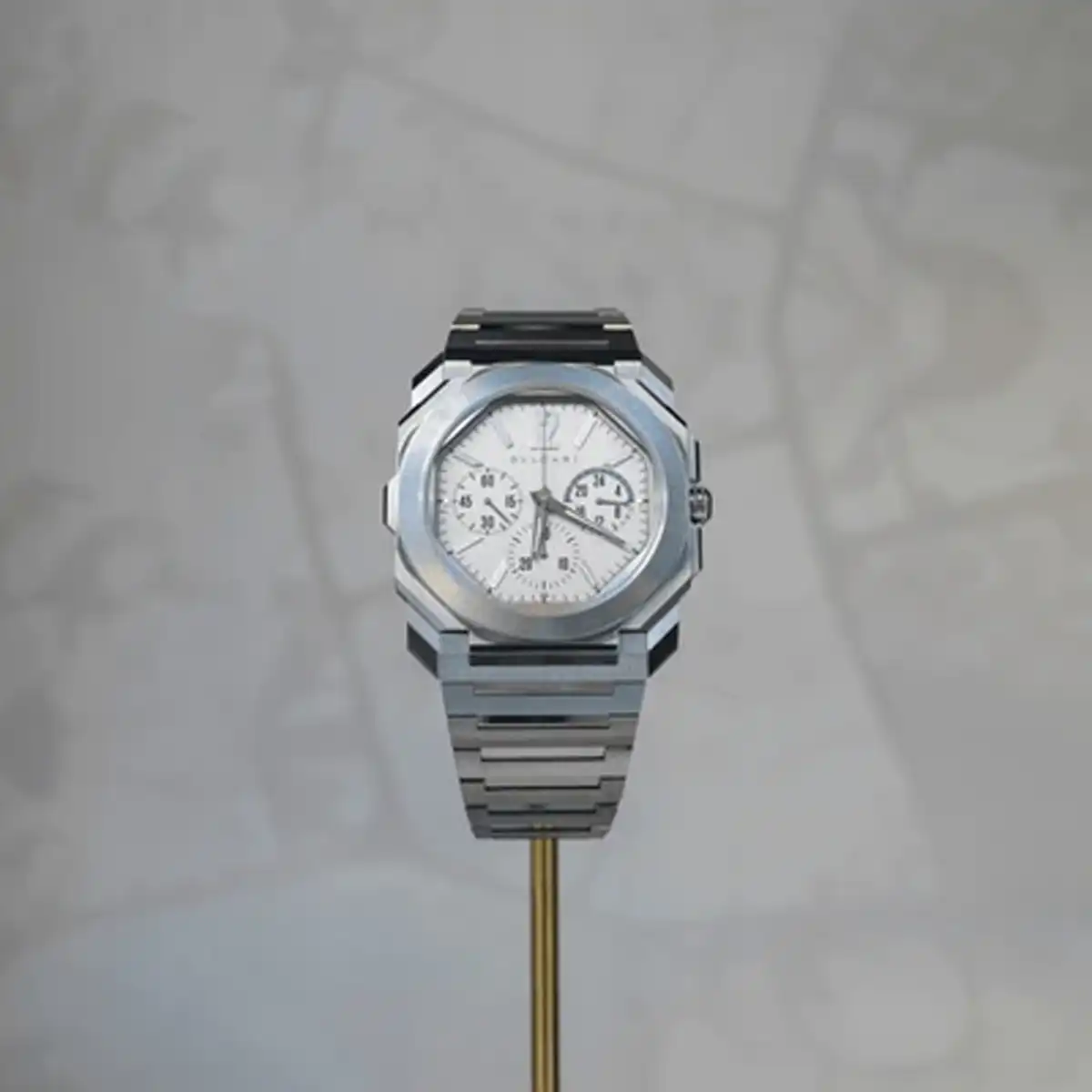
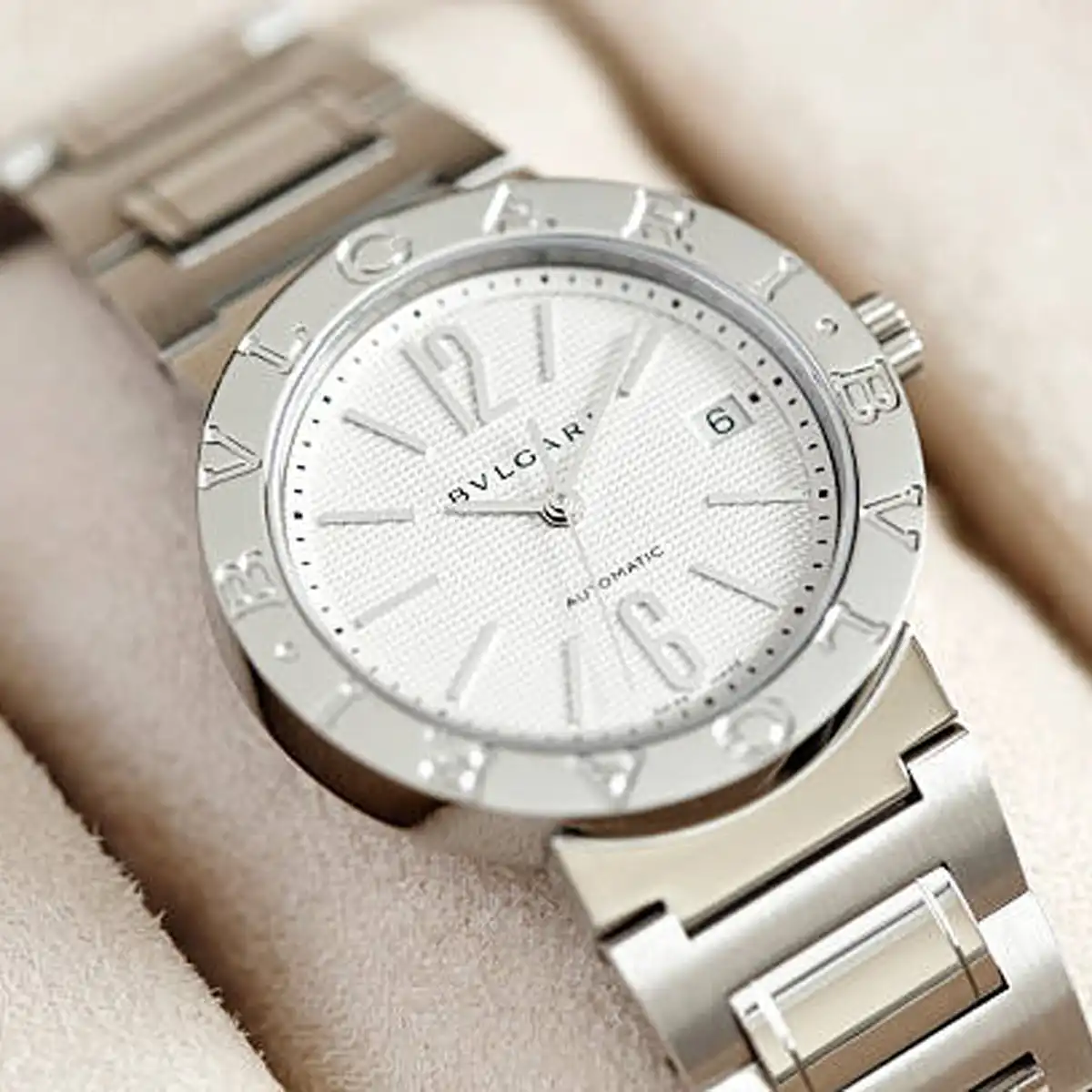
The pre-owned market is equally significant. In the modern segment, firms such as Watchfinder & Co offer certified pre-owned Bulgari watches, including Octo Finissimo pieces. Their inspection processes are particularly relevant given the fineness of Finissimo movements and cases. Neo-vintage and earlier watches by Gérald Genta, branded independently, or early Bulgari sports models, can often be found through specialists on New Bond Street and in Burlington Arcade. The latter is also one of the best places to handle vintage Serpenti and Tubogas bracelets from the 1960s to the 1980s.
When buying pre-owned, there are practical considerations to keep in mind. With titanium Octo Finissimo models, examine the case and bracelet carefully. The sandblasted finish cannot be refinished in the same way as polished steel. Deep marks may require replacing the case or bracelet. Early bracelet models use friction-fit clasps, which should close with authority. Any looseness should be addressed before daily wear. For Serpenti Tubogas pieces, look for gaps between coils or signs that the bracelet does not snap back cleanly when unwrapped. That can indicate fatigue in the hidden internal springs and may require specialist attention.
In terms of value retention, Serpenti Tubogas watches in gold with diamonds tend to behave like blue-chip assets within Bulgari’s universe, often holding around 85–90% of their original retail price if well maintained. Certain Octo Finissimo limited editions, such as collaborations with architects Tadao Ando and Kazuyo Sejima, already trade at significant premiums above retail thanks to their distinctive dials and limited production runs. Standard titanium Finissimo models have found a stable level on the secondary market, frequently representing strong value around the mid four figures in sterling.
Ownership Costs And Servicing For Bulgari Watches
Serious mechanical watches demand proper servicing and Bulgari is no exception. Routine maintenance is essential for performance and to preserve value in a future sale.
In 2025, typical UK pricing for Bulgari service work sits roughly in the following ranges:
| Basic service | Quartz | Around £110 |
| Complete service | Quartz chronograph | Around £405 to £460 |
| Complete service | Standard automatic or manual wind | Around £420 to £640 |
| Complete service | Octo Finissimo | Around £1,150 to £3,030 |
| Restoration or complex high comp | Vintage or grande complication | Price on estimate only |
Costs vary with the specific reference and the condition of the watch. Finissimo models usually have to be returned to Switzerland for full servicing due to the specialist skills and tooling involved, which explains both the higher fees and the longer lead times. A turnaround of three to six months for an ultra-thin complication is not unusual. Owners should factor that into life with a Finissimo and consider having an alternative daily wearer to avoid frustration.
Standard Aluminium and Solotempo-based models are more straightforward. They can often be handled within the UK network, which shortens lead times and keeps costs closer to mainstream Swiss competitors. Regardless of the model, water-resistance checks and gasket replacements are important, particularly if you use an Octo, Aluminium, or dive-style watch in or around water.
From a budget-planning perspective, it is sensible to assume that a regularly worn automatic watch will require a full service approximately every five to seven years, with more complex pieces requiring extra caution. Factoring an amortised annual servicing allowance into the overall cost of ownership gives a truer picture of what it means to buy into Bulgari.
Bulgari Haute Horlogerie And Chiming Watch Leadership
At the very top of the range, Bulgari operates a dedicated haute horlogerie workshop where the legacies of Daniel Roth and Gérald Genta are most visible. Here, the brand has become a serious rival to long-established houses in the field of chiming watches.
The Octo Roma Grande Sonnerie, for example, is a full striking watch that automatically chimes the hours and quarters, with the option to operate as a minute repeater on demand. Bulgari has experimented not only with case materials and gong configurations but also with the very sound signature of its chimes. A collaboration with conductor Lorenzo Viotti reportedly led to the adoption of more adventurous intervals, making the chime pattern instantly recognisable to a trained ear.
Tourbillon watches remain another stage on which Bulgari demonstrates both technical competence and theatre. The Octo Roma Tourbillon Sapphire features clear sapphire case components and skeletonised bridges, so the movement appears to float in space, transforming the tourbillon from a regulating component into a visual spectacle. On the Serpenti side, miniaturised tourbillon calibres such as the BVL 150 show that Bulgari is willing to deliver high complications in forms designed primarily for women, a space that many traditional makers have neglected.
Bulgari Watch Investment Value And Future Strategy
Looking beyond individual references, Bulgari’s broader strategy under CEO Jean Christophe Babin has two clear pillars. The first is the continued miniaturisation of mechanical movements, particularly for the Piccolissimo project. Expect to see more complications, from chiming mechanisms to calendars, shrunk into Serpenti and other jewellery-led cases that were once considered too small for anything beyond quartz. This supports long-term value for collectors who want pieces that combine high jewellery and high horology in one object.
The second pillar is ethical sourcing and sustainability. Since 2022, Bulgari has committed to using only gold that meets the Responsible Jewellery Council's chain of custody standards, meaning every gram can be traced through the supply chain. For buyers in the UK and globally, this is increasingly important when comparing luxury watches that appear similar in specification. A transparent supply chain can influence both purchase decisions and future desirability.
Is A Bulgari Watch Right For You As A Collector
For British collectors and international clients who buy in London, Bulgari occupies a distinctive position. It offers technically sophisticated Swiss watches that look and feel fundamentally different from those of traditional Geneva houses. The Octo Finissimo family appeals to those who enjoy contemporary architecture, cutting-edge engineering and the satisfaction of owning a watch that holds genuine records. The Serpenti line, especially with Piccolissimo movements, speaks to buyers who expect jewellery-level presence on the wrist without sacrificing mechanical watch legitimacy. The Aluminium range provides a more accessible route into the brand, with witty design and strong everyday practicality.
Choosing the right model depends on priorities. If you want to experience the essence of Bulgari’s ultra-thin programme at a relatively attainable level, a pre-owned Octo Finissimo in titanium, such as reference 102713, remains a strong candidate. It delivers the key design cues and movement architecture that made the collection famous, with secondary market pricing that reflects a maturing supply. For focused long-term watch investment, vintage enamel Serpenti and early Tubogas pieces in gold are already treated as grail objects by many collectors, with limited supply and steady demand.
Whichever route you take, buying Bulgari involves a commitment to design as much as to horology. These are watches that look unmistakably Roman, yet beat with high specification Swiss movements. They require appropriate servicing budgets and careful handling for the most delicate complications, but they reward that care with ownership experiences that feel genuinely different. For collectors who have already explored more conservative choices and are looking for pieces that say something about contemporary luxury, Bulgari now deserves a place on the shortlist.