Imagine a collector wearing a Fifty Fathoms over a wetsuit in Cornwall or a Villeret Complete Calendar under a shirt cuff in Mayfair. Blancpain is known as the world’s oldest registered watch brand, founded in 1735, but the company as we know it today was shaped by a major revival in the late twentieth century. For those looking into Swiss watches, Blancpain stands out as a brand that is historically significant, technically advanced, selective in its market approach, and often undervalued when resold.
Blancpain’s story starts in the Jura village of Villeret, where Jehan-Jacques Blancpain registered as a watchmaker in 1735, working from the upper floor of a farmhouse. For almost two centuries, the business stayed in the family and adapted to changing times while keeping its focus on traditional watchmaking. In the nineteenth century, under Frédéric-Louis Blancpain, the company moved from cottage-based production to organised workshops and began developing ultra-thin movements, which later became a signature feature.
The Blancpain family line ended in 1932 when Frédéric-Emile Blancpain died without a direct heir. His assistant, Betty Fiechter, and her associate André Léal stepped in to save the company. Because there was no Blancpain leading the firm, it had to change its name to Rayville S.A., a name inspired by Villeret. Under Fiechter and later her nephew Jean-Jacques Fiechter, Rayville became known more for supplying watch movements to other brands, including American companies like Gruen, Elgin, and Hamilton, rather than as a public-facing brand.
In 1961, Rayville was folded into SSIH, the group that housed Omega and Tissot. The move guaranteed production volume but gradually diluted Blancpain’s distinct marque profile. When quartz technology disrupted the industry in the 1970s, SSIH channelled resources into its large consumer brands and mechanical production at Rayville was wound down. By 1981, the Blancpain name was effectively dormant, a set of archives and rights waiting for someone prepared to take a contrarian position on the future of mechanical luxury watches.
Biver Piguet Revival And The Six Masterpieces
Jean-Claude Biver and Jacques Piguet took that risk. In 1981, they bought the rights to Blancpain from SSIH for about CHF 21,500, showing how out of favour mechanical watches were during the quartz era. They set up in a farmhouse in Le Brassus and rebuilt the brand with a clear message: Blancpain would only make mechanical watches and never produce a quartz model. In the early 1980s, this was a real business gamble, not just a marketing move.
Instead of competing on accuracy or price, the new Blancpain focused on complex features, fine finishing, and creating an emotional connection with buyers. During the 1980s, they released the Six Masterpieces: a complete calendar moonphase, an ultra-slim dress watch, a perpetual calendar, a minute repeater, a split-seconds chronograph, and a tourbillon with a long power reserve. All were set in similar precious metal cases with stepped bezels, making them easy for collectors to identify.
This approach succeeded in many ways. It showed the industry that mechanical watches could offer things quartz watches could not, especially in terms of craftsmanship and feel. It also gave collectors interesting options whena few complicated watches were available. Financially, it boosted the brand’s value. By 1992, the Swatch Group (then SMH) bought Blancpain back for about CHF 60 million, making it one of the most successful deals in modern watchmaking.
Blancpain 1735 Grande Complication As A Statement Piece
After launching the Six Masterpieces, Blancpain wanted to show that its comeback was real, not just marketing. This led to the Blancpain 1735 Grande Complication in the early 1990s. This watch combined a minute repeater, tourbillon, perpetual calendar, split-seconds chronograph, moon phase, and ultra-thin automatic winding in a platinum case, all made from hundreds of hand-finished parts.
Each 1735 reportedly required a year of work from a single master watchmaker, with production limited to a few dozen pieces. For collectors, it functioned less as a piece of jewellery and more as a micro-manufacture on the wrist, compressing the revived company’s technical repertoire into one object. For the market, it sent a clear signal to the so-called Holy Trinity of Swiss watches that Blancpain intended to compete at the same rarefied level of complication, finishing and acoustic performance.
Fifty Fathoms Dive Watch From Military Tool To Tech Gombessa
If the Villeret line is Blancpain’s expression of dress-watch classicism, the Fifty Fathoms is its signature on the tool-watch side. Introduced in 1953 under CEO Jean-Jacques Fiechter in collaboration with French combat diver Captain Robert “Bob” Maloubier, it is widely recognised as one of the first modern dive watches. The brief was straightforward but demanding: a robust watch that could be read in low visibility, track dive time reliably and survive repeated immersion at depth.
Blancpain met these needs with features that are common now but were new at the time. The watch had a large luminous dial, a rotating bezel to track time, and automatic winding to protect the crown seals. To avoid a key Rolex patent, Blancpain created a double O-ring crown system that kept the watch water-resistant even if the crown was pulled out. Later, military versions, especially for the U.S. Navy, added a moisture indicator at six o’clock that changed colour if water got inside, giving a quick safety warning. Models like the Tornek-Rayville, made to meet U.S. rules, are now some of the most sought-after vintage Blancpain watches.
When Marc A. Hayek took over, the Fifty Fathoms returned in the early 2000s and became one of the most advanced luxury dive watches. The modern 5015 model features a domed sapphire bezel, similar in look to early Bakelite versions but much more scratch-resistant. Its Calibre 1315 movement offers a five-day power reserve with three mainspring barrels and is built for everyday use. Somecriticisee the case size and the lack of fine adjustment on older X-71 bracelets, but as both a dive tool and a collector’s item, the Fifty Fathoms is still a key part of Blancpain’s lineup.
In 2023, the story moved on with the Fifty Fathoms Tech Gombessa, developed for technical divers using rebreathers and undertaking long-duration missions. Its distinctive three-hour hand and matching bezel allow precise timing of extended dives. By 2025, the concept had evolved into a permanent reference in Grade 23 titanium with a helium escape valve and an “absolute black” dial that absorbs almost all incident light, improving legibility at depth. For buyers, the Tech Gombessa platform underlines that Blancpain is not only trading on heritage but also solving modern functional problems in professional diving.
Engineering Signatures Carrousel Chiming Watches And Craft
One of Blancpain’s most interesting technical decisions has been to invest heavily in the carrousel, an alternative to the tourbillon that other brands largely ignored. Both mechanisms aim to even out positional errors by rotating the balance and escapement inside a cage. In a tourbillon, a single gear train drives both the timekeeping and the rotation of the cage. In a carrousel, two separate gear trains control those functions, which can offer advantages in robustness and energy distribution.
Blancpain was the first to make a one-minute flying carrousel for the wrist, turning a nineteenth-century concept into a modern high complication. It looks much like a tourbillon, with a rotating opening on the dial, but its design is less common and technically unique. For collectors who already have tourbillons, the carrousel offers a new and interesting take on managing the effects of gravity in watchmaking.
Blancpain has also kept innovating with chiming watches. One recent example is the Grande Double Sonnerie, which lets the wearer pick between two chime melodies using a selector on the case. These watches are very complex, blending precise mechanics with careful tuning of the gongs, and few brands try to innovate in this area. Blancpain’s efforts show it is committed to making serious high complications, not just luxury watches.
Villeret Classic Collection And Golden Hour Updates
Named after the village where the brand was born, the Villeret collection is Blancpain’s anchor in traditional dress watch design. The aesthetic language is tightly controlled: double stepped bezels, slim cases, Roman numerals and leaf-shaped hands that keep legibility high while preserving a sense of understatement. For buyers coming from Patek Philippe Calatrava or Jaeger-LeCoultre Master Control territory, Villeret offers a slightly more romantic but still disciplined take on classic round mechanical watches.
The reference 6654 Complete Calendar Moonphase is the signature piece in this family. It displays the day, date, month and moon phase in a layout that feels richly detailed without tipping into clutter. Two technical features are especially relevant to ownership. First, Blancpain’s under-lug correctors allow calendar adjustments with a fingertip rather than a stylus, protecting the case flanks from the pin marks that often scar traditional calendar watches. Second, the movement is engineered so that the date can be adjusted at any time without risking damage to the mechanism, a valuable safeguard in daily use.
In 2025, the Golden Hour updates brought new opaline and golden brown dials, open-worked solid gold rotors, and a quick-change strap system to the Villeret line. These updates appeal to buyers who like warmer colours and practical strap options, while still keeping the classic Villeret style.
Ladybird And Women's Mechanical Watches
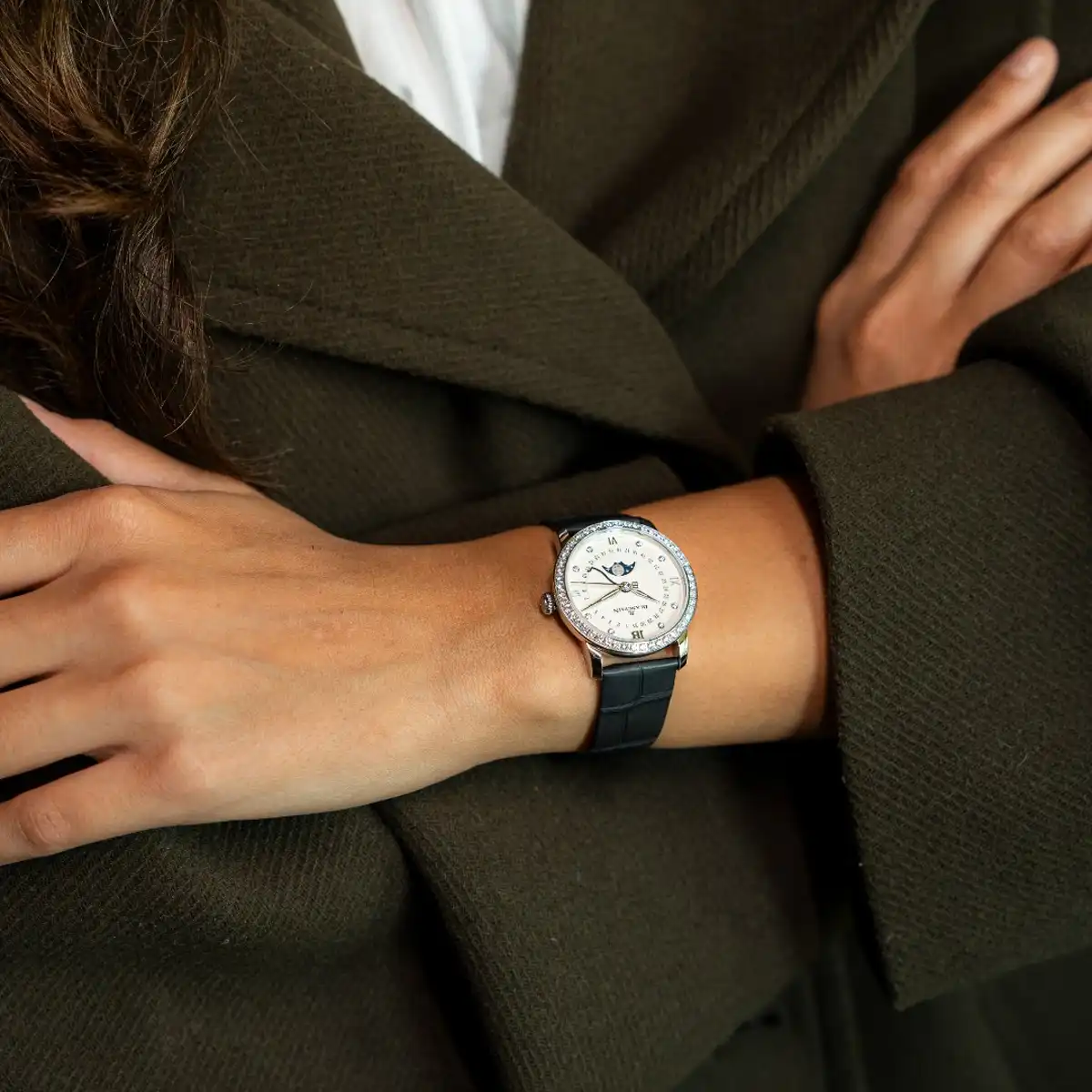
Blancpain’s relationship with women’s watchmaking runs deeper than cosmetic variations. Betty Fiechter's leadership in the twentieth century and the creation of the Ladybird line in 1956 set a precedent that the brand continues to follow. The original Ladybird housed one of the smallest round mechanical movements produced at the time, demonstrating that serious horology could be miniaturised for feminine designs without resorting to quartz.
Today, the LadybirdColourss collection continues that tradition with automatic movements, silicon hairsprings for better resistance to magnetism, and detailed settings. The cases are usually small, with colourful straps and dials, but the mechanical quality matches the men’s watches. For women who want a high-end automatic watch and want to be taken seriously as customers, Blancpain’s Ladybird line is a strong choice.
A notable fact: Betty Fiechter, Blancpain’s long-serving director, is recognized as one of the first women to lead a major Swiss watch company, long before gender diversity was widely discussed in the industry.

Brand Collaborations, Swatch Scuba And Ocean Commitment
In 2023, the Swatch Group drew on Blancpain’s dive watch heritage for the Bioceramic Scuba Fifty Fathoms collaboration. Priced at around £350, these colourful watches used the Sistem51 automatic movement and were themed around five oceans. Purists questioned the long-term durability and serviceability of the movement, which is designed as a sealed unit, but the drop in price point and ubiquity of Swatch boutiques brought the Fifty Fathoms name to a new, younger audience that might otherwise never encounter it. Certain versions, such as the black “Ocean of Storms” and the “Arctic Ocean” with its no-radiation symbol, have already developed a following as playful but conceptually rich entry pieces.
Alongside mass market collaborations, Blancpain invests heavily in ocean conservation through the Blancpain Ocean Commitment. Limited edition BOC watches, including Fifty Fathoms Tech variants, are linked to financial support for marine research projects, with a defined donation per watch flowing to partner organisations. For buyers who care about environmental impact, this programme adds a philanthropic dimension to the decision to purchase a luxury timepiece, especially for professional dive watches that draw design cues from the sea.
Blancpain In The United Kingdom: Buying And Ownership
In the UK, Blancpain keeps a limited retail presence. The London flagship at 11 New Bond Street serves as both a boutique and a showcase for the brand, with woodwork, stained glass, and private spaces that reflect the Vallée de Joux rather than a typical high street jeweller. It is the best place in the country to see the full range of current models, from Métiers d’Art pieces to complex Villeret watches, and to enjoy benefits like private events and collector services.
Beyond Bond Street, the brand partners with major retail groups including Watches of Switzerland, Mappin & Webb, Goldsmiths and Pragnell. These points of sale usually focus on core references from the Fifty Fathoms, Bathyscaphe and Villeret collections, with the most involved complications often reserved for the boutique channel. For buyers who start their research online and then seek to handle pieces in person, this network provides reasonable geographic coverage without undermining the brand’s positioning as a specialist Swiss watch manufacturer.
Ownership costs are an important part of the picture. Independent service centres in the UK quote starting prices in the low hundreds of pounds for straightforward manual-wind watches and more for chronographs, but for modern in-house calibres such as the 1315 or 6654, many collectors prefer to use Blancpain’s own service network. Reports from owners suggest that a full factory service on a Fifty Fathoms can exceed £800, sometimes including case refinishing and other work that not every enthusiast will want. Prospective buyers should factor these costs into total ownership and be clear with service providers about which cosmetic interventions are welcome and which should be avoided.
Bracelet design is another practical consideration. The older X-71 bracelet has often been criticised for limited on-the-fly adjustment compared with systems such as Rolex’s Glidelock, something that matters if a watch is worn regularly on the wrist rather than over a neoprene sleeve. Newer strap quick-change systems on Villeret Golden Hour models and more recent dive references partially address this, but anyone buying pre-owned should pay attention to how the watch fits in real use, not just in the display tray.
Buying Blancpain New Or Pre Owned With Confidence
For secure transactionsauthoriseded channels are still the safest option. Buying from the Blancpain boutique or official partners like Watches of Switzerland and Pragnell ensures you get a manufacturer's warranty, proper paperwork, and access to any service or hospitality programs. This is the lowest-risk way to buy, but it usually means paying full retail price.
The pre-owned market is where Blancpain becomes particularly interesting for value-driven collectors. Standard production models such as the Villeret Complete Calendar or Bathyscaphe versions of the Fifty Fathoms often trade at around 60% of their retail price on the secondary market, in sharp contrast to the premiums that can attach to steel sports watches from some rival brands. For a buyer more concerned with movement architecture and finishing than with social visibility, this creates opportunities to acquire complex mechanical watches at a cost comparable to that of comparatively simple pieces elsewhere.
To reduce the risks of buying complex used watches, especially perpetual calendars and chronographs, many buyers turn to certified pre-owned specialists like Bucherer or The 1916 Company. These dealers sell authenticated, serviced Blancpain watches with their own warranties, lowering the risk of getting a watch that needs expensive repairs right away. Still, it’s important to check the case, dial, and service history carefully, especially for older models where parts may be harder to find.
Investment Profile Depreciation Risks And Collector Upside
From a pure watch investment perspective, Blancpain sits in a nuanced position. Most modern references do not appreciate the way certain stainless steel Rolex or Patek Philippe models have done in recent years. Instead, they behave more like traditional luxury goods, losing a portion of their value after purchase and then stabilising. That can be discouraging for buyers seeking short-term profit, but it is precisely what makes pre-owned Blancpain so compelling for collectors who intend to wear their watches.
Vintage and rare Blancpain watches are a different case. Military-issued Fifty Fathoms models with moisture indicators or “No Radiation” dials have sold for tens of thousands to six figures at recent auctions, depending on their originality and history. Early Biver-era high complications, like platinum minute repeaters and full sets of the Six Masterpieces, are becoming popular with experienced collectors. Limited Air Command flyback chronographs, made in small numbers and based on a rare vintage prototype, have also held their value better than many dressier Villeret models.
At the highest level, watches like the 1735 Grande Complication are in a special category where prices can be high, but they are not easy to sell quickly. These pieces are usually traded privately or through specialised auctions. Anyone thinking about buying at this level should see it as a long-term passion purchase, not a quick investment, and should get expert advice on condition, originality, and after-sales support before spending a lot of money.
Who Makes Blancpain Suits And How To Buy With Confidence
For all the complexity of its history, Blancpain offers a relatively clear proposition to today’s buyer. It is a manufacturer that helped rescue mechanical watchmaking in the 1980s, created a template for the modern dive watch with the Fifty Fathoms, and continues to push at the edges of carrousel engineering and chiming complications. It does not deliver the instant recognition of a Submariner or Nautilus, but it delivers depth of craft, coherent design languages and a clear mechanical philosophy.
In practical terms, Blancpain suits several distinct profiles. The confident collector who already owns well-known sports models may look to Villeret Complete Calendars or Biver-era pieces for movement and finishing. Divers and adventure travellers may gravitate towards Fifty Fathoms or Tech Gombessa models, accepting the physical presence on the wrist in exchange for legibility and robustness. Women who want serious luxury watches with automatic movements, rather than scaled-down quartz fashion pieces, will find the Ladybird line offers both aesthetics and substance.
Before buying, it’s wise to think about a few key questions: do you want new or pre-owned, a boutique or multi-brand retailer, and a simple watch or one with a calendar or chiming complication? Your budget should include not just the purchase price but also future service costs and any strap or bracelet changes for comfort. For UK buyers, the flagship boutique, authorised dealers, and a growing certified pre-owned market make it easier than ever to research and buy Blancpain watches with confidence.
A Blancpain does not stand out loudly. Instead, it rewards careful attention: the glow of a moisture indicator on a vintage diver, the smooth change of a calendar date, or the quiet movement of a carrousel cage. For people who value the mechanics and the brand’s story more than social status, this is exactly what makes Blancpain special.