


If you walk up South Audley Street in Mayfair, you might miss Bamford’s townhouse at first. But once inside, the mood shifts. The rooms are calm, the lighting is carefully set, and trays of matte black chronographs and colourful GMTs are brought out from hidden drawers. For those who spend time comparing jewellers in Hatton Garden and then look for a luxury watch shop in Mayfair, this is where Bamford truly stands out.
The story begins long before the townhouse. George Bamford was raised around heavy machinery, not luxury watches. His family’s JCB business gave him an engineering mindset, where coatings, tolerances, and durability were everyday concerns. This background is important because it shows why his approach to modern luxury watches is based on industrial processes rather than on design alone.
The turning point came when Bamford received a steel Rolex Daytona for his 18th birthday. It had the well-known Zenith-based movement that many collectors admire. He wore it with pride until one night at dinner in London, when he noticed several other guests had the same watch. Realised that owning an expensive mechanical chronograph shouldn’t mean looking just like everyone else. At a time when steel sports watches were global status symbols, this sameness bothered him.
His solution was to look sideways at the coatings used on JCB’s drills and pistons and ask a heretical question: what if that technology could be applied to a Swiss watch case? By adapting industrial Diamond-Like Carbon (DLC) treatments to fine watch cases, he created a deep, even, matte-black finish that appeared to belong to the steel rather than sit on top of it. Early experiments on a Daytona and a GMT-Master drew such attention on a holiday in the South of France that friends began placing orders on the spot. Bamford Watch Department (BWD) was born from that demand, first as a small customiser and quickly as the name most people associated with blacked-out Rolex.
For more than a decade, BWD occupied an awkward position. On one side were traditionalists who saw any third-party intervention on a Rolex case or dial as vandalism that voided the factory warranty. On the other hand was a younger, design-literate clientele, used to limited trainers and hype drops, who wanted their watches to feel as individual as their sneakers. Bamford catered to the latter, colouring dials to match supercars, experimenting with bright hands and reworking models such as the Milgauss with lightning-bolt seconds hands and stealth coatings. The watches were not sanctioned by Geneva, but they tapped into a growing desire for personal expression in luxury that the mainstream Swiss industry had largely ignored.
From outlaw Rolex mods to an LVMH-backed partner
By the mid-2010s, things changed. Custom black Rolex watches from BWD, Pro Hunter, and others were both controversial and popular. They proved to major brands that personalisation was here to stay. Jean-Claude Biver, who led the LVMH watch group at the time, acted first. He brought Bamford in as an authorised custom partner for Zenith, and soon after, for TAG Heuer and Bulgari. This move gave Bamford official status and allowed LVMH to enter the custom watch market more easily.
This change made a big difference behind the scenes. Instead of buying finished watches and taking them apart for coating and dial work, BWD now gets cases, dials, and parts straight from the factories. This means coatings can be applied before assembly and allows for more detailed work, such as decorating movements, creating custom dial bases, and using brand-approved colours.
The partnership also clarified the warranty situation. For approved projects, the movement and main watch are still covered by the original manufacturer’s guarantee, while Bamford covers its own case finishes, dials, and external changes. For buyers who value authorised service, this is important. It turns what used to be a risky purchase into a real alternative to a standard Zenith or TAG Heuer.
Since then, the list of partner brands has expanded to include names such as Girard-Perregaux, Franck Muller and British maker Bremont, giving BWD a presence across both high-complication and tool-watch territory. The company has formally stopped working on Rolex, which has never endorsed third-party modifications, but pre-2017 Bamford-modified Rolex pieces remain sought after as early examples of the custom watch movement.
Materials, coatings and engineering behind Bamford watches
Bamford’s success is not just about colour choices. The Bamfords’ success is about more than just colour options. Watch experts respect the brand for using industrial materials and coatings that create tough finishes, far beyond simple black paint.r applied in a vacuum chamber that bonds to the underlying metal. It is important to distinguish between DLC (the material) and PVD (a method of application). High-quality DLC coatings used in watchmaking typically have a Vickers hardness of 2,000–3,000, compared with roughly 200 HV for standard 316L steel. In practice, that means Bamford’s black cases shrug off everyday scuffs that would quickly mark a brushed steel sports watch. They are not invulnerable to impacts from harder materials such as ceramics or diamond, but long-term owners generally report a gradual softening of edges rather than chips and flakes.
To help the coating stay in place under stress, Bamford uses a special primer layer, often called a military-grade titanium coating, under the DLC. This helps the black finish fit the case shape closely and provides extra protection between the exterior and the steel or titanium beneath. This is especially useful on bracelets and clasps, which often get bumped.
The brand has also been an early mover in forged carbon cases. Rather than using woven carbon cloth, forged carbon involves pressing small pieces of carbon fibre and resin under heat and pressure. The result is a marbled texture in which no two cases look exactly alike, significantly lower weight compared with steel and useful anti-magnetic properties. In larger pieces such as the Bamford London B347 monopusher chronograph, that lightness is what keeps a bold 41.5 mm case comfortable on the wrist.
More recently, Bamford London has introduced Grade 5 titanium cores paired with bioceramic outer shells in the Mayfair 2.0 line. Bioceramic offers a soft, almost chalky tactile feel and rich colour saturation, while the titanium inner module houses the movement and provides water resistance. Owners can clip different coloured outer shells on and off without tools, bringing a degree of physical customisation to an entry-level price band that feels distinct from merely swapping straps.
Fun fact: The original Bamford Mayfair was never meant to be sold at all, but was created as a “service watch” loaned to clients while their customised Rolex or Zenith pieces were on the bench, only becoming a permanent model after customers asked to keep the loaners.
Bamford London watch collections for UK buyers.
While Bamford Watch Department customises other brands, Bamford London is an independent brand on its own. For many UK buyers, it’s the practical way to enter the Bamford world, with original designs, Swiss movements, and a clear house style at prices that fit well within the luxury watch market.
Mayfair and Mayfair 2.0
The Bamford Mayfair has become the brand’s unexpected icon. Its 40 mm asymmetrical case is inspired by military dive watches and features a rotating 12-hour bezel that can also track a second time zone. Early models used sturdy Japanese quartz movements and were water-resistant to 100 meters, making them practical for daily wear. Today, Mayfair models usually start at about £350 from Bamford and authorised retailers, depending on the strap and finish.
The Mayfair 2.0 takes the original design further with a Swiss Ronda chronograph movement and modular titanium-and-bioceramic construction. It comes in curated colour packs, each with shells and straps that can be swapped quickly. Priced around £495, it competes with mid-range fashion brands but offers better watchmaking and a more interesting case.
Bamford London GMT
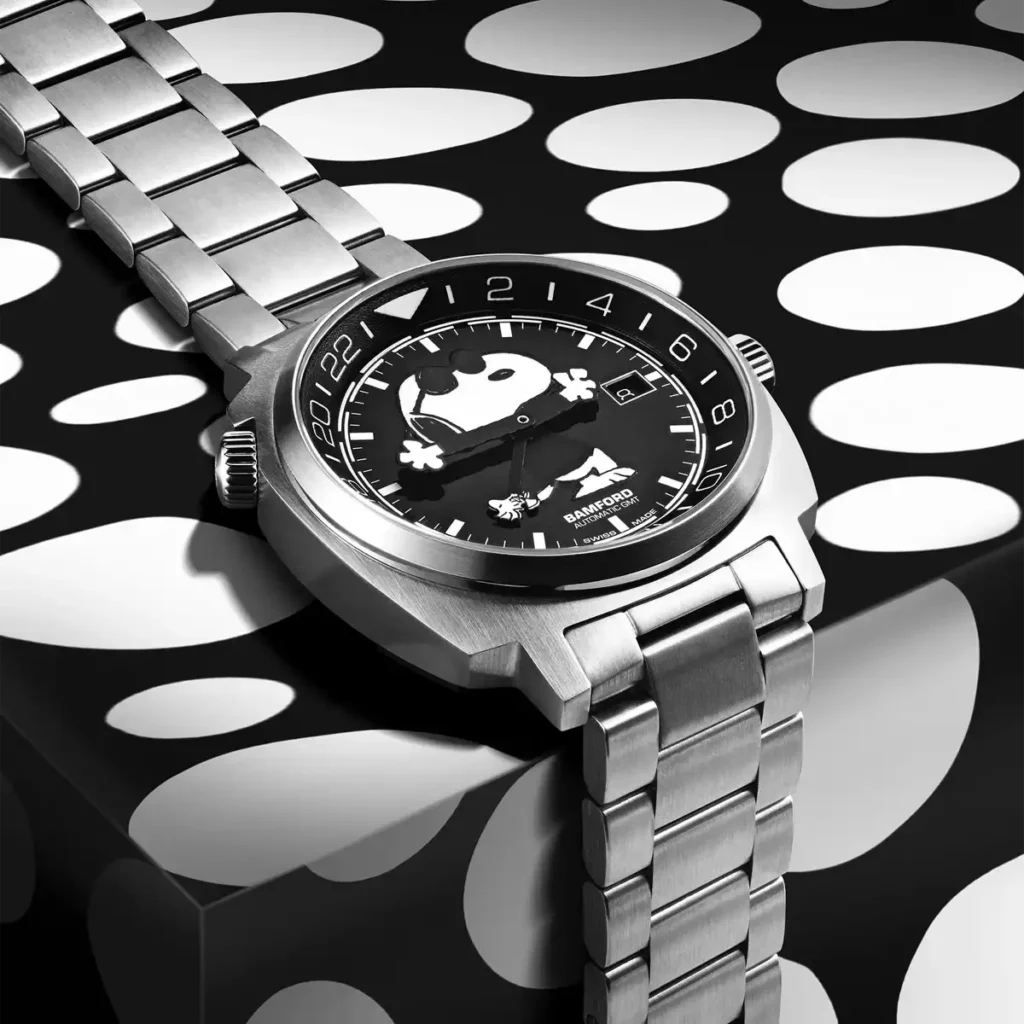
For collectors who travel frequently or simply like the look of a dual-time watch, the Bamford London GMT is the workhorse of the range. The 40 mm cushion case, internal rotating 24-hour bezel and dual-crown layout give it a distinctive 1970s tool-watch flavour. Inside is the Swiss automatic Sellita SW330-2 movement, widely used across the industry and straightforward to service.
Standard steel GMT models are currently priced around £1,450 in the UK. Limited editions, like the Snoopy or special retailer collaborations, cost about £1,700–£1,800. For many, this is the ideal first mechanical Bamford and a strong alternative to mainstream Swiss GMTs at this price.
B347 monopusher chronograph
The B347 is Bamford London’s technical flagship, particularly appealing to enthusiasts who already own steel sports watches and want something more unusual. The design fuses an angular 1970s case with a clean bi-compax dial layout and a single pusher at 2 o’clock that controls start, stop and reset.
Under the hood is the Sellita SW510 monopusher calibre, with a 62-hour power reserve and a date at 6 o’clock. Cases are offered in forged carbon or titanium, often paired with vivid dial accents and rubber straps. Across authorised UK stockists and Bamford’s own site, current B347 models cluster around £2,500.
LR001 and automotive collaborations
If your interests span watches and cars, the LR001 collaboration with Land Rover is worth noting. Produced in a strictly limited run, it mirrors the stripped-back ethos of the modern Defender with a titanium case, a sandwich dial, and field-watch clarity. Launch pricing was set at £1,350, and the run sold out quickly, leaving remaining pieces trading through the secondary market.
Alongside Land Rover, Bamford London has worked with brands ranging from Hackett to Jeremyville and Popeye, but the key point for buyers is that the Bamford London line now covers a clear price ladder. As of 2025, expect to spend from the mid-hundreds for a quartz Mayfair, the mid-four figures for a customised Zenith or TAG via BWD, and a comfortable middle tier of GMT watches and B347 chronographs that sit around the £1,400–£2,500 mark.
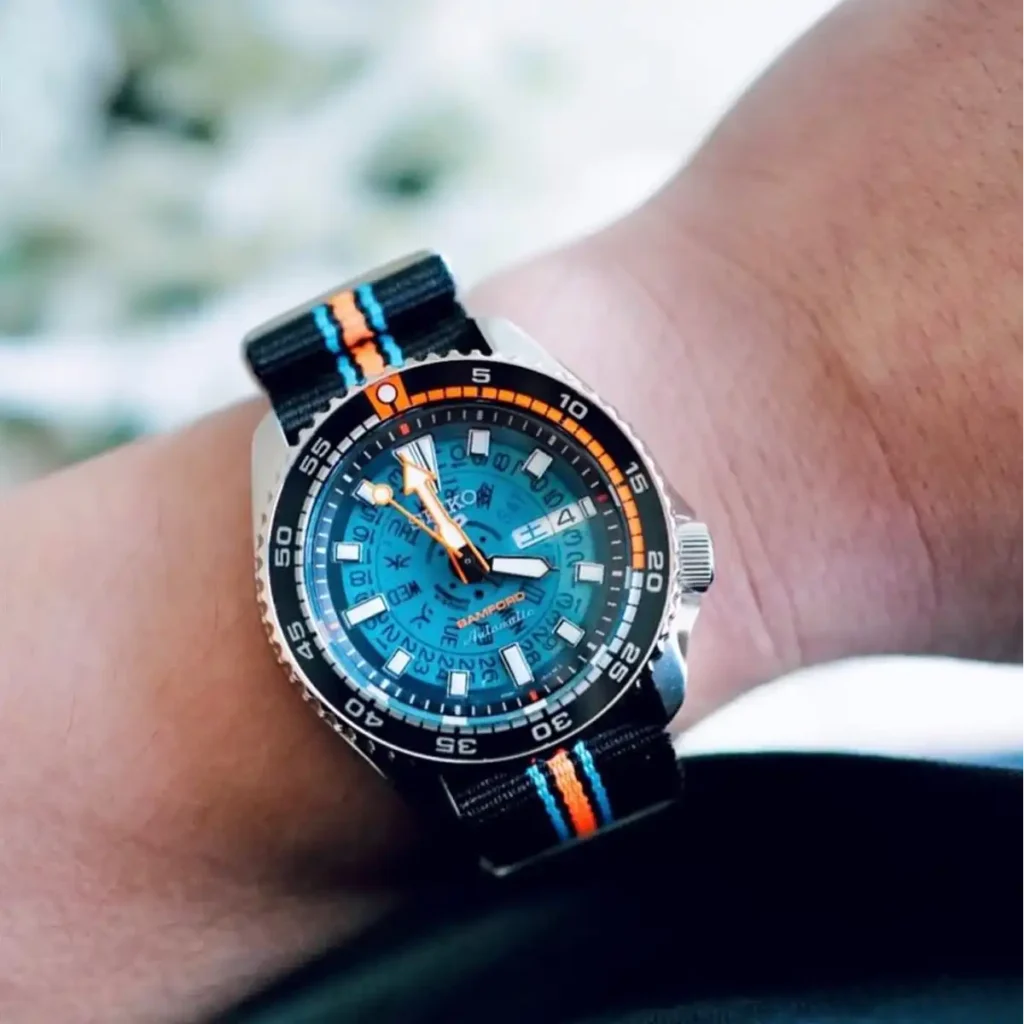
A simplified comparison is set out below as a reference point for UK buyers:
| Mayfair | Steel or coated steel | 40 mm | Quartz | Asymmetric tool watch, 12-hour bezel | From ~£350 |
| Mayfair 2.0 | Titanium core with bioceramic shells | 40 mm | Swiss quartz chronograph | Modular colour shells | Around £495 |
| Bamford London GMT | 316L steel | 40 mm | Sellita SW330-2 automatic | Dual-crown internal-bezel GMT | Around £1,450 |
| B347 | Forged carbon or titanium | 41.5 mm | Sellita SW510 automatic | Monopusher chronograph | Around £2,500 |
| LR001 | Titanium | 40 mm | Sellita SW200-1 automatic | Land Rover co-design, sandwich dial | £1,350 at launch |
*Indicative current or launch pricing; individual limited editions and retailer specials can sit above these figures.
Snoopy Land Rover and G-Shock collaborations explained.
One reason Bamford appeals to collectors who already own classic Rolex, Omega, or Patek watches is its many collaborations. These partnerships connect the brand to art, pop culture, and car history, setting it apart from traditional Swiss brands.
The headline acts are the Peanuts Snoopy projects. Working with the Peanuts estate, Bamford London has produced several mechanical Snoopy GMTs, including limited runs in partnership with retailers and platforms such as Harrods and Hodinkee. These watches are not throwaway character pieces. They use the same Sellita SW330-2 movement as standard GMTs and receive the full Bamford case and dial treatment, with Snoopy integrated into the design rather than pasted on top.
Limited runs, often in the low hundreds, sell out quickly and have shown strong performance on the pre-owned market. Examples of earlier Snoopy editions launched under £10,000 in partnership with other retailers have subsequently sold for over £30,000 in unworn condition, highlighting the power of Bamford’s crossover between pop culture and serious watchmaking.
The Michelin x Bamford B347 Pilot Sport is a standout collaboration for materials. It uses the forged-carbon B347 case, a monochrome racing dial, and a strap made from recycled Michelin Pilot Sport 5 test tyres, featuring real tread and yellow flecks to match Michelin’s colour. Only 133 pieces were made, one for each year since Michelin started, priced at £2,500 and sold through Bamford and select retailers.
At the more accessible end, G-Shock x Bamford London projects take the familiar square and round Casio cases and apply Bamford’s favoured aqua blue and monochrome accents. Current references include a metal-clad GM-5600 collaboration and earlier digital models, which sit well below the £500 mark at launch and tend to sell out quickly through Bamford London or G-Shock’s own channels.
Finally, a Selfridges x Disney x Bamford London GMT reinforces the brand’s comfort with character-driven luxury. This steel GMT combines Disney artwork with Bamford’s case architecture and is sold through the Oxford Street flagship, positioning the watch squarely in the orbit of die-hard collectors and international shoppers browsing fine jewellery counters in the same building.
Where to buy Bamford watches in London and online.
For UK readers comparing Bamford to traditional Mayfair jewellers and watch shops, it’s important to understand where and how to buy.
The main base is The Hive, Bamford’s headquarters at 62 South Audley Street. From the outside, it looks like any other stylish townhouse in W1. Inside, it’s a mix of a design studio, a service centre, and a private showroom. Visits are by appointment only, and clients go through the custom process in private rooms. One floor has a glass-fronted workshop where visitors can watch movements being assembled and serviced.
For most buyers, however, the first contact with Bamford London will be via authorised retailers. Jura Watches, Watches of Switzerland, Goldsmiths and other established groups all carry elements of the Bamford London line, often including B347 and GMT references alongside more mainstream Swiss brands. Department stores play an important role too: Harrods and Selfridges have hosted exclusive Bamford editions, aligning the watches with high-end jewellery concessions and drawing in the same clientele who visit London for diamonds and engagement rings.
Online, BamfordLondon.com and BamfordWatchDepartment.com are the main sources for current collections and official collaborations. They offer international shipping, clear warranty information, and after-sales service.
At the higher end, pre-owned specialists and central-London dealers handle earlier Bamford pieces, especially pre-2017 Rolex projects. Firms such as Watch Club in the Royal Arcade list customised Bamford Daytonas and other references with original BWD paperwork, confirming that the watch was built and finished by Bamford rather than a generic PVD outfit. For anything in that category, documentation is critical. Without it, a coated Rolex is simply treated by the market as a modified watch, with significantly lower resale and more complex servicing.
Many readers who spend time comparing stones and settings among Hatton Garden jewellers now treat Bamford as a complementary stop, booking a Mayfair appointment to explore watches once their diamond shortlist is in place. That pattern reflects how London’s luxury districts are converging around a single, highly informed customer who expects consistent service and aftercare, regardless of whether they are buying a solitaire, a chronograph, or both.
Investment potential and who Bamford watches suit
Financially, Bamford watches fall into three main categories.
At the speculative end are the rarest pieces: early PVD-coated Rolex Daytonas and Milgausses and certain low-run Snoopy or Michelin collaborations. Auction data and dealer asking prices show that selected Bamford Rolex pieces now sell in the mid-five-figure range in sterling, reflecting both scarcity and their position in the history of modern watch customisation. Well-documented Snoopy GMTs have also commanded sizeable premiums over list when flipped quickly after launch, underlining the strength of demand for character-led projects.
The second group includes limited-edition pieces from Bamford London, such as the Michelin B347 Pilot Sport, some Snoopy models, and artist collaborations. These aren’t guaranteed investments, but their strong design, good movement, small edition sizes, and active collector base mean they have a fair chance of retaining their value or even increasing if bought at retail and kept in great condition.
The largest group is regular production Mayfair, GMT and B347 models. These behave much like other well-regarded independent or British brands. Expect the usual gentle depreciation over the first few years, then a stabilisation as the watch finds its level on the pre-owned market. For buyers choosing with the intention of wearing the watch regularly, the focus should be on fit, aesthetics and long-term serviceability rather than speculative upside.
The question of service is worth teasing out. Officially sanctioned Bamford customisations on Zenith, TAG Heuer, Bulgari and other partner brands benefit from a clear division of responsibility. The movement can be serviced through the manufacturer or via The Hive, while Bamford covers case finishes and dial work. Early third-party Rolex projects are different. Rolex service centres typically will not accept watches that have been externally coated or fitted with non-Rolex dials, so owners must plan to work with Bamford directly or with independent watchmakers familiar with DLC coatings. For collectors comfortable with that route, the pieces offer genuine historical interest. For more conservative buyers, recent Bamford London models or LVMH collaborations are a safer long-term proposition.
Bamford usually attracts clients who appreciate tradition but aren’t limited by it. If you like handmade engagement rings from Hatton Garden and custom suits, but want your watch to showcase your style through design rather than just precious metals and diamonds, Bamford will likely appeal to you. On the other hand, if you prefer factory-original models and official brand history, you might want to keep your Rolex or Zenith as is and look at Bamford’s own-brand watches instead.
How to choose the right Bamford watch for your collection
For UK buyers, particularly those already navigating the dense cluster of Hatton Garden jewellers and Mayfair boutiques, the most practical way to approach Bamford is to frame it against your existing collection and your main use case.
If you want a durable watch for daily wear with a strong design, the Mayfair and Mayfair 2.0 are great starting points. They’re affordable for luxury watches, handle bumps well, and come in enough dial and shell options to look good with both a suit and casual clothes.
Frequent travellers or readers who prefer a do-everything steel sports watch should consider the Bamford London GMT. Its internal bezel keeps the profile clean, the Sellita movement is well proven, and the design language is distinctive enough that you will not confuse it with mainstream competitors. For many collectors who already own a classic Swiss diver, this GMT becomes the second watch to get most of their wrist time.
Enthusiasts with deeper collections who enjoy discussing movements and case materials will naturally gravitate toward the B347. The monopusher layout, forged-carbon or titanium cases, and motorsport-influenced colour schemes give it the kind of technical edge and visual impact that stand out even in a watch-heavy Mayfair lounge or a Hatton Garden trade lunch.
If you want the full concierge experience and your schedule allows, book an appointment at The Hive in Mayfair. Even if you end up choosing a standard Bamford London model instead of a custom Zenith or TAG Heuer, seeing the workshop, materials, and digital tools in person helps you understand the brand. It’s also a rare chance to look at watches in a quiet setting, away from the usual shop crowds.
No matter which option you pick, Bamford is best seen as a brand focused on individuality within London’s luxury scene. Like choosing a diamond in Hatton Garden, picking a Bamford watch means balancing technical features, collaboration stories, and long-term use. If you get it right, you’ll have a watch that feels like it was designed just for you, matching the care you put into the rest of your jewellery.


