A trickle of dawn light spills over Mount Tanigawa. Frost clings to ropes and jackets, yet the climber stops for a heartbeat, brushes snow from his cuff, and checks the time. On his wrist sits the Seiko Alpinist, a watch conceived for these very slopes yet somehow just as comfortable beneath a shirt cuff in the City of London. That unlikely duality is the key to its enduring charm. While rivals try to draw firm lines between dress and adventure, the Alpinist blurs them, offering polished refinement one moment and hard-wearing grit the next. It is the rare field watch that earns a nod from both seasoned mountaineers and boardroom executives, and it has done so for more than six decades.
Origin Story of a Mountain Tool
When recreational climbing exploded across Japan during the late 1950s, Seiko saw an unmet need. Local clubs needed a timepiece able to shrug off sleet, sand, and sudden temperature swings. In 1959, the firm answered with the Laurel Alpinist, its first sports watch. Only domestic customers could buy it, yet that scarcity proved prophetic. With a screw-down back, bold triangular indices and a leather cuff to guard against sweat, the watch became essential kit for the “yama-otoko”, or men of the mountains.
Fun Fact: Early adverts showed hikers using the Alpinist not just for timekeeping but also as a quick compass by aligning the hour hand with the sun. The trick still works today once you master the angles.
Two years later, the Seiko Champion Alpinist 850 series arrived, adding radial dial lines and an engraved mountain on the case back. Those flourishes turned practicality into personality and helped lay the groundwork for the legend.
Renaissance of the Nineties Design
Enthusiasts thought the adventure was over when the line went quiet through the seventies and eighties. Then, in 1995, Seiko revived the name inside its professional specification family, a move that first tied Alpinist to what we now call Seiko Prospex. Designer Shigeo Sakai introduced the internal compass ring, complete with a second crown at four o’clock, and paired it with ornate cathedral hands. Collectors nicknamed these references the Red Alpinist because of the scarlet script beside six o’clock. Beneath the dial, a high-beat calibre 4S15 buzzed away at 28,800 vibrations per hour. A tough Sapphlex crystal and 200-metre water resistance made the watch feel over-engineered in the best possible sense. Crucially, Sakai’s design language would set the standard for every modern Alpinist that followed.
SARB Series and Internet Fame
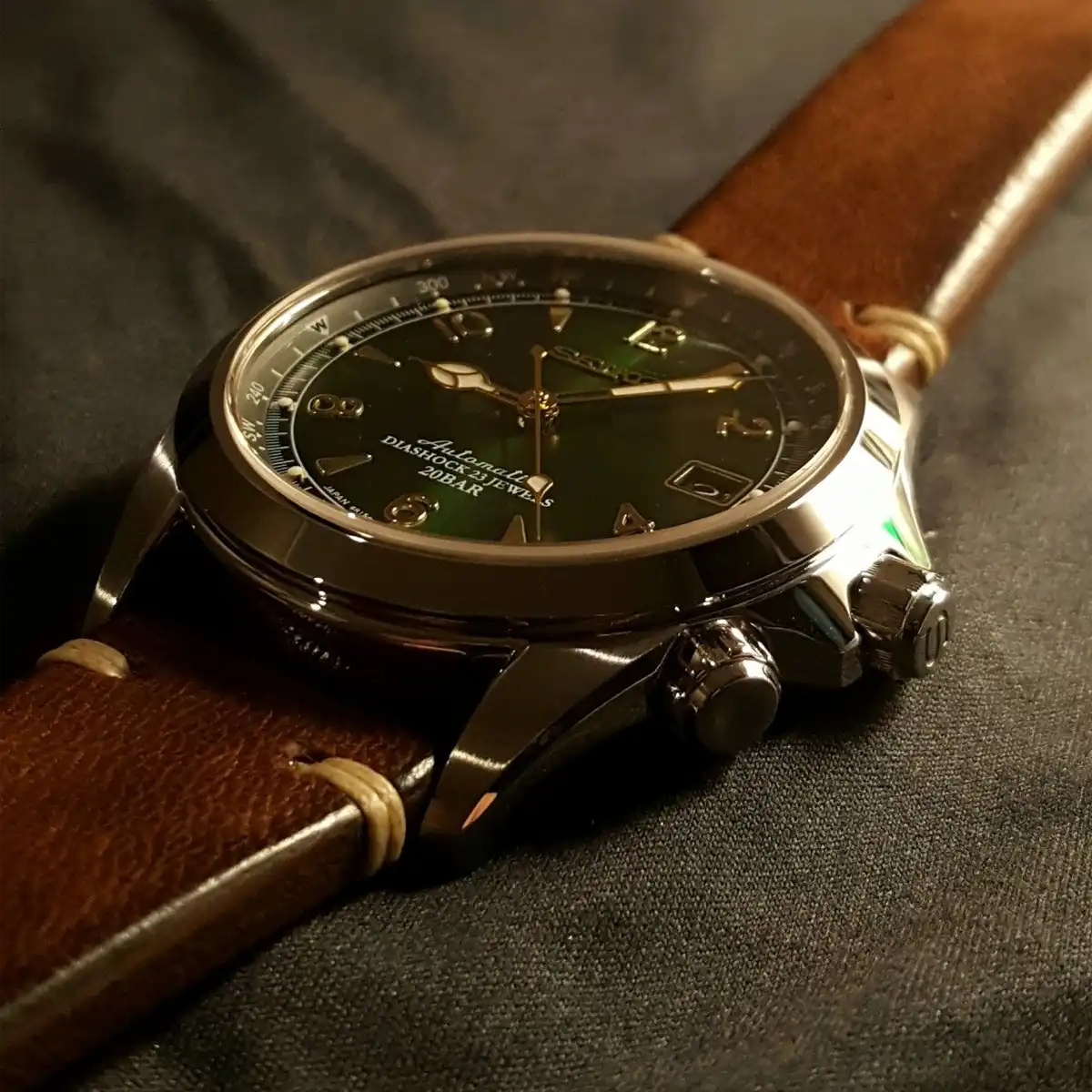
Seiko’s next masterstroke arrived in 2006, though almost nobody outside Japan noticed at first. The SARB line carried over the dual crowns and compass, but dial colours became bolder and finishing more refined. One reference changed everything. The SARB017, with its enchanting sunburst green face and golden numerals, electrified forums such as WatchUSeek at the very moment social media connected far-flung enthusiasts. Importing that JDM model demanded patience, currency exchange calculations, and the nerve to trust a seller halfway around the globe. Success felt like finding hidden treasure, and word-of-mouth praise shot the Alpinist to cult status.
Prices stayed modest, yet the technical package was generous. The 6R15 automatic movement added hacking, hand-winding and a 50-hour reserve. A sapphire crystal topped it all. For many buyers, the SARB017 became the best everyday watch money could buy, capable of trekking the Highlands on Saturday and attending a wedding on Sunday.
Anatomy of a Paradox
Understanding why the Alpinist resonates requires looking closely at its physical ingredients and how they contradict one another in just the right proportions.
Case and Dual Crown
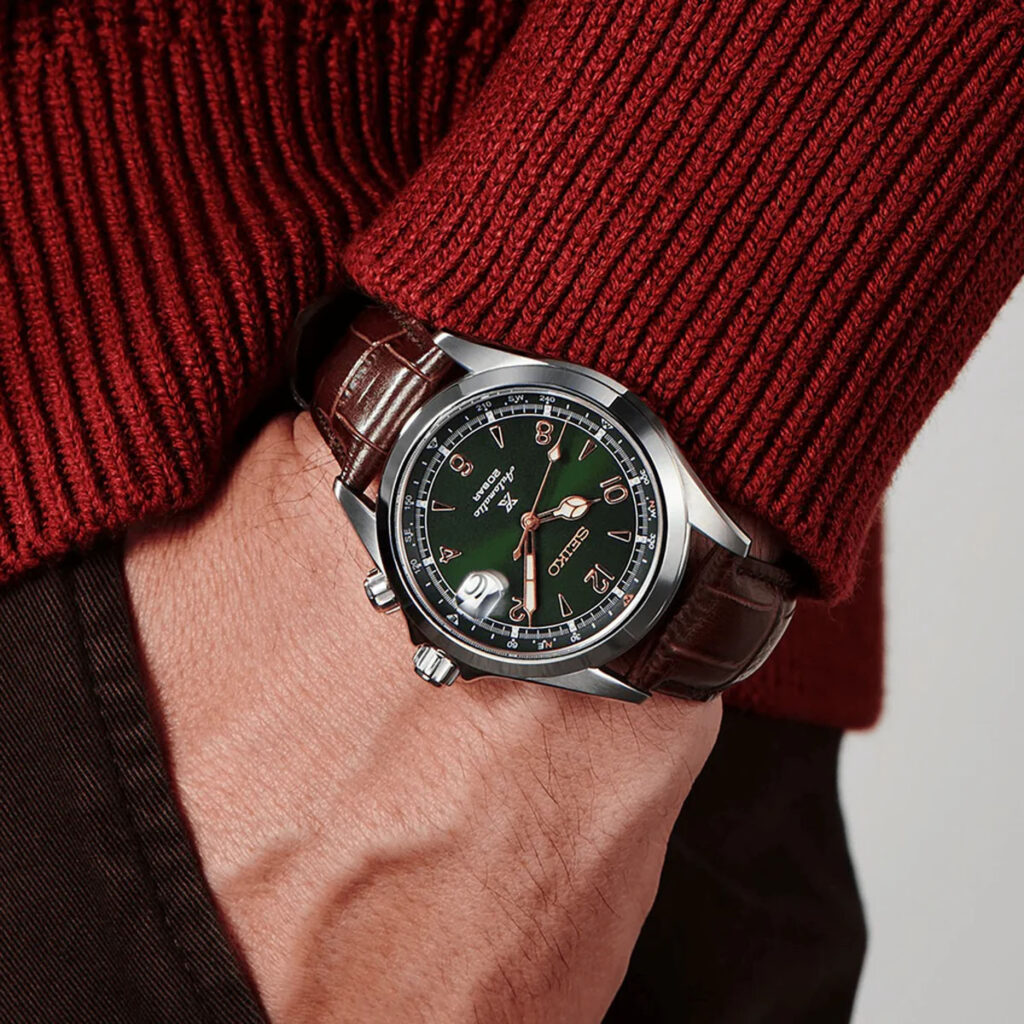
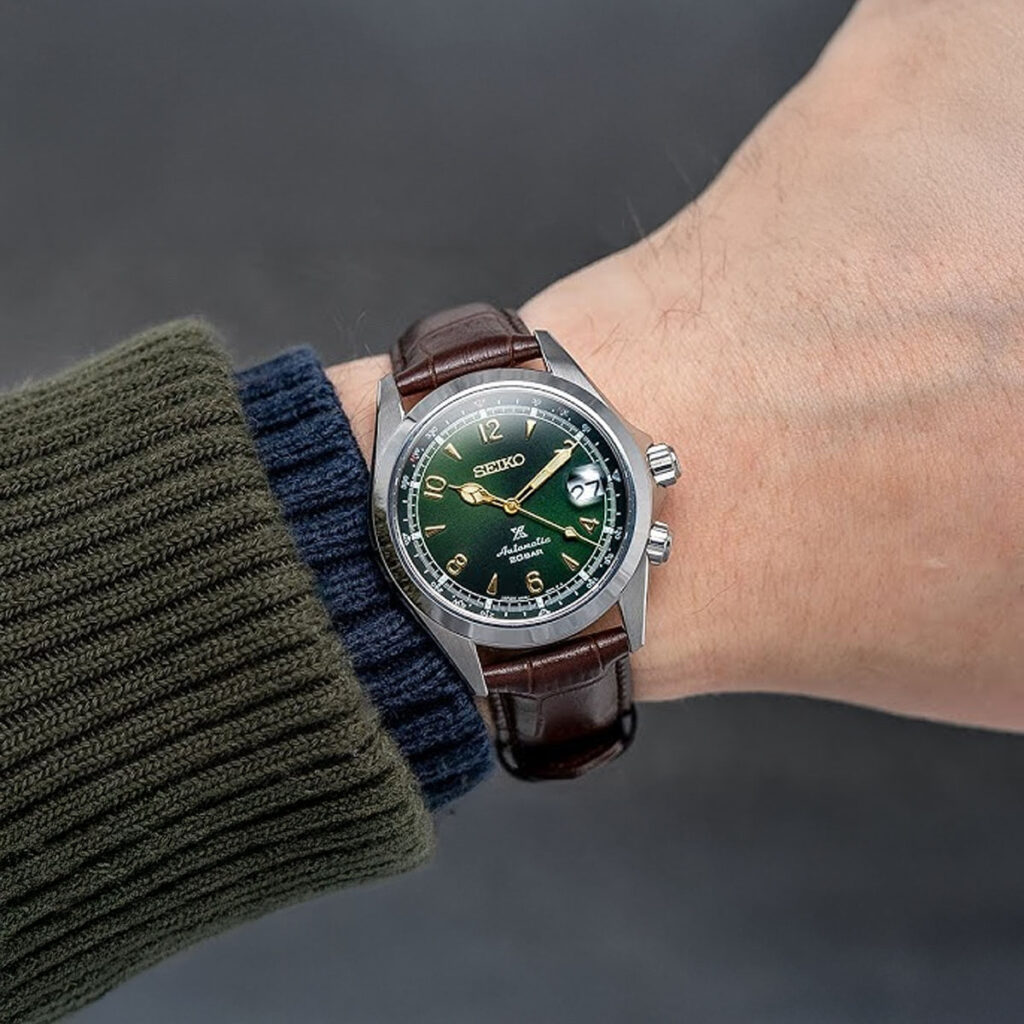
Classic examples measure a sweet-spot 38 mm across, with later Prospex versions nudging 39.5 mm. Lug-to-lug stays under 47 mm, so even slender wrists avoid the dinner-plate look. Brushed upper lugs whisper utility, while mirror-polished flanks shout elegance. The primary crown screws down to guarantee 200-metre resistance, a figure that embarrasses most rivals. The secondary crown, although not screw-down, turns the compass ring and gives the silhouette instant recognisability. Some owners complain that it spins too freely. Yet, few would surrender the feature because it makes the Alpinist unmistakable at a glance.
Dial and Hands
The face is an exhibition of contrasts. Take that famous green dial watch: under soft light, it appears deep forest, almost black; under noon sun it glows like jade dusted with gold. Applied Arabic numerals at even hours share the stage with sharp peaks at the odds, evoking both cathedral architecture and mountain summits. The handset looks lifted from a vintage officer’s watch, complete with stained-glass skeleton windows filled with bright LumiBrite. It is whimsical, maybe even self-indulgent, yet functional lume plots ensure true night visibility.
Crystal, Strap and Everyday Practicalities
Seiko’s decision to fit a flat sapphire crystal to the SARB line was nothing short of generosity when many competitors at the price still relied on mineral glass. Modern Prospex editions keep the sapphire but add anti-reflective coating and, in a nod to 1995, a cyclops over the date. Purists debate the cyclops endlessly, yet nobody questions the clarity it brings.
The one element that draws near-universal scorn is the original brown strap supplied with SARB references. Stiff, plasticky and slow to break in, it was often replaced within hours of unboxing. That misstep turned into an unexpected strength, however, because the watch looks superb on almost anything: riveted pilot leather, brushed oyster bracelet, even striped NATO. Straps became a canvas for owners to express style, and social-media exchanges of combinations widened the Alpinist’s footprint far beyond traditional advertising.
Movements That Evolve
Underneath, the engine has changed only twice in modern history, moving from 6R15 to the newer 6R35. The latter stretches reserve to a weekend-friendly 70 hours but arrives from the factory with wider accuracy variance. Some enthusiasts still prefer the proven stability of the earlier calibre, while others accept a quick regulation for extra stamina. Either way, both movements are proudly in-house, a badge of honour for any Japanese watch brand competing against Swiss rivals.
Cultural Impact and Community
Watches rarely become icons through specification sheets alone. They need storytellers, and for the Alpinist, those storytellers are watch collectors themselves. Scarcity outside Japan, combined with a price point that felt attainable, turned ownership into a shared adventure. Blog posts chronicling import headaches, customs duties and first impressions read like mini-travelogues. As a result, the Alpinist secured a reputation not merely as a tool watch but as a rite of passage within the hobby.
Modding culture soon embraced the platform. Vendors now sell alternative dials, cases and bezels that let builders craft anything from a tribute to early Laurel models to a fantasy GMT conversion. This hands-on creativity underscores how the Alpinist’s design invites participation rather than dictates taste.
Technical Performance in Daily British Life
Any watch can list specifications, yet true capability is measured on the wrist. Owners across the UK confirm that the modern Prospex Alpinist lives up to its data sheet. The screw-down crown and solid case marry to create a genuine 200-metre seal. A weekend paddle in Cornwall or an unexpected rainstorm on Snowdon cannot breach it. LumiBrite remains a highlight. Two minutes under an LED lamp charges the paint until it glows through an entire film, outlasting many Swiss rivals that cost twice as much.
The Calibre 6R35 inside recent models offers a long 70-hour reserve, meaning you can set the watch down on Friday evening and return to it on Monday without winding. Out-of-box precision varies, often hovering between plus ten and minus fifteen seconds per day. A routine regulation by a competent technician narrows those figures to within five seconds, proving that headlines about poor watch accuracy are solvable rather than structural. Earlier SARB pieces that use the 6R15 show marginally tighter timekeeping but shorter endurance, so buyers must decide which trait matters most.
Magnetic protection sits at 4,800 A/m, perfectly adequate for daily exposure to laptop speakers and phone cases. Seiko’s gaskets also resist dust intrusion, so countryside ramblers find the Alpinist keeps its crisp click when the compass crown is rotated years later.
Rivals on the Field
British boutiques carry plenty of field watches, yet few hold the same mix of character and utility. The Hamilton Khaki Field is the obvious opponent. It costs a shade less, runs a highly regulated 80-hour H-10 calibre, and slips neatly under a shirt cuff. Against this, the Alpinist counters with twice the water resistance, stronger lume, and a dial that sparks conversation rather than fading into the crowd.
Stretch the budget and the German-made Sinn 556 enters play. Its Sellita movement is chronometer-grade, the case machining approaches surgical, and it exudes stark minimalism. What the Sinn lacks is warmth. Owners often praise the Alpinist for making them smile every time its sunburst catches a pub’s pendant light. That emotional pull should not be discounted when choosing the best everyday watch.
For shoppers who demand luxury finishes and COSC certificates, Tudor’s Black Bay 36 or Ranger bring even finer tolerances, though at triple the price. Many enthusiasts still keep an Alpinist beside their Tudor because one satisfies refinement while the other scratches the itch for exploration.
Buying an Alpinist in the United Kingdom
Authorised Dealer Route
Goldsmiths, Ernest Jones and a growing list of independent jewellers now stock the compass-bezel SPB121, the cleaner SPB155 and the vintage-flavoured SPB241. Retail prices start near £650 and rise to £1,400 for GMT editions. Purchasing from an AD secures Seiko’s two-year warranty and guarantees factory-fresh condition. Most stores can order uncommon references within three weeks if a deposit is placed.
The Grey and Pre-owned Market
Since official distribution broadened, grey discounts are slimmer than in past years. Yet, platforms such as Chrono24 or Watchfinder still list new pieces at £50-£80 below high-street tags. The discontinued SARB017, once available for £350, now trades between £600 and £1,000 depending on box, papers and bracelet. Prices rose steeply after 2018 and have plateaued, so buyers today pay for rarity rather than speculation.
When approaching a private listing, request a macro photograph of the four-digit dial code near six o’clock and confirm it matches the calibre first four digits on the case back. Cross-check the serial number’s first two digits with online decoders to verify the build month aligns with the production window. Genuine watches show sharp engraving, centred print and a smooth crown thread. If a seller refuses close-up images, walk away.
Servicing and Parts
Seiko’s UK service centre in Maidenhead holds components for Prospex references and still supports SARB models. A full overhaul, including pressure test and polish, costs roughly £250 and returns the watch with a one-year service guarantee. Independent specialists such as Watch Repairs UK and Ryte Time in Croydon charge less and often regulate the movement more finely than factory tolerance. Spare crystals, crowns and gaskets are widely available, and modding suppliers stock alternate dials if you wish to create a homage without touching an original.
Trust Through Provenance
Seiko’s open approach to documentation builds confidence. Each Prospex Alpinist ships with a stamped warranty card and individual quality-control sheet. Owners frequently post these documents on forums, offering transparency that helps police the market. Vintage examples benefit from an active archive project where enthusiasts catalogue serial ranges, dial variations and movement changes. This communal record makes forgery harder and values clearer.
Moreover, decades of mountaineering stories underpin the brand’s credibility. Reports from the Japanese Alpine Club during the 1960s praise the Laurel Alpinist for surviving sub-zero ascents when pocket chronographs froze. Modern testimonials feature Scottish Munro baggers applauding the watch’s grip on a Perlon strap soaked in sleet. Such anecdotes reinforce that marketing slogans here rest on lived experience.
Action Plan for Prospective Owners
If you desire a watch that bridges city meetings and Lake District scrambles, few options match the Alpinist. Begin by trying one in person to judge whether the secondary compass crown bothers your wrist. Next, decide between the personality of green or the subtlety of black and cream. Budget an extra £40 for an aftermarket strap, because even Seiko’s improved leather remains stiff at first. Finally, schedule a regulation after three months of wear so the movement settles within chronometer-like precision.
The Alpinist’s greatest gift is freedom. It frees a traveller from swapping watches before dinner, frees a commuter from panicking over summer downpours, and frees a collector from homogeneity. Wear it through mud, rinse it under the tap, polish the bezel on your cuff, then slip into a blazer and it still feels right. That versatility is why so many owners call it their desert-island choice.
Final Reflection
A timepiece, at its core, is a promise to mark every passing second. The Seiko Alpinist keeps that promise while urging its wearer to use those seconds boldly. It whispers of cedar forests and granite ridges even when you are trapped on the Central line. In a world where possessions grow ever more specialised, this watch remains gloriously multi-talented. Choosing one is less about collecting steel and gears and more about endorsing a philosophy that work, play and discovery can share the same moment.
Like the trusty compass tucked into a seasoned rambler’s pack, the Alpinist points true whether skies are clear or clouded. Buy thoughtfully, treat it kindly, and it will repay you for decades. As the old British saying goes, “Look after your kit and your kit will look after you.”