Timeless fascination surrounds the sport-ready watch that looks just as assured beneath a wetsuit as it does under a shirt sleeve. In 2025, that passion has intensified. Social feeds brim with steel-clad wrists, forums buzz with tick-by-tick accuracy reports, and buyers scour boutiques in search of the elusive sweet spot between heritage, performance, and cost. Into this crowded arena steps the Tissot Seastar 1000, a watch pitched as a Swiss watch under £1000 yet aiming to punch far above its weight in the category. Before we weigh its credentials, it is worth confronting a simple truth. For many enthusiasts, value is not measured only in pounds or francs. It is measured in stories, touch points and the confidence that a piece of kit will endure every splash and scrape of daily life. That emotional charge is where our journey begins.
A Heritage Forged Underwater
Tissot has been planting its flag in horological history since 1853. The family firm launched the first dual-time pocket watch in its founding year, serving travellers when rail networks were still stitching continents together. By 1930 Tissot joined forces with Omega, creating an industrial powerhouse that later evolved into the Swatch Group. The relationship granted Tissot access to movements that would share DNA with the calibre propelling the Moon-bound Speedmaster. Such cross-pollination laid the groundwork for the name "Seastar". In the buoyant post-war era of the 1950s, it identified rugged, water-resistant models rather than a single reference. Dress pieces, chronographs and everyday automatics all carried the moniker, mirroring Omega's broad use of "Seamaster".
Collectors trawling auction sites today stumble across Seastar Sevens, Visodates and cushion-cased chronographs fitted with Lemania engines. One 1970s Seastar, notable for its integrated bracelet, even inspired the 21st-century PRX that now dominates Tissot's best-seller lists. These lines prove that the Seastar badge is not marketing froth. It is a living thread that entwines vintage chic with contemporary engineering.
Fun Fact: In 1930 Tissot merged with Omega, making the two brands stablemates decades before the Swatch Group era.
Anatomy of a Contemporary Diver
Placing the present-day Seastar on the table reveals a study in calculated specification. Tissot's designers had to satisfy hardened scuba instructors while courting office dwellers who merely fancy a splash of sport on the commute.
Case and Crystal
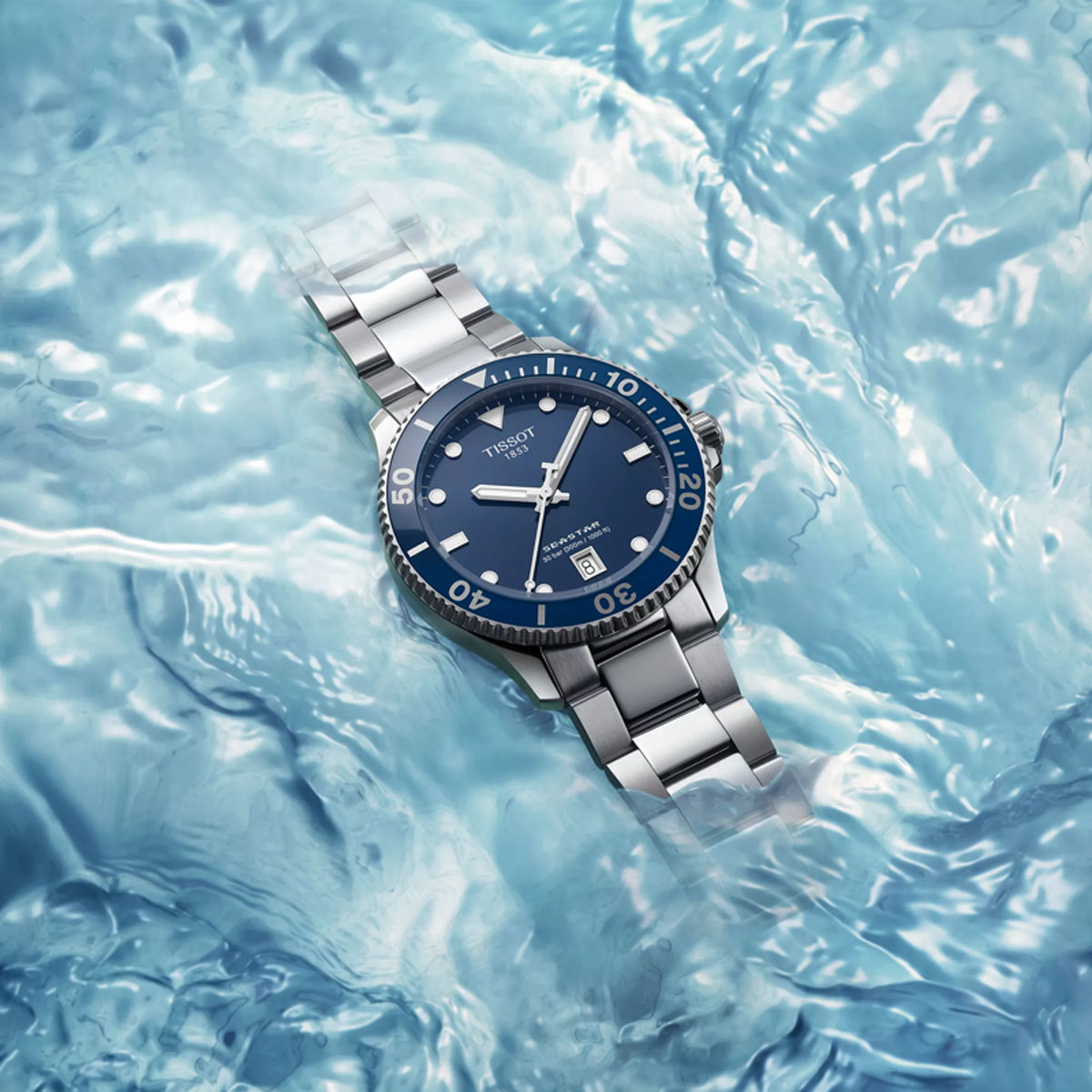
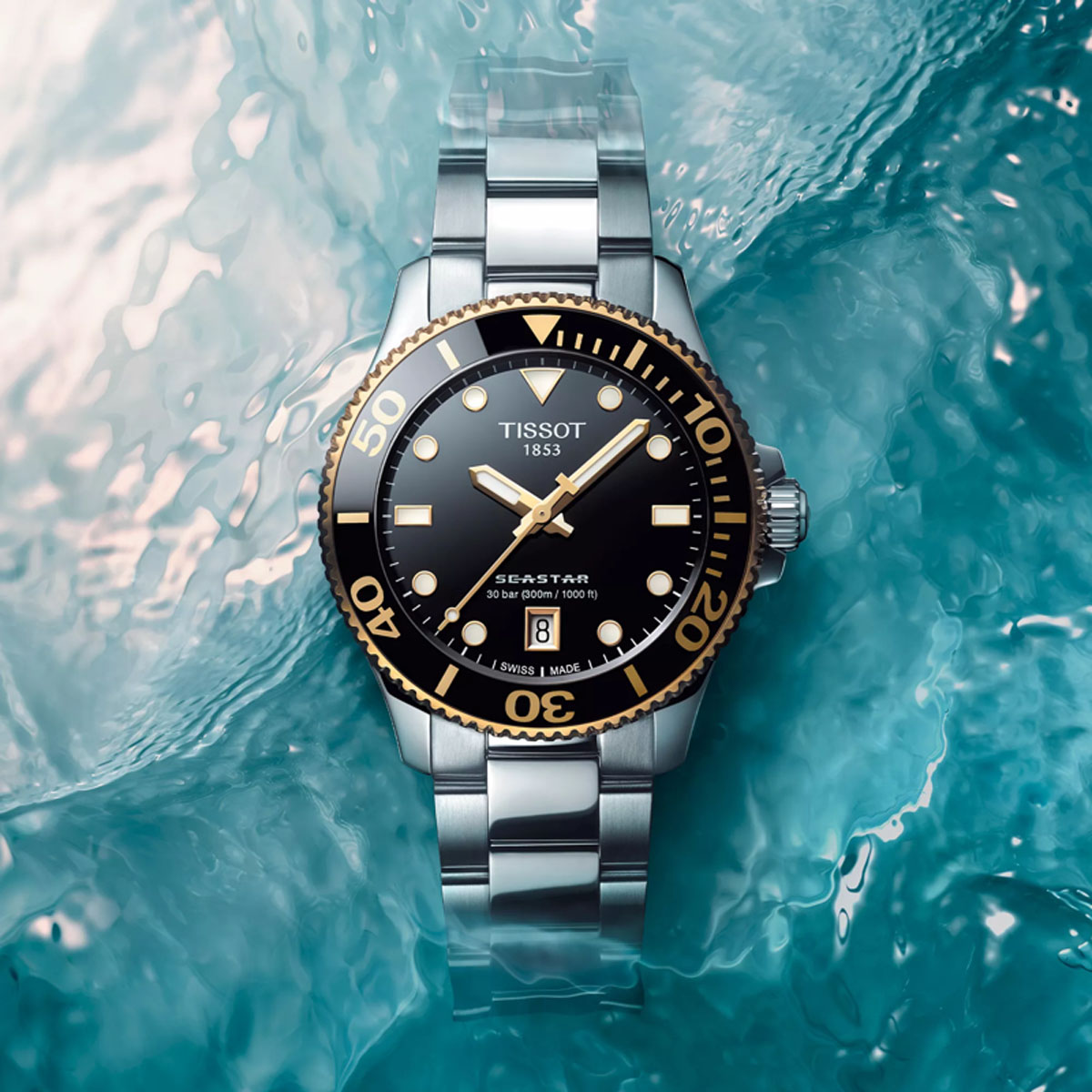
The foundation is 316L stainless steel, the industry benchmark for corrosion resistance. A flat sapphire crystal sits on top, featuring an anti-reflective coating that resists desk-diving abrasions. Crucially, many variants include a ceramic bezel insert. Only a few years ago, this scratch-proof finish was exclusive to luxury models costing triple the price. Its presence here cements the Seastar's pitch as a ceramic bezel watch for mainstream budgets.
Early Seastars measured 43 mm across, a girth that dominated slimmer wrists. In response to community feedback, Tissot unveiled a 40mm version. At 12.5 mm thick and 46 mm lug-to-lug the smaller case slips neatly under a cuff yet retains enough road presence to feel purposeful. Alternating brushed and polished surfaces plus a polished notch along each flank add visual sparkle without straying into jewellery territory.
Dial and Legibility
Tissot keeps the dial architecture clean. Triangular markers at twelve, rectangles at the quarters and circular plots elsewhere deliver instant orientation. Recent releases introduce vertical brushing and a fumé fade that drifts from inky black at the edge to charcoal at the centre. Super-LumiNova paint ensures low-light clarity. Owners praise the after-glow although they note the lume dot on the bezel is the sole illuminated reference outside the crystal.
The bezel itself turns through 120 firm clicks. Most wrists report a precise alignment, yet enough mis-aligned examples circulate on forums to warrant a pre-purchase check. For a safety instrument any mismatch between bezel pip and minute track undermines trust.
Bracelet, Strap and Everyday Versatility
An Oyster-style steel bracelet with polished centre links is the default pairing. It appears dressier than a purely tool-oriented option and echoes the older Sea-Dweller aesthetics. Cost trimming is evident in the stamped clasp. It fastens securely but lacks the push-button glide micro-extension systems now appearing on rivals. Offsetting that compromise is a quick-release spring-bar system. A fingernail tug frees the bracelet, inviting owners to switch to T-fit rubber or NATO straps in seconds. The system makes the Seastar a genuine chameleon, blending seamlessly between the boardroom and the beach.
Seastar 1000 Powermatic 80 (40 mm) Key Specifications
- Reference example: T120.807.11.051.00
- Case diameter: 40 mm
- Thickness: 12.5 mm
- Lug-to-lug: 46 mm
- Lug width: 20 mm
- Crystal: Sapphire with anti-reflective coating
- Bezel: Unidirectional 120-click, ceramic or mineral insert
- Water resistance: 300 m (30 bar)
- Movement: Powermatic 80 movement
- Power reserve: 80 hour power reserve
- Luminescence: Super-LumiNova hands and indices
- UK RRP (June 2025): £685
Movement in Focus
The heart of the watch is the Powermatic 80 movement, a heavily modified ETA 2824-2. Extended autonomy ranks as its marquee selling point. Leave the Seastar resting all weekend and it will still tick come Monday morning. The secret is a slower 3 Hz beat and an upgraded barrel. Critics grumble that the seconds hand sweeps in six steps each second rather than eight, producing a slightly twitchier motion. Supporters counter that the gain in convenience outweighs the aesthetic trade-off.
Synthetic escapement components and Tissot's Nivachron hairspring deliver exceptional anti-magnetic resistance. That is a tangible advantage in a world brimming with smartphones, laptops and handbag clasps. The flip side is serviceability. Independent watchmakers have limited access to Powermatic parts, and Tissot's own service network favours movement swaps over traditional tweaking. Purists seeking a calibre built for century-long fettling may hesitate. Pragmatists drawn to robust accuracy at a sharp price often shrug and buy.
Competitive Landscape
No watch exists in isolation. The Seastar jostles for visibility against a deep bench of rivals, each pushing a distinct narrative of quality.
- Best affordable diver. The Seiko Prospex SPB143 exemplifies Japanese grit with its in-house 6R35 calibre. Forums tally Seiko bezel alignment gripes as often as they record Tissot ones, yet the SPB143's comfort and serviceability remain strong selling points, shaping the Seiko Prospex vs Tissot debate.
- Longines HydroConquest comparison. Sitting one rung higher within the Swatch hierarchy, the HydroConquest offers a thinner case, a more refined L888 movement and brand prestige at roughly double the money. Many buyers weigh the extra polish against the Seastar's ceramic bezel and extended reserve.
- Oris Aquis. An independent success story celebrated for finishing and design identity. It commands almost triple the Seastar's outlay, reminding shoppers that artistry carries a premium.
These alternatives sharpen the Seastar's proposition. They demonstrate that while the Tissot may concede ground on bracelet clasp finesse or artisan servicing, it counters with genuine Swiss lineage, contemporary materials and an impressive specification sheet.
The Professional Sibling
Pushing the specification ceiling, Tissot unveiled the Seastar 2000 Professional. Water resistance increases to 600 m, accompanied by a helium escape valve, and the watch bears an ISO 6425 certified badge. Yet social media reports of bezels spinning freely straight out of the box have dented its reputation. The 2000 may serve more as a halo piece projecting extreme potential onto the smaller model than as a foolproof instrument itself.
Inside the Movement – Service, Reliability and the Collector's Dilemma
The Swiss dive watch looks bullet-proof on paper, yet its heart reveals a delicate balance between engineering ambition and long-term upkeep. Tissot's Powermatic platform delivers consistency that rivals quartz for day-to-day drift, but it does so through factory-set tolerances that leave little room for village-clock-tower tinkering. The escapement is laser-regulated then sealed under a full balance bridge, a feature that boosts shock resistance yet frustrates traditional watchmakers who rely on micro-adjustment screws. Add a Nivachron spring, moulded from an exotic titanium alloy, and the movement shrugs at household magnetism that would freeze lesser calibres. Owners living beside commuter gates, laptop hinges and magnetic phone mounts notice the benefit.
Independent servicers can replace oils, swap gaskets, and reseat crowns, but Powermatic components, such as the synthetic pallet fork, remain available only through Authorised channels. A complete calibre exchange often proves faster and cheaper than piecemeal repair. However, that runs against the mechanical romanticism many enthusiasts cherish. The decision feels rather like choosing between rebuilding an engine or fitting a factory crate motor. Performance is identical, yet a sliver of heritage is lost in the swap.
Ownership in the United Kingdom – Warranty, After-Sales and Cost of Care
Buying a Seastar on British soil is uncomplicated. High-street chains, specialist independents and Tissot's own e-commerce platform carry steady stock. Each watch arrives with a digitally activated two-year international guarantee, extended to three years for chronometer models. At the point of sale staff upload serial data to Tissot's global record, meaning any service centre worldwide can confirm coverage within seconds.
Routine maintenance is recommended every four to five years. Official service pricing starts at roughly £230 for a mechanical diver, climbing if water-pressure testing reveals worn seals or crown tubes. The bill includes movement inspection, ultrasonic case cleaning, bezel re-greasing and fresh Super-LumiNova if required. For owners who log pool laps rather than decompression stops, stretching the interval makes economic sense; however, delaying too long risks unnoticed moisture ingress until dial spots bloom.
A cluster of accredited independents, most notably Swiss Time Services in Essex, sits between off-brand repairers and Tissot's own workshops. These centres source genuine parts, issue their own twenty-four-month guarantee and can often reduce turnaround from the eight-week factory average to little more than a fortnight. Their existence tempers fears that Swatch's integrated supply chain will lock owners into a monopoly pricing structure.
Tip: Keep the warranty card and purchase receipt together. Authorised centres require both to honour factory terms.
Calculating watch servicing costs over a decade puts the Seastar near the middle of its competitive field. A typical owner might face two full services and one additional pressure test, totalling around £700. Comparable figures for a Longines HydroConquest, with its thinner yet more intricate L888, edge toward £900. Seiko's in-house 6R35 can be maintained more cheaply, though UK parts delays sometimes stretch appointments into double-digit weeks.
Beyond the Spec Sheet – Real-World Wear and Community Sentiment
Forum chatter paints a nuanced portrait. Out of hundreds of photographs, bezel misalignment crops up in roughly one in ten examples. For many buyers the issue is cosmetic, yet it remains galling in a sector where straight indices are a mark of pride. Bracelet comfort consistently wins praise, with the polished centre links reflecting ambient light like a mirror-finish sports car roof. However, some owners opt for rubber for gym sessions to avoid desk-rash scuffs.
Accuracy logs tell an encouraging story. Fresh from the boutique, most Powermatic Seastars settle within plus three seconds per day after a fortnight of wrist time. Power-reserve claims also hold true; testers regularly record 82 hours before stoppage. Water resistance, verified by independent pressure rigs, demonstrates reliable sealing up to 200 metres, above which specialist kit becomes expensive and rare in civilian hands. The mis-aligned bezels, therefore, stand out precisely because so little else goes wrong.
A different concern circles the Seastar 2000 Professional. The combination of an oversized case and a wave-pattern dial splits opinion. Some love the oceanic flourish, others find the motif distracts from instant legibility. More troubling are reports of rotating rings loosening within weeks. Tissot has issued upgraded click-spring assemblies, but social feeds suggest the fault lingers in early stock. Anyone lusting after a saturation-rated Tissot would be wise to check batch numbers and confirm the upgraded part is fitted before purchasing.
Environmental and Ethical Considerations – Swiss Watch Sustainability
Mechanical watches already enjoy an advantage over battery-powered consumer tech; many will tick for generations with sympathetic care. Tissot amplifies that narrative through renewable-energy targets at its Le Locle and Chemin-des-Tourelles production sites. Solar panels on factory roofs feed assembly lines, and water used in polishing is recycled through closed-loop filtration. Boxes arrive made from Forest Stewardship Council cardboard and biodegradable foam, removing the plastic inserts that once cluttered watch drawers worldwide.
The brand has also joined the Responsible Jewellery Council, pledging to conduct strict audits on the sourcing of steel, gold, and diamonds. Although the Seastar contains no gemstones, stainless steel often originates from scrap fed into electric arc furnaces powered by low-carbon energy in Sweden and France. Critics argue that true transparency would list exact supply chains for each model. Still, the shift marks progress in an industry traditionally reticent about raw-material provenance. Buyers focusing on sustainable watchmaking appreciate the incremental gains.
Final Verdict – Precision, Charisma and Practical Value
Stack the Seastar 1000 against its classmates and a familiar picture emerges. It may concede the satin glide of a Longines clasp or the near-mythic tool heritage of a Seiko Turtle, yet it counters with ceramic toughness, eighty hours of autonomy, and a design language that looks at home in both the conference room and the coral lagoon. That blend makes it a watch that is perfect for daily wear.
Yes, the Powermatic's closed adjustment loop will nettle fettlers who enjoy regulating their own balance wheels. Yes, some bezels ship a half-click adrift. Correct those flaws and the Tissot would threaten pricier siblings inside the Swatch Group. Perhaps that is why not every rough edge receives immediate refinement. As it stands, the Seastar operates in a carefully plotted bandwidth, offering exceptional value without cannibalising brands a tier above.
Slip one on, feel the reassuring snap of its crown seal and you experience Swiss watchmaking distilled to its modern trade-off: robust industrial precision balanced against artisanal tradition. In horological terms the Seastar is the gateway to deeper currents, like a coastal rock pool hinting at ocean depths beyond. For many first-time collectors, it marks the moment a casual hobby transforms into lasting fascination. As the old saying goes, a rising tide lifts all boats.