Everest Origins and Early Testing
Ask a climber what time it is on the final push to 8,848 metres and the answer matters more than etiquette. On the 1953 British Everest expedition, wristwatches were survival tools, and Rolex supplied several prototypes to measure not just elapsed hours but engineering limits. The company's founder, Hans Wilsdorf, had been sending Oyster Perpetuals into polar winds and tropical humidity since the 1930s, confident that real-world trials would outshine any brochure. His strategy paid off: when Edmund Hillary and Tenzing Norgay stood on the roof of the world, at least one of those Swiss instruments ticked steadily in the thin air, proving the marriage of a waterproof case with a self-winding rotor.
Marketing departments dream of such moments. Rolex never claimed Hillary's personal wrist outright. Yet, photographs of the expedition, newsreels and triumphant headlines allowed the brand to link its name to humankind's most significant altitude gain. Every press release stressed that the team was "equipped with Rolex", a phrasing that sidestepped the debate over which specific watch breached the summit while keeping the story firmly on Genevan terms.
The First Explorer Watches
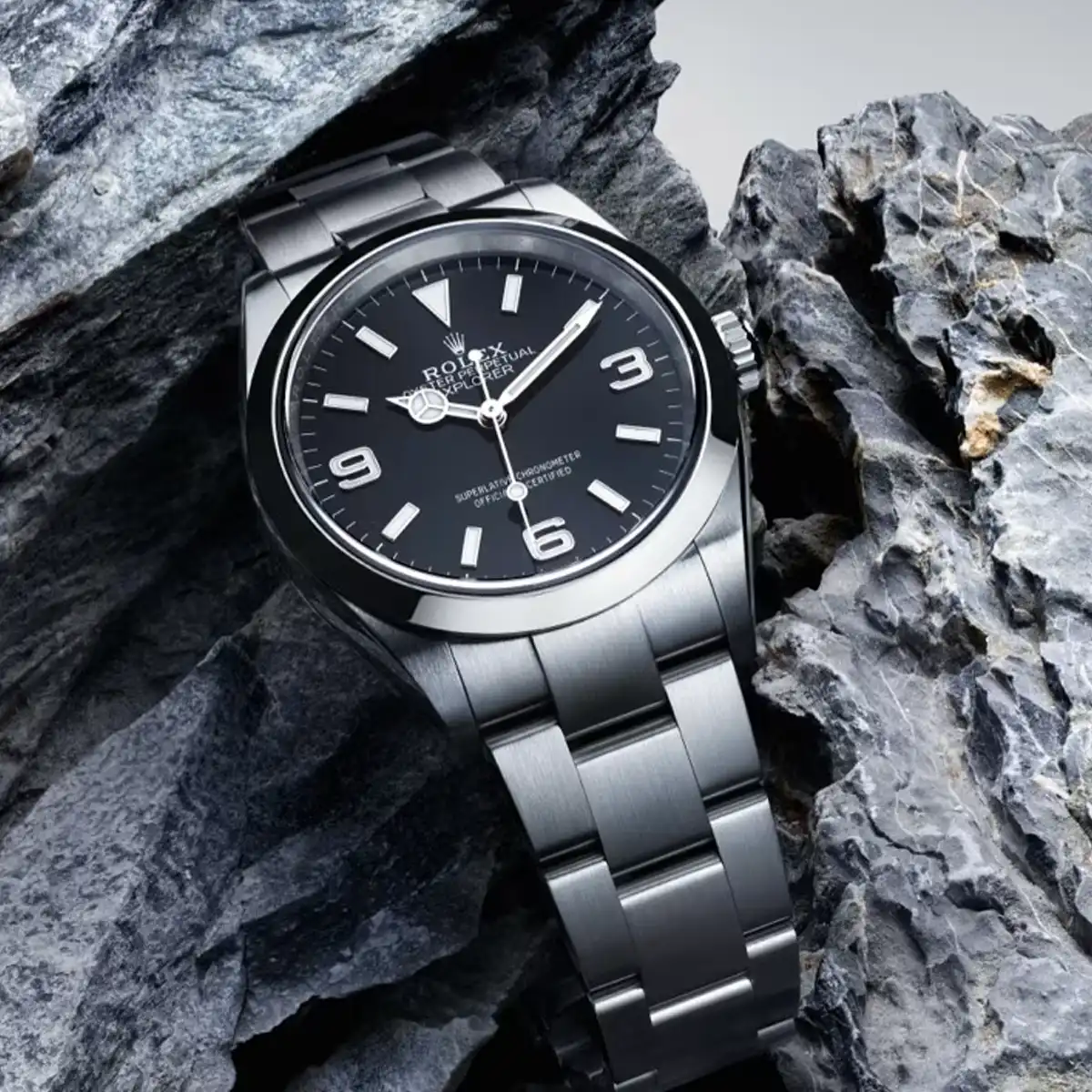
With public attention fixed on Everest, Rolex acted quickly. Late in 1953, two stainless-steel references, 6150 and 6350, carried the new EXPLORER signature across a stark black dial: inverted triangle at 12, bold Arabic numerals at 3 6 9, and luminous Mercedes hands. Inside beats the calibre A296, familiar yet adjusted to chronometer precision for the 6350. These watches were not flashy; they were instruments resized for everyday wrists, built to survive frost and monsoon alike. Collectors today prize the honey-warm gilt lettering and "big bubbleback" casebacks, the scars of hard travel that no factory patina can fake.
Vintage Icons and the Legendary 1016
Progress in Swiss watchmaking tends to hide beneath casebacks. In 1956, the Explorer gained the slimmer calibre 1030, allowing a flatter profile that slipped easily under a shirt cuff. Reference 6610 opened this chapter, but the milestone arrived in 1963 with the Rolex Explorer 1016, a model that would remain in production for a remarkable 26 years. Early examples kept glossy gilt dials; later pieces adopted matte finishes and switched from radium to safer tritium lume. Throughout, the design stayed almost monastic: no date window, no extra hand, just perfect legibility and 100-metre water resistance. Ian Fleming wore one while writing Bond novels, proof that brains and brawn can share a bracelet.
Transition to Modern Materials
By the late 1980s Rolex customers wanted sapphire crystals and brighter lume without sacrificing heritage. Reference 14270 answered in 1989 with a scratch-proof flat crystal, applied white-gold numerals and a glossy lacquer dial. For two short years, an ultra-rare variant nicknamed the "Blackout" filled those numerals with black enamel instead of luminous paint, creating a stealth aesthetic that now commands strong auction results.
The 114270 of 2001 refined the formula again, fitting calibre 3130 and solid end links while keeping the classic 36 millimetre size. Size, however, became the talking point in 2010 when Rolex unveiled the 39 millimetre 214270. Purists felt the hands looked undersized and the numerals lost their glow, criticisms quietly addressed in the 2016 "Mk 2" update with longer hands and fully lumed markers.
The Present Day Explorer Range
Rolex surprised enthusiasts in 2021 by reverting to 36 millimetres for reference 124270, powered by the new calibre 3230 with a 70-hour reserve and the efficient Chronergy escapement. At the same time, a two-tone Yellow Rolesor version, 124273, repositioned the once-spartan tool watch within the luxury bracket. Yet the brand acknowledged modern tastes again in 2023 with a 40 millimetre option, reference 224270, giving the faithful Rolex Explorer its first simultaneous two-size lineup. Whether the owner prefers compact discretion or extra dial real estate, both models promise identical robustness.
Fun Fact: During post-expedition analysis in 1953, Rolex discovered its Everest prototypes had lost only two seconds over the entire climb, a figure that stunned engineers and shaped future chronometer standards.
Experience | Expertise | Trust | Action
- Experience – Seven decades of service from polar caps to city boardrooms underline the explorer's practical heritage.
- Expertise – Calibre 3230 delivers class-leading precision, anti-magnetism and a weekend-long power reserve.
- Trust – Each watch is COSC-certified and then tested again by Rolex after casing to guarantee 2/+2 seconds per day.
- Action – Choose the 36 millimetre for historic proportions or the 40 millimetre for modern presence, then put it to work; the explorer was made to earn scratches, not hide in a safe.
Explorer II and its Cave Born Design
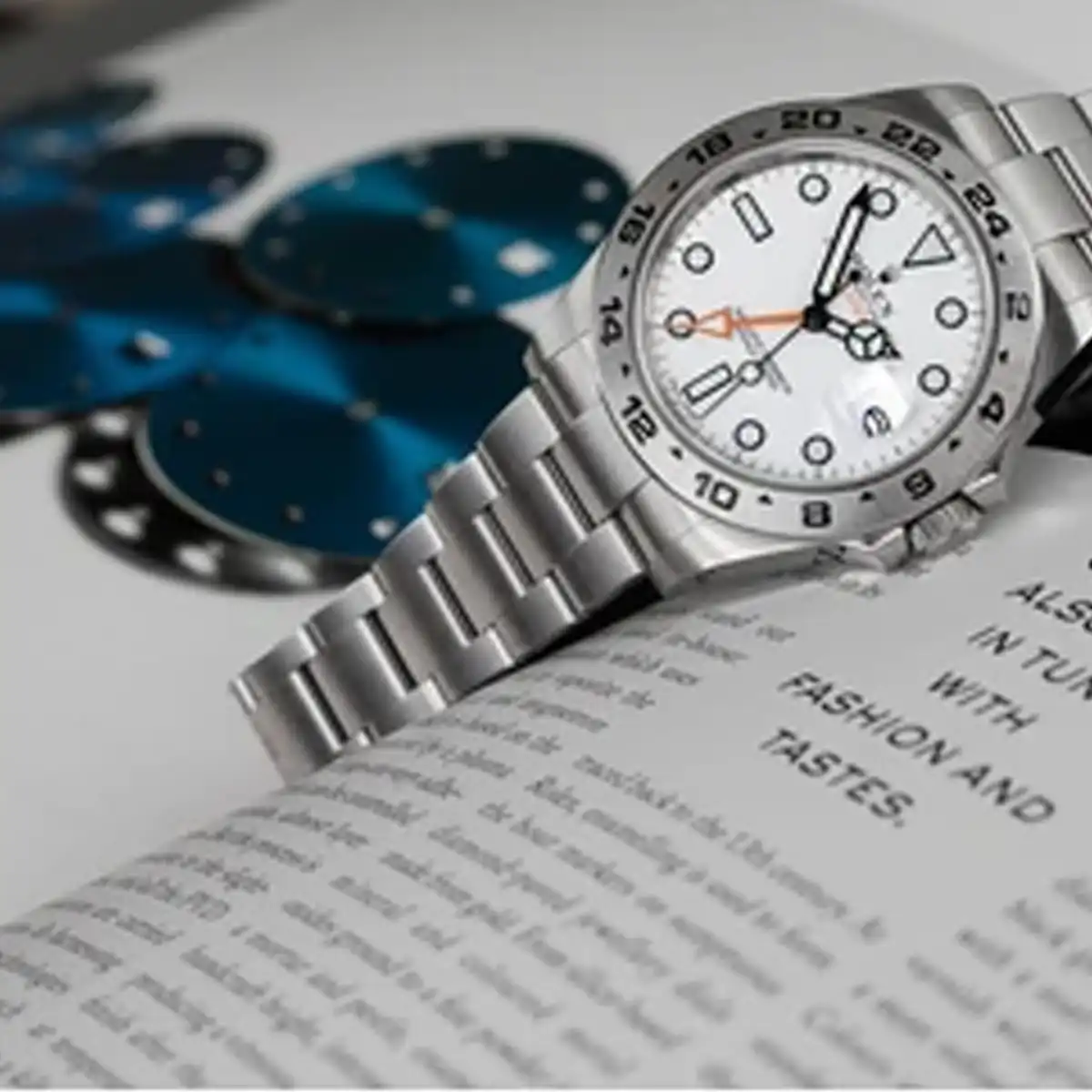
When daylight is a memory, telling morning from midnight becomes critical. In 1971, Rolex answered with the Explorer II, reference 1655, purpose-built for speleologists. A fixed steel bezel engraved with a 24-hour scale paired with a bright orange arrow hand that circled the dial once per day, anchoring the wearer to a stable sense of time. Square-cut markers and a busier minute track made the watch unmissable, though commercial success arrived slowly; the public preferred Submariners and Daytonas.
The "Steve McQueen" nickname followed, based on a magazine error rather than reality, McQueen wore a Submariner, but the myth lingers. Serious collectors value the 1655 on its own merits: unpolished bevels, creamy tritium plots and that unmistakable orange hand.
From Speleology to Global Travel
Evolution came in 1985 with the transitional 16550. Sapphire crystal, a larger case, and the option of a crisp white dial nicknamed "Polar" set the aesthetic tone, yet the breakthrough hid inside. Calibre 3085 allowed the 24-hour hand to adjust independently, turning a darkness aid into a fully fledged GMT. This refinement matured in reference 16570, produced from 1989 to 2011, now seen as a sweet spot of build quality, wearable 40 millimetre size and approachable price.
The Modern Explorer II
Fifty years on, reference 226570 embodies everything learnt since the caves. The case measures 42 millimetres yet sits balanced thanks to tapered lugs and a broader Oyster bracelet. Calibre 3285 brings the Parachrom hairspring, Chronergy escapement and 70-hour autonomy shared with the GMT-Master II. Owners choose between glacial white or inky black dials, each glowing blue under Chromalight. The orange arrow remains, acknowledging its 1970s origin while guiding modern pilots across time zones.
Choosing Between Explorer I and Explorer II
| Feature | Explorer I (124270/224270) | Explorer II (226570) |
| Movement | Calibre 3230 | Calibre 3285 |
| Functions | Hours, minutes, seconds | Hours, minutes, seconds, date, second time zone |
| Sizes | 36 mm or 40 mm | 42 mm |
| Bezel | Smooth | Fixed 24-hour scale |
| Dial | Black only | Black or White |
| Bold Identity | luxury watch for every occasion | adventure watch with GMT utility |
The first rewards minimalism and historical purity, perfect for the thinking person's Rolex. The second suits travellers and bold tastes, its giant arrow hand hinting at expeditions yet to come.
Inside the Oystersteel Case
Rolex machines every explorer from 904L Oystersteel, a nickel-rich alloy that shrugs off saltwater and polishes to a peerless shine. The Oyster case remains a fortress, its screw-down crown and twin-lock gaskets guaranteeing 100-metre resistance. Bracelets have progressed from hollow rivets to solid links with Easylink extension, making quick comfort adjustments possible after a long-haul flight or alpine start.
Chromalight lume, introduced to the Explorer line in 2021, glows an electric blue for up to eight hours, far outlasting previous Super-LumiNova coatings. Whether reading a compass at dawn or checking the train schedule at midnight, clarity is instant.
Buying Advice for UK Collectors
Official UK prices at the end of 2024:
- Rolex Explorer 36 124270 – £ 6,400
- Rolex Explorer 40 224270 – £ 6,650
- Rolex Explorer II 226570 – £ 8,550
Authorised Dealers rarely have stock on display; waiting lists are the norm. Patience and a genuine relationship help, though nothing is guaranteed. The Rolex Certified Pre-Owned scheme, available at retailers such as Goldsmiths, offers factory-inspected watches aged at least three years, each with a two-year warranty and the distinctive CPO seal.
Independent specialists fill the gap for discontinued and vintage references. Expect premiums above retail for unworn current models, but value remains compelling when compared with the market for Daytonas and Submariners. The 40 millimetre Explorer II 16570 and the transitional Explorer 39 214270 "Mk 1" represent attractive entry points with future upside.
UK Market Snapshot 2024–25 (pre-owned values)
| Reference | Model | Typical Range | Collectors’ Note |
| 124270 | Explorer 36 | £6 500–£8 000 | Modern classic, high demand |
| 224270 | Explorer 40 | £7 000–£8 500 | New size, early scarcity |
| 226570 | Explorer II | £8 500–£10 500 | Polar dial commands premium |
| 214270 | Explorer 39 Mk 1 | £6 000–£7 500 | Short hands add curiosity value |
| 114270 | Explorer 36 | £5 000–£6 500 | Solid end links, vintage charm |
| 16570 | Explorer II 40 | £6 000–£8 500 | Last 40 mm generation |
| 1016 | Explorer 36 | £10 000–£30 000+ | Gilt dials fetch strongest prices |
Legacy and Cultural Impact
Ed Viesturs summited all fourteen peaks above 8,000 metres with an Explorer on his wrist. Dawa Yangzum Sherpa guides clients across crevasse-laced glaciers wearing the same reference. Closer to sea level, filmmakers and authors choose it for its restrained good looks. Swiss timepiece collectors call it the ultimate blend of heritage and practicality.
In literature, the watch's quiet strength is immortalised by Ian Fleming, who gave Bond an Explorer in the novel On Her Majesty's Secret Service. Cinema later leaned towards Submariners, yet among aficionados, the Rolex Explorer remains the original 007 choice, a subtle nod understood by those who care.
The Explorer family teaches a simple lesson: let the mission define the tool. Whether you cross continents or just the daily commute, a durable, legible, impeccably finished watch offers constant reassurance. Strap one on, and the spirit of 1953 travels with you.