Stroll past the windows of London's most exclusive jewellers and a question often surfaces on search bars afterwards: "How much are Richard Mille watches?" The answer, invariably staggering, is only half the story. When the first Richard Mille reference appeared in 2001, it shook a conservative industry built on gold cases and quiet pedigree. The newcomer wrapped a high-speed tourbillon inside a curving tonneau chassis, pinned the price above six figures, and challenged collectors to rethink what luxury watches could look and feel like. Two decades later, the brand still turns heads for the same reasons – radical engineering, materials pilfered from F1 garages, and prices that underline extreme scarcity.
Richard Mille's Founding Vision
French industry veteran Richard Mille spent decades selling watches for other maisons before deciding that incremental tweaks were no longer enough. A boardroom disagreement at Mauboussin in 1999 set him free to create a business with one guiding rule: every technical decision would favour the most advanced, not the cheapest, solution. He partnered with long-time friend Dominique Guenat for manufacturing depth. He persuaded Audemars Piguet Renaud et Papi to supply tourbillon know-how. The trio formed Horometrie SA in Les Breuleux, allowing the fledgling label to launch at full throttle rather than climb slowly through entry-level pieces.
Partnerships Powering Innovation
Guenat's workshop delivered microscopic tolerances, while APR&P contributed split-second chronographs and shock-proof tourbillons that smaller ateliers could only dream of. Audemars Piguet also took a minority shareholding – a quiet endorsement that reassured early buyers writing cheques for watches that cost more than a London flat deposit. By pooling resources, the firm sidestepped the usual apprenticeship period. It introduced its first reference, the RM 001, as a finished statement rather than a prototype for future ambition.
The Racing Machine Ethos
Every subsequent model follows a mantra coined by Mille himself – a racing machine on the wrist. Cases must hug the forearm through lateral G-forces, movements must shrug off 10,000 G shocks, and weight must stay low enough for professional athletes to forget the watch is there. This philosophy filters all design briefs. If carbon fibre, grade 5 titanium or a graphene composite delivers an edge in stiffness or mass reduction, it is adopted regardless of cost.
Fun Fact: Richard Mille engineers borrowed ultrasonic windshield washer jets from Le Mans prototypes to clean cutting oil from machine tools, keeping tolerances within two microns during case production.
Architectural Casework and Skeleton Movements
The signature tonneau shell is more than a silhouette. It curves on three axes, requires up to 215 milling operations, and is assembled with distinctive five-spline screws that distribute torque evenly across the bezel. Inside, bridges are pared back to their structural essentials, revealing the entire gear train. This skeletal aesthetic is functional first, removing grams of excess metal improves shock resistance – yet it also creates a visual theatre that seasoned collectors recognise from across a room.
Material Science at the Forefront
Where rivals showcase precious metal hallmarks, Richard Mille pursues aerospace composites. Carbon TPT® and Quartz TPT®, built from 45-micron layers cured at high pressure, yield feather-light cases with organic wave patterns unique to each watch. Graph TPT® adds graphene from The University of Manchester to improve tensile strength by 30% and helped the RM 50-03 McLaren weigh just 38 grams with its strap. Sapphire cases, machined over 1,000 hours, prove transparency need not compromise durability. Even traditional alloys get re-engineered: TitaCarb® blends polyamide with carbon fibre for the RM 27-04 worn by Rafael Nadal, surviving impacts beyond 12,000 G.
These breakthroughs are expensive because they are difficult, not because they are decorative. Machining errors often scrap a component minutes before completion, and finishing teams still apply painstaking anglage, black polishing, and micro-bead blasting by hand. The result is a watch that hides nothing – every wheel, spring and screw announces the labour invested.
Performance Complications That Put Machinery First
Traditional watchmaking prizes moon-phase discs and minute repeaters. Richard Mille redirects that ingenuity towards functions which protect or enhance the watch itself. The patented G-sensor converts lateral or longitudinal force into a visual cradle that tips as acceleration rises, alerting rally drivers and golfers when they are approaching dangerous thresholds. Split-seconds chronographs arrive tuned for millisecond accuracy after high-G shocks, an achievement that still draws nods of respect from movement purists. More subtle yet equally practical is the declutchable rotor: once the mainspring tops out at 50 hours, the oscillating weight uncouples, preventing overwind and the gritty wear that follows. When the reserve slips below 40 hours, the clutch re-engages, restoring automatic efficiency. The owner does nothing; the watch preserves itself.
Variable-geometry rotors push personalisation further. Watchmakers adjust tiny winglets on the rotor's rim to match a sedentary office routine, a tennis schedule or a racing driver's daily cockpit jolts. This user-specific calibration, usually reserved for F1 dampers or aerospace fuel valves, reveals why Richard Mille prices refuse to drop: the engineering has no lazy option.
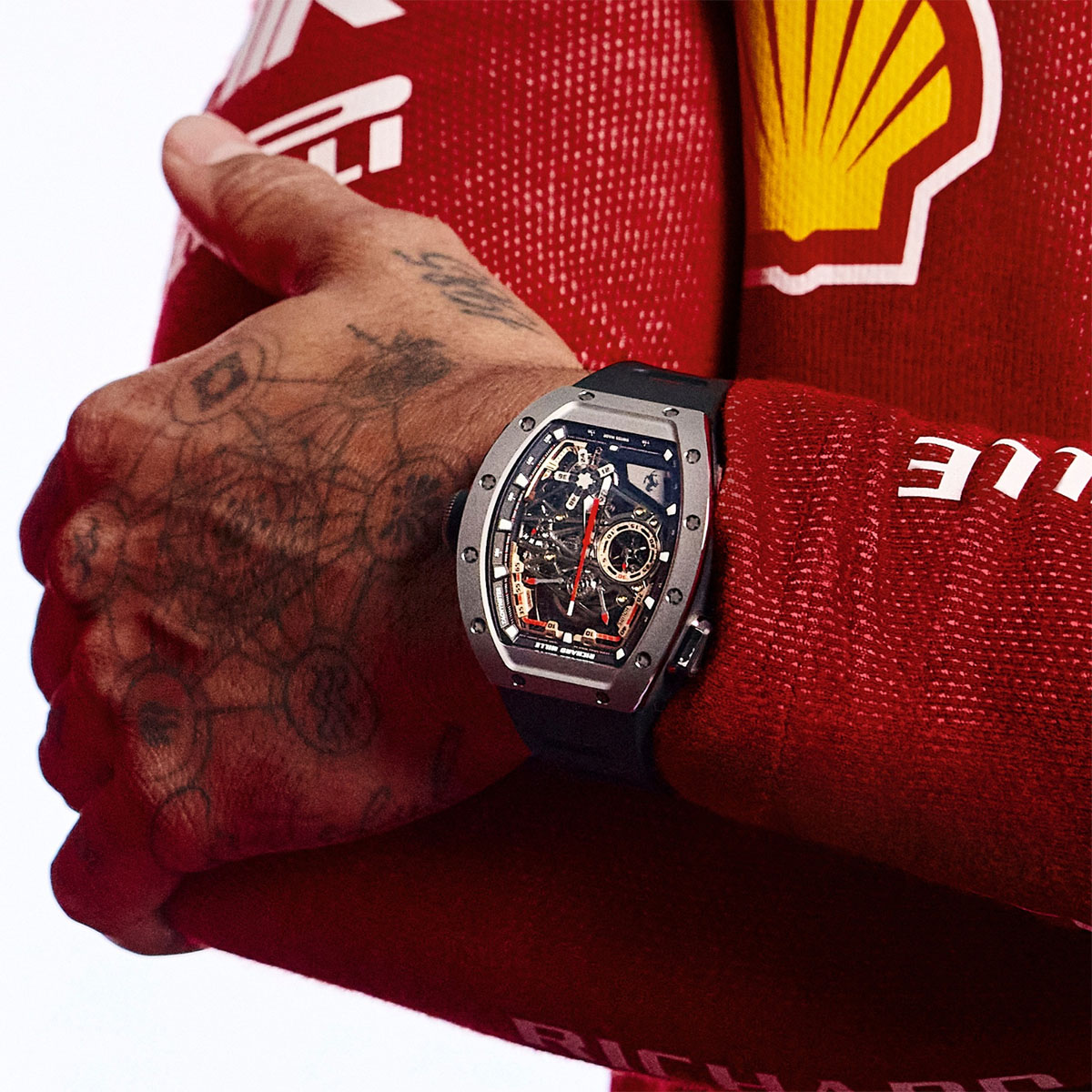
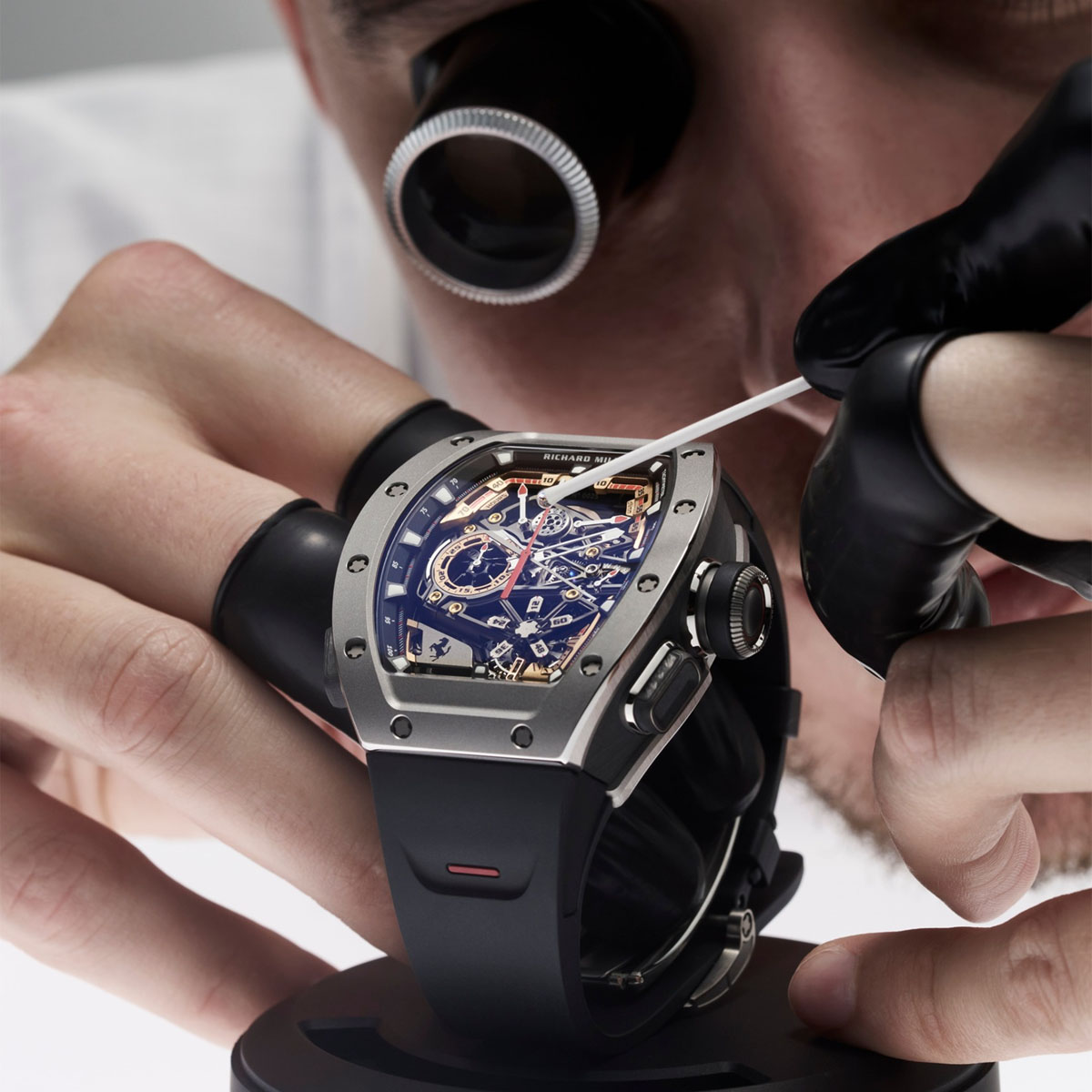
Athlete Testbeds Proving Shock Resistance
Laboratory rigs deliver repeatable data, yet Mille insists on live sport to uncover weaknesses. Rafael Nadal's first prototype shattered during clay-court practice when a topspin forehand drove 3,000 G through the tourbillon cage. Engineers reinforced pivots, added cable suspension and returned a lighter case. The next failure arrived on a hard court. Only after a full season without breakages was the RM 27 approved. That watch survived 10,000 G and weighed under 20 grams without its strap.
Brazilian driver Felipe Massa provided lessons in vibration and rapid temperature change, wearing early carbon-nanofibre models in brutal heat cycles from Monaco asphalt to wind-swept podium ceremonies. Golfer Bubba Watson taught the team about torsional shock as the club head released through impact. Each athlete signed off a reference by breaking several.
Icons That Anchor the Collection
RM 001 opened the story with a 17-piece tourbillon and a six-figure tag that stunned even seasoned Geneva retailers. RM 006 slid carbon nanofibre onto the movement plate for Massa. RM 009 replaced metal bridges with ALUSIC® – an aluminium-silicon-carbide composite borrowed from satellite mirrors, trimming the whole watch to 29 grams. The mainstream hit arrived with RM 011, a flyback chronograph whose bold Arabic numerals and sculpted pushers became the shorthand image for Richard Mille watches in glossy magazines.
Slimmer ambitions surfaced in RM 67-02, a 32-gram automatic worn by sprinters Wayde van Niekerk and Akani Simbine. The upper echelon of excess remains the sapphire-cased RM 56 series, where light refracts across every plane, exposing gear wheels as if they float. Auction results prove demand: a RM 56-01 reached CHF 3.65 million in 2022, while the record-thin RM UP-01 Ferrari fetched USD 1.38 million within months of launch.
Scarcity Strategy and Secondary Market Dynamics
Annual production hovers around 5,500 units, a tenth of Patek Philippe and a drop compared with Rolex. Boutiques in London, Paris and Dubai allocate pieces to long-standing clients first; newcomers join lists measured in years. This bottleneck pushes collectors to the secondary market, where prices often exceed retail by 40% plus. Paradoxically, such premiums strengthen primary demand: buyers view the purchase as liquid capital rather than depreciating indulgence. Analysts at Morgan Stanley now rank Richard Mille sixth by Swiss watch revenue despite its tiny volume, proof that selling few at a very high margin can topple brands built on scale.
Cultural Status and the Billionaire Handshake
Visibility is everything. When Jay-Z rapped about an RM 11-03 while wearing one on stage, search queries for Richard Mille price spiked within hours. A single Wimbledon final broadcast shows Nadal's tourbillon to 17 million viewers; social-media zooms and price captions do the rest. For ultra-high-net-worth circles, the tonneau silhouette has become an instant identifier – a handshake without words that says the wearer values modern engineering over inherited heirlooms. This reading amplifies among younger entrepreneurs who grew up amid start-up culture and Formula 1 livestreams, not oak-panelled boardrooms.
Controversy as Brand Fuel
Collectors rooted in classic Geneva dress watches dismiss Richard Mille as brash, call the curves ostentatious, and question servicing fees that rival small-car prices. The firm answers by leaning harder into experimentation, arguing that shock-proof tourbillons and graphene cases cannot be polite. Negative commentary thus becomes reverse endorsement; each public gripe confirms that Richard Mille refused to soften its concept.
Looking Ahead Under Alexandre Mille
Commercial Director Alexandre Mille pushes after-sales capacity, launching certified pre-owned hubs to channel vintage pieces back through factory benches for warranty renewal. Vertical integration is now tighter with ProArt (case-making) and VMDH (dial fabrication) being entirely in-house, giving engineers the freedom to trial materials without outside supplier delays. Sustainability messaging, still nascent, focuses on recyclable titanium, energy-efficient five-axis mills and a stated goal of carbon-neutral workshops by 2030. Investors note these moves placate a new breed of eco-minded clients without diluting the extreme-performance narrative.
Actionable Advice for UK Collectors
- Expect multi-year waits at authorised retailers; establish purchase history with entry references such as the RM 005 or RM 67 before requesting limited tourbillons.
- Verify pre-owned stock through the nascent Richard Mille certified network to avoid refinished or movement-swapped examples that can reduce residual value by 30%.
- Service intervals remain five years; budget at least £ 5,000 for routine maintenance and far more for sapphire-case polishing.
- Insurance should specify full replacement value at the current market, not retail, as auction prices often lead retail by eighteen months.
London's Bond Street watch specialists confirm that well-documented RM tourbillons now change hands within forty-eight hours of consignment, a liquidity rivalling vintage Rolex sport models. For investors balancing passion with portfolio thinking, that speed matters.
Conclusion
Richard Mille forced Swiss horology to update its playbook, swapping heritage for hard science and leveraging partnerships that treat watches like precision vehicles, not static jewellery. A tonneau case on a stranger's wrist today sends a clearer message than any business card: here is a person comfortable at the frontier of craft, technology and finance. London may measure status in discreet tailoring, yet even Savile Row cannot ignore the statement ticking beneath a jacket cuff when that case appears.
A quiet proverb often shared between workshop veterans fits the legacy: Measure twice, cut once, then never compromise. Richard Mille measures a thousand times, cuts in materials nobody else touches. Still, he refuses to compromise, ensuring his machines keep rewriting the rules tomorrow.