The story begins in 1953, when two French naval officers emerged from the Mediterranean with water-logged wristwatches and an urgent need for something better. At almost the same time, a young Swiss chief executive, who had just gasped his way back to the surface after running out of air, resolved to build the timing instrument he had lacked below. Their paths crossed, and the outcome reshaped mechanical watchmaking. Today, the Blancpain Fifty Fathoms is spoken of with the same respect accorded to Concorde or the Leica M3 – products created for a narrow professional task that ended up defining an entire category.
Beneath that fame lies a simple motivation: survival. Combat swimmers needed a device that would not flood, fog or mislead them in murky water. Jean-Jacques Fiechter, the civilian diver who ran Blancpain, needed assurance that his next underwater exploration would end safely on a deck rather than in a decompression tent. Their shared problem forged a tool whose clean design language still feels contemporary seven decades later.
Fun Fact: The first Fifty Fathoms prototypes were tested in a naval pressure chamber that simulated 91.45 metres – exactly fifty fathoms – because the French military budget did not stretch to open-water trials for every sample.
Military Demands Set the Blueprint
The French combat swimmer specification
Captain Robert Maloubier and Lieutenant Claude Riffaud listed five non-negotiables: large luminous numerals, a black dial, an easily gripped rotating bezel, water resistance far beyond a gentleman's dress watch, and a movement that kept running even if the crown was knocked. Early commercial watches failed on every point.
Blancpain accepted the challenge. Fiechter's team created a 42 mm stainless-steel case, enormous by the standards of 1953, fitted with a double O-ring crown, a patented channel-seated case-back gasket, and an automatic movement to cut crown wear. They added a bezel locked by downward pressure, guarding against fatal knocks. Each feature solved a real risk faced by frogmen, and each later appeared in the ISO 6425 definition of a professional submersible watch.
Why the name matters
A fathom is six feet. Multiply by fifty and the figure aligns with the safe depth limit for compressed-air diving equipment of the early 1950s. Shakespeare supplies a lyrical touch in The Tempest, but the engineering decision came first.
A Rival Emerges Yet Purpose Prevails
Rolex released the Submariner to the public at Basel in 1954. While Blancpain's patents were still marked "pending", Rolex presented finished watches for civilian buyers. Historians now argue that the Geneva firm won the race to market. Yet the Fifty Fathoms had already passed naval acceptance trials and entered service. The distinction is clear: Submariner launched as a commercial luxury-sport product, whereas Fifty Fathoms was forged strictly as lifesaving equipment. That origin continues to colour brand perception. Collectors respect Blancpain Fifty Fathoms for authenticity, while buyers seeking a universally recognised symbol often turn to Rolex.
Early Variants Gain Cult Status
MIL-SPEC and the moisture indicator
By 1957 the United States Navy demanded visual proof of water integrity. Blancpain responded with a white-to-red humidity disc at six o'clock. Any discolouration meant the watch had leaked and must be serviced. This simple safeguard, now revived in limited tributes, turned the MIL-SPEC into a grail for collectors.
'No Rad' for a nuclear age
Radiation fears swept the Cold War public. To demonstrate that new models used tritium rather than radium paint, Blancpain printed a yellow-and-red trefoil symbol crossed through with a black X and the words "No Radiations". German Kampfschwimmer units received the earliest deliveries, and the graphic became one of the most recognisable motifs in vintage watch circles.
Barakuda and Tornek-Rayville
Supplying the US Navy required a domestic contractor, so Blancpain shipped parts to Allen Tornek, who cased them under the sterile name Tornek-Rayville TR-900. Meanwhile, German distributor Barakuda requested bright two-tone indices for shop-window impact. Both runs were tiny; surviving examples command six-figure prices today.
Bathyscaphe Bridges Professional and Civilian Worlds
Oversize tool watches looked out of place with a business shirt in the 1950s. Blancpain therefore introduced the Fifty Fathoms Bathyscaphe in 1956, shrinking the case to 35-38 mm while retaining a timing bezel and serious water resistance. The move anticipated modern crossover sports watches by half a century, proving that practicality and elegance could share a dial.
Trouble at the Surface – Quartz Crisis
Electronic accuracy arrived from Japan in the 1970s, draining demand for mechanical pieces. Production of the Fifty Fathoms stopped. The Blancpain marque itself went dormant until Jean-Claude Biver and Jacques Piguet bought the rights in 1982 and rebuilt the company around hand-finished complications. They famously vowed never to make a quartz watch, yet the celebrated diver remained absent until 1997, when a 40 mm re-issue formed part of a sports trilogy. Even then, full commitment had to wait.
Twenty-First-Century Revival
The 2003 anniversary edition
Marc A. Hayek, scuba enthusiast and newly installed president, championed a 50th-anniversary limited run of 150 pieces. Its most striking feature was a domed sapphire bezel insert, clear as still water and almost as hard as diamond. Collectors snapped them up within days, encouraging a comprehensive relaunch.
Calibre 1315 enters in 2007
The modern flagship gained an in-house movement with three barrels for a five-day reserve, a free-sprung balance and a silicon spring immune to magnetism. For the first time, owners could gaze at Côtes de Genève through a sapphire back, turning a military instrument into an exhibition of haute finishing.
Bathyscaphe reborn
In 2013, the Bathyscaphe returned with a crisp, angular silhouette, ceramic bezel and Liquidmetal numerals. Sized at 43 mm for three-hand models and 43.6 mm for chronographs, it offered a contemporary alternative to the more classical 45 mm Fifty Fathoms.
Material innovation and mechanical excellence
When Blancpain re-entered the sports watch arena in 2007, its engineers refused to rest on nostalgia. The in-house Calibre 1315 became the anchor. Three mainspring barrels unwind in series, delivering a five-day reserve that far outstrips most competitors. A free-sprung balance mounted on a bridge, together with a silicon spring, shrugs off shocks and magnetic fields from laptop lids and airport scanners. Because silicon is inherently anti-magnetic, the soft-iron inner cage once used in the 1950s is no longer essential, and many references now reveal the movement through a sapphire back. Owners can enjoy Geneva stripes, polished bevels and a solid-gold rotor without forfeiting professional capability.
The visual signature rests on a single lustrous component: the domed sapphire bezel insert. Each crystal is machined from a clear boule, ground to its complex shape, then printed on the underside with luminous numerals before bonding to the steel, titanium or gold base. The final effect evokes depth in both senses, looking like a pool of still water while withstanding abrasions that would scar aluminium or ceramic. It is practical beauty, proof that a tool can aspire to art.
Blancpain also experimented with case materials. Grade 23 titanium retains the tensile strength of steel at two-thirds the weight, making the 45 mm Automatique feel unexpectedly nimble. Ceramic gives the Bathyscaphe line a stealthy presence and near-perfect scratch resistance. In 2023, the brand introduced Bronze Gold, a patented alloy containing nine-carat gold that develops a gentle surface tone without the flaky, green corrosion typical of pure bronze. Each metal choice tells a story of purpose: lighter for endurance, darker for discretion, warmer for vintage character.
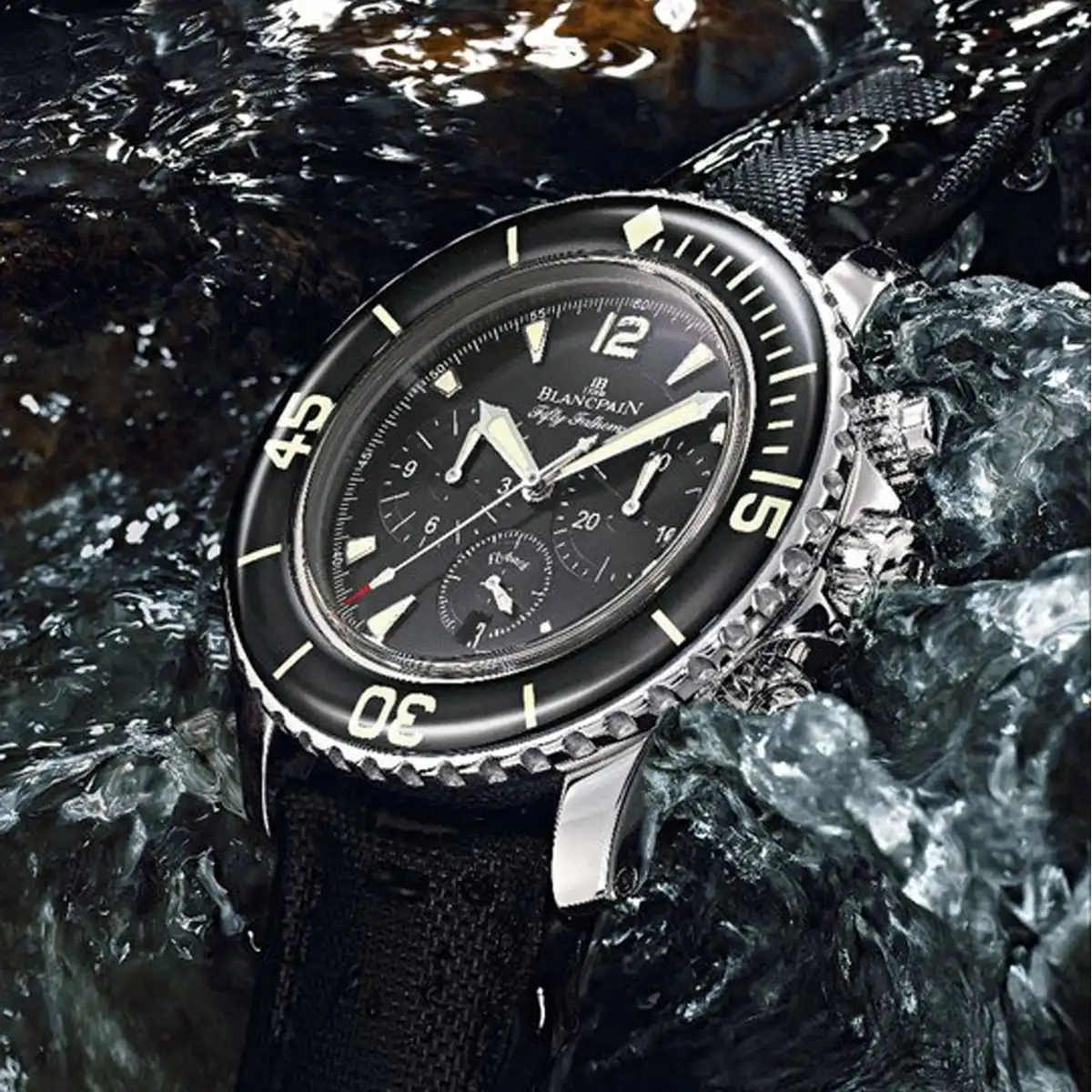
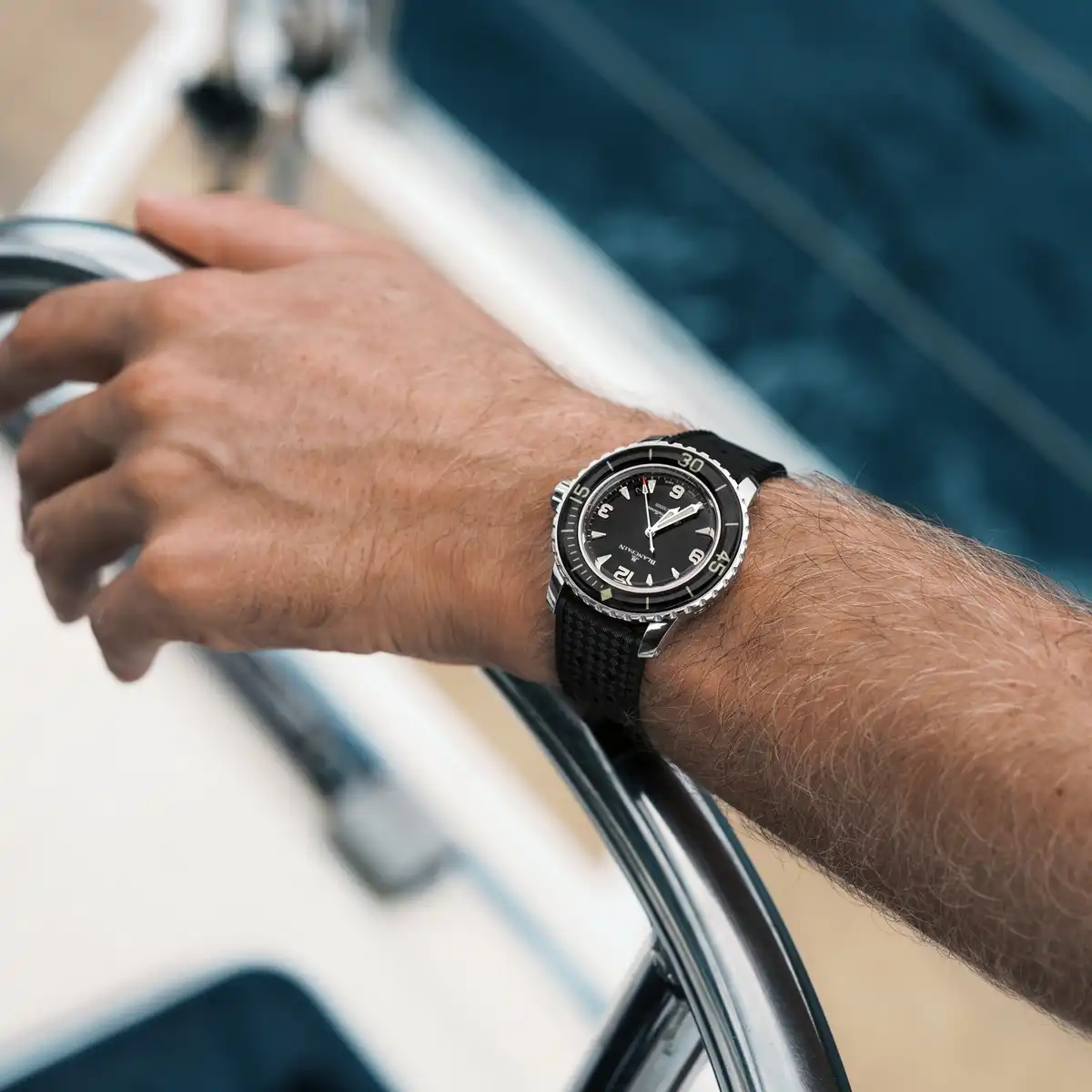
Seventy year celebration in three acts
Act 1 – a human-sized case
Collectors had long praised the heritage but questioned the 45 mm diameter. Blancpain answered with Act 1, a polished steel model resized to 42.3 mm, limited to three runs of seventy pieces. A platinum rotor inside acknowledged the platinum jubilee and hinted at the prestige on offer. Demand overwhelmed supply; within days, dealers reported wait-lists longer than allocation. Encouraged, the house promoted the format to permanent status in steel, titanium and red gold. The Fifty Fathoms had regained everyday wearability without surrendering gravitas.
Act 2 – Tech Gombessa embraces extreme science
Deep-sea biologist Laurent Ballesta needed a timer for multi-hour rebreather missions, far beyond the sixty-minute scale of standard bezels. Blancpain created a fourth hand geared to one revolution every three hours, matched by a bezel with a corresponding scale. Set once, the instrument tracks extended saturation descents with the same clarity a naval frogman valued in 1953. A 47 mm Grade 23 titanium shell keeps weight down, while an "absolute black" dial absorbs ninety-seven per cent of light to maximise contrast. Act 2 reminded observers that innovation still bubbles at Le Brassus.
Act 3 – Heritage reborn in Bronze Gold
The final chapter tipped its hat to the MIL-SPEC lineage. Act 3 reinstated the moisture indicator at six o'clock and adopted a period-correct 41.3 mm silhouette. The new Bronze Gold alloy glowed softly against gilt print and vintage-coloured lume. Only five hundred fifty-five pieces left the workshops, each powered by Calibre 1154.P2 rated to one thousand gauss without a shielding cage. Admirers praised the authenticity yet balked at the twenty-eight-thousand-pound price, proof that boutique alloys command a premium some find hard to reconcile with a NATO strap.
Ocean commitment and conservation impact
Marc A. Hayek transformed corporate philanthropy into tangible stewardship through the Blancpain Ocean Commitment. The programme funnels a portion of watch sales, especially from limited editions, into marine research and protection. Beneficiaries include National Geographic Pristine Seas and Oceana. Scientific data gathered by Gombessa expeditions has already supported the declaration of twenty new Marine Protected Areas, safeguarding 4.7 million square kilometres of habitat. For buyers, the link adds moral substance: a luxury purchase funds coral surveys in French Polynesia or shark population counts in the Indian Ocean.
Market dynamics and collecting strategy
Among seasoned enthusiasts, the Blancpain Fifty Fathoms carries a "connoisseur's choice" reputation. Main-line references, particularly the 45 mm models, often appear on the secondary market at modest reductions to retail, creating opportunities for value-driven collectors. Limited runs, especially the 40.3 mm tributes issued since 2017, behave differently. Launch allocations disappear instantly and auction prices climb. Vintage remains the blue-chip tier: a Tornek-Rayville TR-900 in good order passed eighty thousand pounds at Phillips in 2024, underscoring the scarcity of military-issued pieces.
The Swatch x Blancpain Scuba collection, released in five colourful bioceramic cases, introduced the silhouette to a mass audience. Like the earlier MoonSwatch, it carried no mechanical pedigree, yet it planted brand awareness among new demographics who may later graduate to mechanical models. Long term, this funnel could raise baseline demand, lifting residual values across the range.
Specification comparison with Rolex Submariner
| Feature | Blancpain Fifty Fathoms Automatique 5010 | Rolex Submariner 124060 |
| Case diameter | 42.3 mm | 41 mm |
| Case thickness | 14.3 mm | ~12.5 mm |
| Case material | Steel, titanium, red gold | Oystersteel |
| Water resistance | 300 m | 300 m |
| Movement | Calibre 1315 | Calibre 3230 |
| Power reserve | 120 hours | 70 hours |
| Bezel insert | Domed sapphire, luminous | Cerachrom ceramic |
| Magnetic protection | Silicon balance spring | Parachrom balance spring |
| UK retail (steel) | £16,100 on sailcloth | £8,050 on Oyster |
The table highlights a higher entry price for Blancpain, offset by a longer power reserve, exhibition movement and signature bezel. Rolex counters with slimmer dimensions and unmatched brand recognition. Choice rests on priorities: technical artistry versus universal status.
Final reflection and closing thought
Seventy years after French commandos first evaluated prototypes in a pressure chamber, the Blancpain Fifty Fathoms still balances mission readiness with horological refinement. Each modern reference inherits the double-sealed crown, high-contrast dial and unidirectional bezel that once protected frogmen, yet pairs those fundamentals with five-day autonomy, exhibition casebacks and hand-finished bridges. Add a genuine pledge to marine science and the watch becomes more than an accessory; it is a pact between owner and ocean.
Collectors who savour engineering depth, historical authenticity and quiet prestige will continue to choose the Fifty Fathoms, confident that the brand's next innovation will respect the blueprint set in 1953. In the words of a Cornish saying often quoted by British sailors, "A smooth sea never made a skilled mariner." The same can be said of watchmakers: true mastery surfaces only after time under pressure.