Seiko’s Alpinist story begins in 1959, on ridgelines where white clouds skim cedar peaks and climbers carry little more than hemp rope, iron crampons and the fierce optimism of post-war Japan. Engineers in Tokyo realised those “yama-otoko” needed a watch that could shrug off snow, impact and sudden altitude shifts without burdening the wrist. The result was a rugged stainless-steel Laurel model whose luminous hands and angular indices could be read in biting wind or failing light.
Six decades later, the watch has crossed oceans, forums and fashion swings to become a cult classic in the United Kingdom. It has earned affection for its rare ability to dress up a blazer one day and survive a soggy hike the next. This guide sets out the whole journey, explains why collectors queue for discontinued references, and shows why the Japanese explorer’s watch still outperforms rivals twice the price.
A Watch Born for Vertical Challenge
Post-war economic confidence turned tens of thousands of city workers into weekend mountaineers. Seiko responded with the Laurel Alpinist, a stainless-steel case on a thick leather bund strap with a screw-down back that kept grit and perspiration at bay. Bold mountain-shaped indices at 3, 6, 9 and 12 provided crude orientation, an early nod to field navigation. Function dictated every detail, yet the dial carried a quiet refinement that hinted at future versatility.
From Laurel Pioneer to Dormant Legend
Early success led Seiko to badge later models Champion Alpinist, complete with an engraved mountain logo on the caseback. Production paused in the late 1960s, and fans waited almost thirty years for a revival. Patience was rewarded in 1995 with the SCVF “Red Alpinist” trio. These watches added an internal compass bezel driven by a second crown at four o’clock, upgraded water resistance to 200 m and introduced gilt cathedral hands that would become a signature. The high-beat 4S15 movement delivered smooth seconds and reminded Swiss rivals that Japan could match their finesse.
1995 Revival and the Birth of a Modern Icon
Collectors soon fixated on the SCVF009, whose deep green dial paired with warm gold markers predicted a colour scheme that still dominates Seiko discussion threads. The model confirmed that utility and elegance can coexist, a philosophy later brands would try to imitate. Significantly, prices stayed within reach of younger enthusiasts, nurturing a new generation of brand loyalty.
Fun Fact: Designer Shigeo Sakai chose the green-and-gold palette after spotting a classic almond-green Mini Rover parked near Seiko headquarters.
The SARB017 and the Internet’s Favourite Emerald
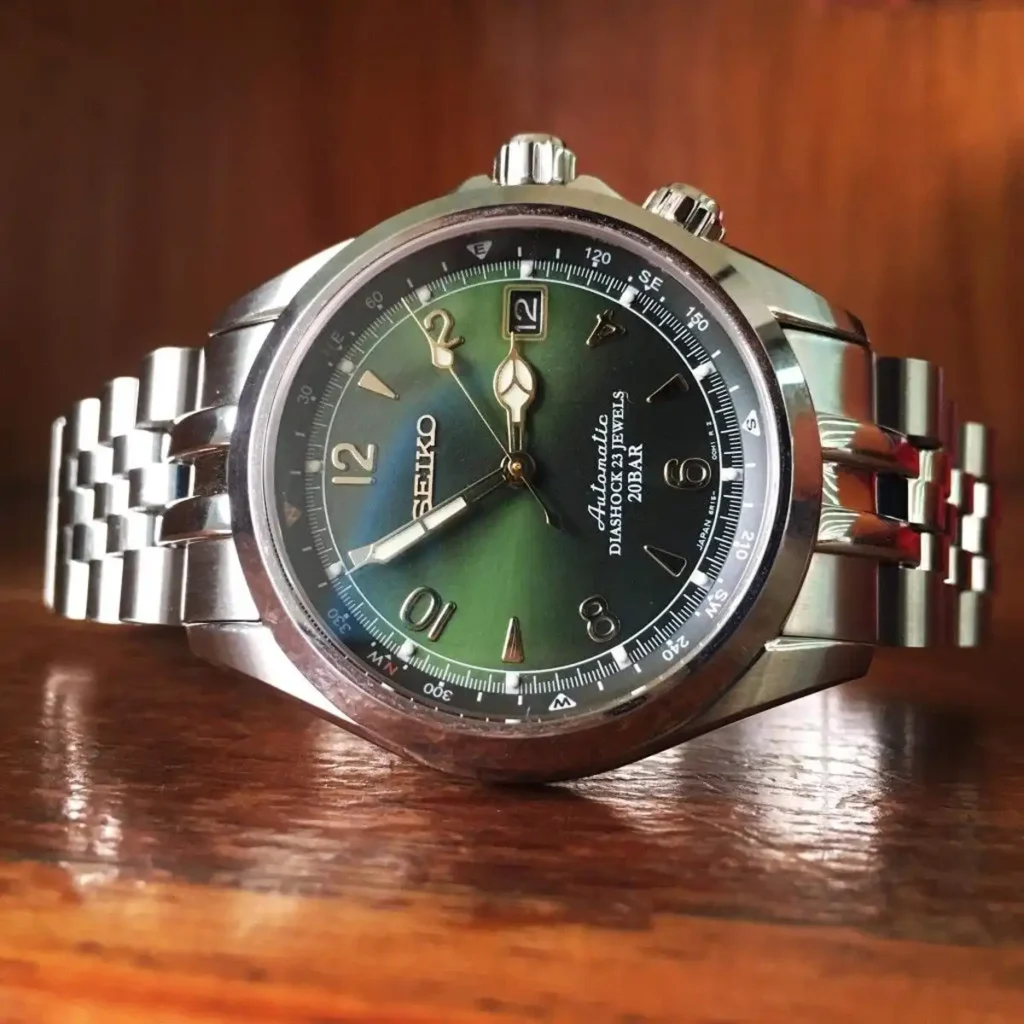
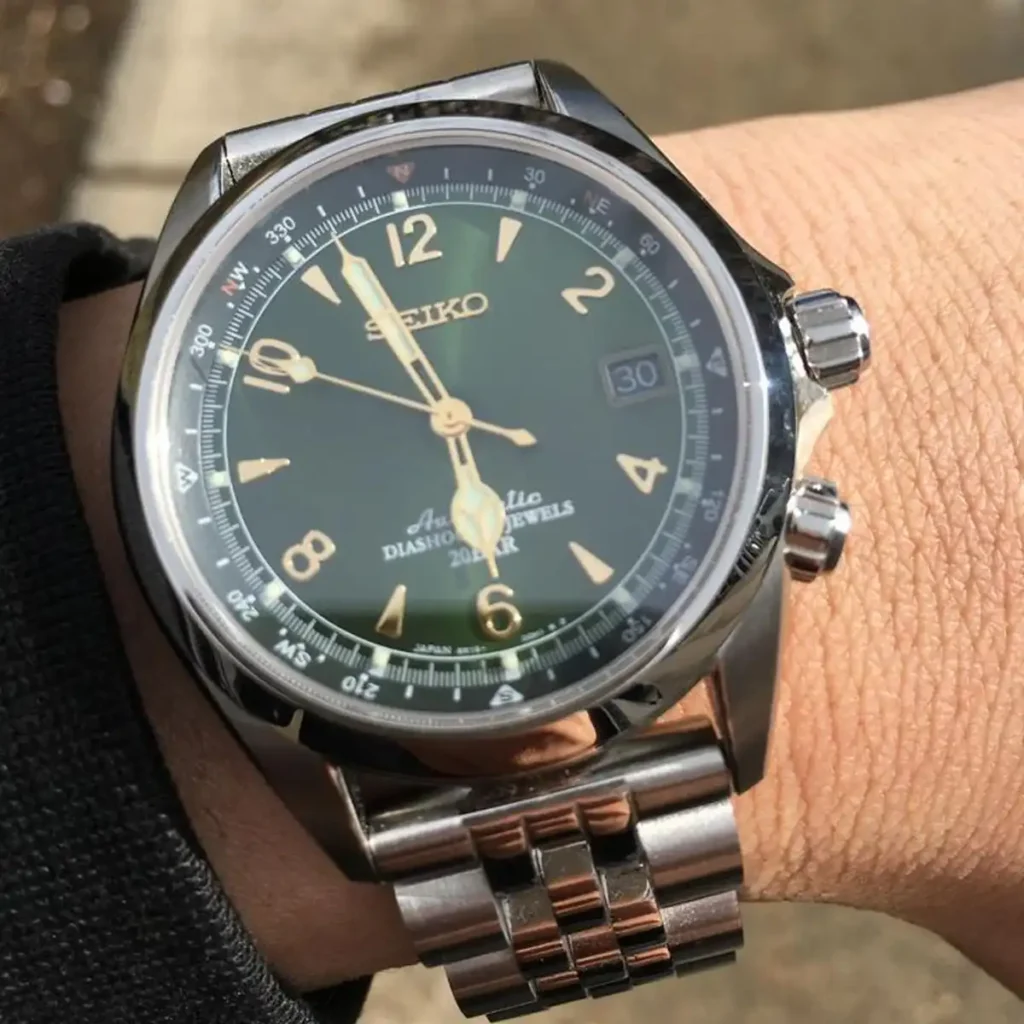
Enthusiasm turned into devotion in 2006 when Seiko launched the fifth-generation SARB series. The SARB017 Green Alpinist unified everything owners loved: a compact 38 mm case, sunburst emerald dial, gilt Arabic numerals and cathedral hands that glowed like campfire embers. Because the reference was sold only within Japan, British buyers trawled grey-market sites, pushing demand to fever pitch. When production stopped in 2018, secondary prices soared, sealing its cult status as the “forbidden fruit” of mechanical watches.
Prospex Era and the Six R35 Upgrade
Seiko heard the noise. In 2020, it folded the Alpinist into the Prospex Land line, making it globally available while adding the Prospex “X” on the dial, a sapphire crystal with cyclops, an exhibition back and the long-running 6R35 calibre with seventy-hour reserve. The decision split opinion. Newcomers welcomed broader access and stronger specification sheets. Purists missed the clean dial and secret-club vibe. Either way, the watch’s toughness remained: 200 m water resistance, drilled lugs and a compass bezel that still clicks with reassuring heft.
A Design That Balances Elegance and Endurance
The modern SPB121 measures 39.5 mm across yet sits low on the wrist thanks to a tapered case back and short lugs. Alternating brushed tops and mirror-polished flanks catch light without looking flashy. Inside, deep lacquer or sunburst finishes shift colour through pine, moss and jade depending on light angle. The cathedral hands evoke nostalgia, while applied markers add 3D depth, a feature often absent in many field watches.
Engineering Heartbeats that Refuse to Quit
The fifth-generation SARB models used the 6R15, a hacking and hand-winding calibre with a rock-solid fifty-hour reserve. The present-day 6R35 extends that stamina to seventy hours, making weekend winding optional. Regulation out of the box may vary, yet owners routinely report accuracy within ten seconds a day, especially after a minor adjustment by a competent watchmaker. Robust architecture, a Spron mainspring and Diashock protection help the movement shrug off shocks that would stall lesser mechanisms.
Understanding the Compass Bezel in the Field
Using the bezel is simple in Britain’s latitudes. Hold the dial flat and point the hour hand toward the sun. Rotate the inner ring until the S marker sits midway between the hour hand and 12 o’clock. The bezel now indicates cardinal points, giving walkers a quick orientation check on misty footpaths. It will not replace a Silva compass on Ben Nevis, yet it can bring reassurance when phone batteries fade.
Why Britain Fell in Love with the Alpinist
Heritage plays a part, but British affection also springs from design cues that echo country sports. Designers have admitted drawing inspiration from waxed-cotton jackets and fly-fishing reels. The watch pairs suede chukka boots as readily as technical Gore-Tex. Retail prices between £650 and £850 undercut Swiss field competitors while offering an in-house movement, sapphire crystal and 200 m resistance – a specification sheet unheard of at this level a decade ago.
Smart Buying Advice for UK Collectors
- Authorised dealers: Seiko Boutique UK, Watches of Switzerland, C W Sellors and Jura Watches supply full warranties and local after-sales support.
- Grey market: Attractive for discontinued JDM pieces, but factor import VAT and verify seller feedback. Use PayPal Goods and Services for protection.
- Secondary prices: Expect £550 – £800 for a clean SARB017 with box and papers. Modern SPB references typically lose little value after purchase, making them low-risk entries into mechanical ownership.
Spotting Counterfeits
- Examine dial print under magnification; genuine examples show razor-sharp text at six o’clock.
- Check caseback depth; counterfeit engravings look shallow or smudged.
- Inspect movement rotor; an authentic 6R15 or 6R35 carries vertical striping, not flat bead-blasting.
Comparing the Core Models
- SARB017 – 38 mm, 6R15, solid back, no cyclops, classic green legend.
- SPB121 – 39.5 mm, 6R35, cyclops, exhibition back, global release.
- SPB117 – 39.5 mm, 6R35, black dial, chevron markers, steel bracelet.
- SPB155 – 38 mm, 6R35, no compass bezel, textured dial, nicknamed “Baby Alpinist”.
Expert Voices and the Future of the Line
Writers at Hodinkee and Monochrome Watches praise the recent mechanical GMT versions, calling them “logical evolutions for real travellers”. The upcoming European-exclusive Night Sky SPB531, set for September 2025, swaps green for midnight blue with silver flecks that mimic starlight. Limited runs like this keep current owners engaged and draw fresh eyes to the catalogue, ensuring the Alpinist remains a conversation piece rather than a nostalgic footnote.
Final Thoughts on an Everyday Companion
The Seiko Alpinist began as a kit for Japanese mountaineers and matured into a thinking person’s GADA watch. It offers function without frills, elegance without fragility and value without compromise. Whether you strap it on for a presentation in Canary Wharf or a wet scramble up Tryfan, it keeps perfect company – proof that the best tools stay humble even when the world notices. Remember the old Yorkshire saying: “Where there’s muck there’s brass.” In watch terms, hard use often uncovers hidden worth.